Fire incident management systems provide the organizational framework and technology to coordinate complex emergency responses effectively. These comprehensive platforms integrate standardized procedures, command structures, and modern software to manage everything from routine structure fires to massive wildland incidents requiring hundreds of personnel across multiple agencies.
TLDR: Key Takeaways
- Fire incident management systems combine ICS frameworks with software to coordinate emergency responses
- Core components include command structure, resource management, real-time communications, and planning capabilities
- Software platforms enhance traditional ICS by centralizing data and improving situational awareness
- NIMS compliance ensures standardization and interoperability across agencies
- Implementation success depends on comprehensive training, system integration, and FEMA-evaluated platforms
What is a Fire Incident Management System?
A fire incident management system is a comprehensive framework that integrates organizational structures, standardized procedures, and technology to manage fire incidents from initial response through recovery.
These systems provide the foundation for coordinated emergency response across all incident types and scales.
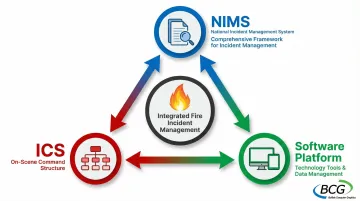
The Relationship Between ICS, NIMS, and Software
These three components work together:
Incident Command System (ICS) is the standardized on-scene emergency management structure used to command tactical operations. It provides the organizational framework for managing resources and personnel directly at the incident site.
National Incident Management System (NIMS) is the comprehensive national framework that incorporates ICS but extends beyond it. NIMS includes preparedness, resource management, communications, and information management across all levels of government.
You use ICS to manage the fire, but NIMS to manage your entire department's preparedness and response capability.
Incident management software is the technological tool that digitizes and enhances both ICS and NIMS. Modern platforms don't replace the organizational structure—they automate documentation, improve information sharing, provide real-time resource visibility, and create accessible digital Incident Action Plans.
Scope of Incidents Covered
These systems support "all-hazards" response across diverse scenarios:
- Structure fires from single-family dwellings to high-rise complexes
- Wildland fires and urban-wildland interface incidents
- Hazardous materials responses
- Mass casualty incidents
- Technical rescue operations
- Multi-agency emergencies requiring regional coordination
Primary Objectives
Standardized fire incident management systems achieve several critical objectives:
- Establish clear command: Define authority and decision-making hierarchy
- Coordinate resources: Track and deploy personnel, equipment, and supplies efficiently
- Maintain accountability: Document all actions, decisions, and resource utilization
- Ensure responder safety: Monitor conditions and implement protective measures
- Protect life and property: Execute tactical operations that minimize harm
Research demonstrates that jurisdictions fully implementing standardized incident management approaches show significantly improved response times and outcomes during complex events.
The difference between success and failure often comes down to coordination, not resources.
Evolution and Importance of Fire Incident Management Systems
Origins: The 1970 California Wildfires
Modern fire incident management systems emerged from disaster. During a devastating 13-day period in 1970, Southern California wildfires killed 16 people, destroyed nearly 700 structures, and burned over 500,000 acres.
Post-incident analysis revealed a troubling pattern: response failures rarely resulted from lack of resources. Instead, they stemmed from non-uniform terminology, incompatible communications, and the absence of a centralized organizational structure.
Congress responded by funding FIRESCOPE (Firefighting Resources of Southern California Organized for Potential Emergencies), an interagency group that developed the original Incident Command System and Multi-Agency Coordination System.
This represented a quantum jump in coordination capabilities that transformed fire service operations.
National Adoption Post-9/11
While ICS became standard in the fire service, universal adoption across all disciplines didn't occur until after September 11, 2001.
President George W. Bush issued Homeland Security Presidential Directive 5 in 2003, mandating creation of a single, comprehensive national incident management system. The Department of Homeland Security released the first NIMS document in March 2004, establishing ICS as the national standard for all domestic incident management.
Contemporary Challenges Driving Modern Systems
Today's fire service faces increasingly complex challenges that demand robust management systems:
Mega-fires driven by climate factors become more frequent and destructive each year. The 2018 Camp Fire and 2020 August Complex fires demonstrated the need for scalable systems that can manage thousands of personnel across multiple jurisdictions for extended periods.
Urban-wildland interface fires create unique coordination challenges, requiring seamless integration between structural and wildland firefighting resources with different training, equipment, and operational procedures.
Interoperability gaps remain despite decades of progress. The 2013 Yarnell Hill Fire investigation highlighted how communication gaps and loss of situational awareness can have fatal consequences, reinforcing the critical need for strict adherence to ICS principles and technology-enabled coordination.
Core Components of Fire Incident Management Systems
Organizational Structure: The Five Functional Areas
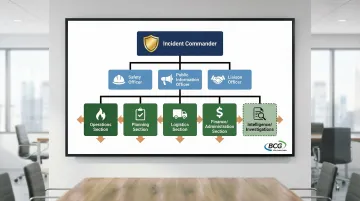
FEMA's NIMS doctrine requires a modular organization built on five primary functions. These scale from single-engine responses to complex incidents:
1. Command provides overall management, sets objectives, and approves the Incident Action Plan (IAP). This function is always activated, even for the smallest incidents.
2. Operations directs all tactical actions to achieve incident objectives. This section manages resources on the ground and is typically the first section activated after Command.
3. Planning collects and evaluates information, maintains resource status, and prepares the IAP. This becomes critical for incidents extending beyond a single operational period.
4. Logistics provides all support needs including facilities, transportation, supplies, equipment maintenance, and medical services for responders.
5. Finance/Administration monitors costs, tracks personnel time, administers procurement contracts, and manages compensation and claims.
A sixth function, Intelligence/Investigations, may be established for incidents involving criminal activity or terrorism.
Scaling Principles
These five functions work together through scaling mechanisms that expand or contract based on incident complexity.
ICS relies on two key principles:
- Span of control: Maintains manageable supervision ratios—ideally one supervisor to five subordinates (1:5), with an acceptable range of 1:3 to 1:7—ensuring effective communication and oversight
- Modular organization: Builds from the top down, activating only required functions; on a small fire, the Incident Commander may handle all functions, but as incidents grow, Section Chiefs are appointed to manage specific areas
Command Facilities: ICP vs. EOC
Confusion often exists between on-scene and off-scene management structures.
The Incident Command Post (ICP) is the physical location where the on-scene Incident Commander oversees tactical operations. It focuses on the immediate incident and houses command staff directly managing the emergency.
The Emergency Operations Center (EOC) is an off-site location that supports the on-scene response. The EOC does not command the incident; instead, it provides strategic coordination, secures external resources, and manages information for the jurisdiction.
Resource Management and Communications
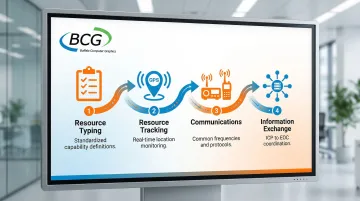
Effective resource management requires standardized resource typing. FEMA maintains the Resource Typing Library Tool (RTLT), which defines specific capabilities for resources. For example, a "Fire Engine Strike Team" is strictly defined as five engines of the same type with common communications and a leader.
Interoperable communications are equally critical. Key elements include:
- Radio systems with common frequencies and protocols
- Common terminology across all responding agencies
- Standardized reporting procedures for consistent information flow
- Seamless information exchange between tactical units, command posts, and EOCs
This coordination maintains situational awareness across all operational levels.
Key Roles and Responsibilities in Fire Incident Management
Incident Commander
The Incident Commander holds overall authority and responsibility for conducting incident operations. Key responsibilities include:
- Setting incident priorities and determining strategic objectives
- Approving the Incident Action Plan (IAP)
- Ensuring responder safety throughout operations
- Managing the transfer of command during extended incidents
- Coordinating with agency administrators and elected officials
Command Staff
These roles report directly to the Incident Commander:
Safety Officer monitors conditions and develops measures to ensure the safety of all assigned personnel. This position has the authority to immediately stop unsafe acts.
Public Information Officer serves as the conduit for information to the public and media, gathering, verifying, and disseminating accurate information upon IC approval.
Liaison Officer serves as the primary contact for representatives from assisting and cooperating agencies, ensuring their resources are integrated and concerns addressed.
Section Chiefs (General Staff)
Operations Section Chief manages all tactical operations and supervises execution of the IAP. Key responsibilities include:
- Determining strategies and tactics for incident response
- Requesting resources to support tactical operations
- Directly managing suppression activities and tactical deployment
The Planning Section Chief oversees information management and future planning. Responsibilities include:
- Collecting and analyzing operational information
- Supervising preparation of the IAP
- Tracking status of all assigned resources
- Forecasting future needs based on incident progression
Logistics Section Chief ensures resources reach the incident. This role handles:
- Procurement of equipment and supplies
- Facilities management and ground support
- Communications support
- Medical services for responders (not civilians)
The Finance/Administration Section Chief manages financial and administrative aspects. Key areas include:
- Personnel time tracking and cost analysis
- Procurement contracts
- Compensation claims
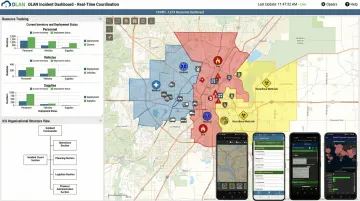
Modern incident management systems like BCG's DLAN platform help coordinate these roles by providing real-time communication, resource tracking, and IAP management in a centralized interface.
Software Solutions for Fire Incident Management
Modern incident management software enhances traditional ICS by providing capabilities that were impossible with paper-based systems.
These platforms centralize data, improve situational awareness through mapping and visualization, enable real-time collaboration, and streamline documentation.
FEMA NIMS STEP Program Compliance
The NIMS Supporting Technology Evaluation Program (STEP) provides objective assessment of whether products meet technical requirements for NIMS compliance. This includes the ability to generate standard ICS forms (such as ICS-201 and ICS-209) and exchange data with other systems.
BCG's DisasterLAN (DLAN) became the first and only incident management system evaluated by FEMA's NIMS STEP program as fully compliant with NIMS and ICS principles as well as interoperability communications standards. The October 2010 evaluation confirmed that DLAN is consistent with all 24 NIMS concepts and principles, providing fire departments with confidence that their software meets federal standards.
Key Software Capabilities for Fire Departments
Beyond meeting compliance standards, effective incident management software must deliver practical capabilities that improve operational efficiency.
When evaluating systems, fire departments should prioritize:
Centralized data management – Eliminates information silos and ensures all personnel access current information simultaneously
Mobile accessibility – Provides offline capabilities for field personnel in remote wildfire locations where connectivity is limited
GIS integration – Delivers real-time mapping, satellite fire detection, thermal hotspot analysis, and evacuation route planning
Resource tracking – Monitors personnel, apparatus, and equipment locations with automated status updates
ICS-compliant IAP creation – Includes template-guided workflows, digital signatures, and version control aligned with FEMA guidelines
Communication tools – Supports SMS, email, radio integration, and in-app notifications for coordination across all operational levels
Deployment Options
Cloud-based systems offer flexibility and accessibility, enabling seamless data sharing across jurisdictions. However, CISA and SAFECOM guidance emphasizes that cloud solutions for public safety must meet high availability standards (often 99.999%) and possess "edge mode" or offline capabilities to function during connectivity loss—common during major wildfires or disasters.
On-premises solutions serve agencies with specific security requirements or connectivity limitations, providing complete control over data and infrastructure.
Implementation Considerations for Fire Departments
Training Requirements
Successful implementation requires comprehensive training at all organizational levels:
- All personnel complete ICS-100 (Introduction to ICS) and ICS-200 (Basic ICS for Initial Response)
- Mid-level management advances to ICS-300 (Intermediate ICS for expanding incidents)
- Command and general staff require ICS-400 (Advanced ICS for complex incidents)
- Specialized roles like Safety Officer or Section Chief need position-specific advanced courses
- Hands-on software training tailored to organizational workflows and system configuration
Regular Exercises and Drills
Testing both organizational structure and technology platforms through exercises identifies gaps before real incidents occur. Fire departments should conduct:
- Tabletop exercises for command staff
- Functional exercises testing specific capabilities
- Full-scale exercises simulating realistic incident conditions
- Software training scenarios with real-time simulated events
Integration Challenges
Beyond training, fire departments face technical hurdles when connecting incident management software with existing systems:
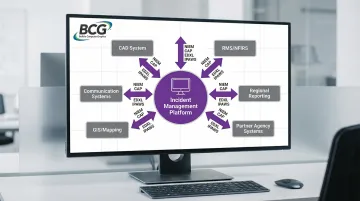
CAD system integration ensures accurate data flow from Computer-Aided Dispatch to Records Management Systems and NFIRS.
Departments must work with vendors to properly map data fields, as CAD systems often capture "911 call time" rather than the actual "Alarm Time" required by NFIRS, leading to inaccurate response time metrics.
Regional and state reporting systems require standardized data exchange protocols.
Systems following NIEM and NIST guidelines ensure meaningful information exchange without requiring external servers or third-party plug-ins. For example, platforms evaluated under FEMA's NIMS STEP program—like BCG's DLAN system—meet these interoperability standards from the ground up.
Interoperability with partner agencies demands support for multiple communication protocols.
These include CAP (Common Alerting Protocol), EDXL (Emergency Data Exchange Language), and IPAWS (Integrated Public Alert and Warning System) to ensure seamless coordination across jurisdictions.
Frequently Asked Questions
What are the five major components of a fire incident management system?
The five functional areas are Command (overall management), Operations (tactical response), Planning (situation analysis and IAP development), Logistics (resource support), and Finance/Administration (cost tracking).
What is the difference between ICS and NIMS in fire incident management?
ICS is the tactical on-scene organizational structure for managing incidents at the operational level. NIMS is the comprehensive national framework that includes ICS plus preparedness, resource management, and communications standards across all levels of government.
How does incident management software integrate with traditional ICS?
Software digitizes and enhances ICS by automating documentation, improving information sharing, and providing real-time resource visibility. The organizational structure remains the same—technology makes it more efficient without replacing proven command principles.
What should fire departments look for when choosing incident management software?
Prioritize NIMS compliance (look for FEMA STEP evaluation), user-friendly interfaces for field use, mobile accessibility with offline capabilities, GIS and mapping integration, interoperability with existing CAD and RMS systems, vendor support quality, and flexible deployment options.
How long does it take to implement a fire incident management system?
Software deployment may take 2-4 months, but full organizational adoption including training, procedure updates, and culture change typically requires 6-12 months with ongoing refinement. Cloud-based systems like DLAN can provide immediate access upon contract completion, though comprehensive training and workflow customization extend the timeline.
What is BCG's DisasterLAN and how does it support fire departments?
DisasterLAN (DLAN) is a NIMS-compliant incident management platform providing real-time GIS mapping, mobile capabilities, resource tracking, and ICS-compliant IAP generation. It became the first and only system evaluated as fully NIMS-compliant by FEMA's STEP program.