Introduction: Understanding NIMS and Its Role in Incident Management
Picture a major wildfire spreading across county lines. Fire departments, law enforcement, emergency medical services, and federal agencies converge on the scene—each with different radio systems, organizational structures, and terminology. Without standardized protocols, coordination collapses into chaos.
The National Incident Management System (NIMS) solves this problem. The Department of Homeland Security developed NIMS following 9/11 as the comprehensive national framework that enables agencies at all levels to work together seamlessly during emergencies, regardless of cause, size, or complexity.
For state and local agencies receiving federal preparedness funding, NIMS compliance isn't optional—it's mandatory.
This article examines the 14 critical management characteristics that make NIMS effective, explores how the five core components work together, and explains practical implementation strategies for organizations managing incidents of any scale.
TLDR: Key Takeaways
- NIMS is a federally mandated framework required for agencies receiving preparedness grants
- Fourteen management characteristics ensure coordination, safety, and efficiency across all incidents
- Core components include Incident Command System, resource management, and communications protocols
- Compliance enables seamless multi-agency coordination and access to federal resources during incidents
- Training requirements range from basic awareness (IS-700) to advanced command courses (ICS-400)
Why NIMS Matters: The Foundation of Effective Incident Management
Historical Context: From FIRESCOPE to National Standard
NIMS didn't emerge overnight. Its foundation lies in the FIRESCOPE project of the 1970s, when California firefighters developed the Incident Command System to manage chaotic multi-agency wildfire responses.
The September 11, 2001 terrorist attacks exposed critical gaps in national coordination, leading to Homeland Security Presidential Directive 5 (HSPD-5) in February 2003.
FEMA published the first NIMS document in 2004, with major revisions in 2008 and October 2017 incorporating lessons learned from real-world incidents. Today, NIMS represents over four decades of refinement in incident management standards.
The Core Problem NIMS Solves
This historical development addressed a critical operational gap. Before NIMS, multi-jurisdictional incidents suffered from incompatible communication systems, conflicting command structures, and inconsistent resource descriptions.
When a requesting jurisdiction asked for "a water rescue team," they might receive personnel with vastly different capabilities depending on the sending agency's interpretation.
NIMS standardizes terminology, organizational structures, and operational procedures across all disciplines and jurisdictions. This interoperability proves critical during disasters when agencies that have never worked together must coordinate seamlessly under extreme pressure.
Who Must Comply
NIMS compliance requirements vary by organization type:
- Federal mandate: All federal departments and agencies must adopt NIMS per HSPD-5
- Grant requirement: State, local, tribal, and territorial governments must implement NIMS to receive federal preparedness grants including the Homeland Security Grant Program and Emergency Management Performance Grant (non-compliance jeopardizes funding eligibility)
- Voluntary adoption: Private sector organizations and NGOs are encouraged to adopt NIMS to integrate effectively into national response efforts
The Five Key NIMS Components and How They Work Together
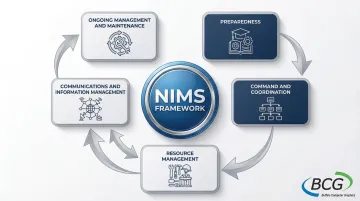
NIMS operates through five interconnected components that form a comprehensive management system:
1. Command and Coordination Defines leadership roles and organizational structures. This component establishes how incidents are managed at operational and support levels through:
- Incident Command System (ICS)
- Emergency Operations Centers (EOCs)
- Multiagency Coordination Systems
2. Preparedness A continuous cycle that creates the foundation for successful response. Preparedness activities occur before incidents and include:
- Planning and organizing
- Training and equipping personnel
- Exercising and evaluating readiness
3. Resource Management Standard mechanisms to identify, order, mobilize, track, and demobilize resources. This includes personnel, equipment, supplies, teams, and facilities.
Standardized resource typing ensures requesting jurisdictions receive exactly the capability they need.
4. Communications and Information Management Systems and methods that ensure incident personnel have the means and information needed to make decisions. This includes:
- Interoperable communications systems
- Common operating pictures
- Coordinated public messaging
5. Ongoing Management and Maintenance The National Integration Center provides strategic direction, oversight, and continuous refinement of NIMS based on lessons learned and evolving best practices.
These components work together seamlessly. Preparedness activities (Component 2) ensure personnel are trained in ICS (Component 1), which enables effective resource management (Component 3).
Integrated communications (Component 4) support all operations, while ongoing maintenance (Component 5) continuously improves the system based on real-world experience.
The 14 Critical NIMS Management Characteristics Explained
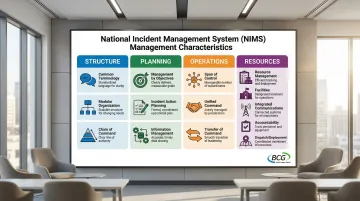
The foundation of NIMS effectiveness rests on 14 management characteristics that guide all incident operations:
Common Terminology
All agencies must use standardized terms for organizational functions, resource descriptions, and facility names. Plain language replaces codes and jargon.
A "Type 1 Engine" means the same thing in California as it does in New York, preventing dangerous confusion during multi-jurisdictional responses.
Modular Organization
The ICS structure expands and contracts based on incident complexity, developing from the top down. A small incident may require only an Incident Commander.
As complexity increases, the IC activates additional positions—Command Staff, then General Staff sections—to maintain effective management without overwhelming any single supervisor.
Management by Objectives
Every incident operates on a six-step process:
- Understand agency policy and direction
- Assess the incident situation
- Establish incident objectives
- Select appropriate strategies
- Provide tactical direction and assignments
- Follow up to ensure objectives are met
This structured approach ensures all tactical actions directly support strategic goals.
Incident Action Planning
Every incident requires an Incident Action Plan that communicates objectives, specifies activities, and covers defined operational periods. Simple incidents may use oral plans, but written IAPs are mandatory when incidents extend beyond one operational period or involve multiple jurisdictions. Hazardous materials incidents always require written IAPs.
Manageable Span of Control
Supervisors should manage between three and seven subordinates, with the optimal ratio being 1:5. Factors influencing span of control include incident complexity, geographic dispersion, and subordinate experience levels.
Incident Facilities and Locations
NIMS establishes standard facilities with consistent terminology:
| Facility Type | Purpose |
|---|---|
| Incident Command Post (ICP) | Where the Incident Commander and Command Staff direct operations |
| Base | Location where primary logistics and administrative functions occur |
| Staging Areas | Temporary locations where resources await assignment |
| Camps | Locations providing food, water, rest, and sanitation for incident personnel |
Comprehensive Resource Management
Accurate inventory, tracking, and management of all resources throughout the incident lifecycle ensures accountability and efficiency.
Key components include:
- Check-in procedures for all personnel and equipment
- Resource status tracking (assigned, available, out-of-service)
- Systematic demobilization when resources are no longer needed
Integrated Communications
Personnel from different agencies must communicate effectively through interoperable systems and common communications plans.
This requires:
- Establishing common frequencies
- Standardized protocols across agencies
- Backup communication systems
Establishment and Transfer of Command
Clearly defined procedures govern when and how command transfers occur. The process includes face-to-face briefings, documentation requirements, and notification to all relevant parties.
Unified Command
When incidents affect multiple jurisdictions or require multiple agencies, Unified Command allows agencies to manage together through common objectives and a single IAP while maintaining individual authority and accountability.
Chain of Command and Unity of Command
Chain of Command establishes the orderly line of authority within the incident organization. Unity of Command ensures every individual reports to only one designated supervisor, preventing conflicting instructions.
Accountability
Essential for personnel safety and resource tracking, accountability ensures all resources are accounted for throughout the incident.
Key elements include:
- Check-in procedures for all personnel
- Tracking assignments and location
- Maintaining span of control ratios
- Ensuring work aligns with IAPs
Dispatch/Deployment
Resources deploy only when requested or dispatched by appropriate authority through established channels. Self-dispatching creates coordination problems and safety risks.
Information and Intelligence Management
The systematic gathering, analyzing, assessing, sharing, and managing of incident-related information and intelligence throughout the incident lifecycle supports informed decision-making at all levels.
The Incident Command System (ICS): NIMS in Action
ICS Organizational Structure
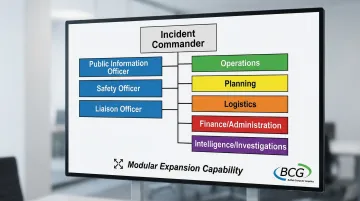
ICS provides the operational system within NIMS, using a modular structure that adapts to incident needs:
Incident Commander: The only position always staffed, responsible for overall incident management, setting priorities, establishing objectives, and directing IAP development.
Command Staff (report directly to IC):
- Public Information Officer: Communicates with media and public
- Safety Officer: Monitors operations and advises on safety matters
- Liaison Officer: Coordinates with external agencies and organizations
General Staff (functional sections):
- Operations Section: Conducts tactical operations to execute the plan
- Planning Section: Develops the IAP and maintains resource status
- Logistics Section: Provides communications, supplies, facilities, and support services
- Finance/Administration Section: Tracks costs, manages contracts, and handles claims
- Intelligence/Investigations: Optional section for specialized incident needs
Transfer of Command and Accountability
Maintaining clear command structure ensures accountability throughout incident response. Modern incident management systems like BCG's DLAN support these ICS protocols by automating documentation and resource tracking.
Command transfers occur when:
- A more qualified person arrives
- The incident situation changes
- Normal turnover of personnel occurs
Transfer procedures include:
- Face-to-face briefings when possible
- Documentation of transfer details
- Notification to all relevant agencies and personnel
Accountability measures include:
- Mandatory check-in procedures
- Continuous resource tracking
- Unity of command maintenance
- Clear assignment and reporting relationships
Resource Management Under NIMS
Effective resource management prevents the chaos of mismatched capabilities and ensures the right resources arrive at the right time. NIMS standardizes how agencies classify, track, and deploy resources across incidents.
Resource Typing
NIMS uses two classification dimensions:
Kind: Broad classes describing like resources (personnel, teams, facilities, equipment, supplies)
Type: The resource's capability level, with Type 1 representing the highest capability and Type 4 the lowest
For example, a "Type 1 Fire Engine" has specific minimum capabilities for pump capacity, tank size, and hose diameter. This standardization ensures requesting agencies receive exactly what they need.
Resource Management Lifecycle
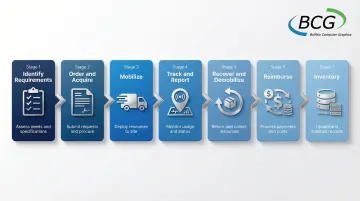
Resources move through seven stages:
- Identify Requirements: Incident commanders determine what's needed based on objectives and operational priorities
- Order and Acquire: Resources are requested through established channels using standardized forms and procedures
- Mobilize: Personnel and equipment deploy to the incident, with travel arrangements and check-in procedures coordinated
- Track and Report: Resource status and location are monitored continuously through check-in systems and status updates
- Recover and Demobilize: Resources return systematically using demobilization plans that prevent premature release
- Reimburse: Financial settlement is managed through documentation of costs and payment processing
- Inventory: Agencies maintain accurate counts of available resources to support future incident planning
Mutual Aid Agreements
These legal mechanisms enable resource sharing across jurisdictions. Mission Ready Packages use NIMS resource typing to describe expected capabilities and pre-identify resources for rapid deployment during emergencies.
Communication and Information Management Principles
NIMS identifies four key principles that support effective incident communications:
- Interoperability enables personnel to communicate within and across jurisdictions via voice, data, and video through compatible equipment, common protocols, and coordinated frequencies
- Reliability, Scalability, and Portability ensure systems function in any context, scale to incident size, and remain portable across different environments
- Resilience and Redundancy maintain performance despite damaged infrastructure, with backup capabilities ensuring uninterrupted communication when primary systems fail
- Security protects sensitive information and systems, including HIPAA compliance for medical information and safeguards for classified data (added in the 2017 NIMS update)
Systems like BCG's DLAN platform are designed to meet these interoperability standards, having achieved recognition as the first and only incident management system evaluated by FEMA's NIMS STEP program as fully compliant.
Joint Information System and Center
The Joint Information System (JIS) integrates incident information and public affairs to provide consistent, coordinated, and accurate messaging across all agencies.
The Joint Information Center (JIC) is the physical or virtual facility where JIS operations occur, serving as the central point of contact for media and coordinating all public information activities.
Implementing NIMS: Training, Technology, and Best Practices
FEMA Training Requirements
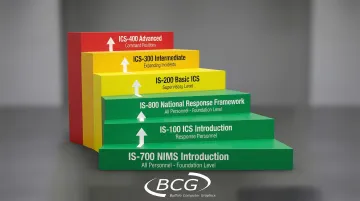
FEMA establishes a national curriculum with baseline and role-specific courses that provide standardized incident management training.
Baseline Courses:
- IS-700: NIMS Introduction (all personnel)
- IS-100: ICS Introduction (all response personnel)
- IS-800: National Response Framework Introduction
Role-Specific Training:
- IS-200: Basic ICS for supervisory personnel
- ICS-300: Intermediate ICS for expanding incidents
- ICS-400: Advanced ICS for complex incidents and command positions
Compliance Requirements
To meet federal preparedness grants and partnership agreements, organizations must demonstrate NIMS compliance across six key areas:
- Formal NIMS adoption through legislation or executive order
- Personnel training at appropriate levels
- Implementation of standardized resource typing
- Development of plans and procedures aligned with NIMS
- Participation in exercises testing NIMS implementation
- Progress toward National Qualification System objectives
Meeting these requirements manually can be resource-intensive, which is where technology platforms become essential.
Technology-Enabled Compliance
FEMA-certified incident management platforms streamline compliance through standardized features.
BCG's DisasterLAN, the first and only system evaluated by FEMA's NIMS STEP program as fully compliant, provides:
- Standardized ICS forms and templates aligned with FEMA guidelines
- Resource tracking with real-time status and location monitoring
- Organizational charting that maintains proper span of control
- Integrated communications supporting common operating pictures
- Documentation capabilities for IAPs, situation reports, and after-action reviews
Actionable Implementation Steps
- Conduct a gap analysis to assess current capabilities against NIMS requirements
- Ensure all personnel complete appropriate FEMA courses
- Formalize resource sharing with neighboring jurisdictions
- Classify all deployable resources using NIMS standards
- Validate implementation by conducting regular drills that test coordination across agencies
- Use after-action reviews to continuously improve
Frequently Asked Questions
What is the National Incident Management System?
NIMS is a standardized framework developed by the Department of Homeland Security in 2004. It enables coordination across all levels of government and disciplines during incidents of any cause, size, or complexity.
How many NIMS characteristics are there?
There are 14 critical management characteristics that guide effective incident management. Key characteristics include common terminology, modular organization, manageable span of control, unified command, and comprehensive resource management.
What are the 5 main components of NIMS?
The five components are Command and Coordination, Preparedness, Resource Management, Communications and Information Management, and Ongoing Management and Maintenance.
What's the difference between NIMS and ICS?
NIMS is the overarching national framework for incident management, while ICS is one component within NIMS—specifically the operational system used for on-scene incident command and coordination.
Who is required to comply with NIMS?
Federal agencies are mandated by HSPD-5, while state and local governments must comply to receive federal preparedness funding. Private sector organizations and NGOs are encouraged to adopt NIMS for seamless emergency integration.
How does NIMS improve incident response effectiveness?
NIMS standardization enables better coordination, communication, and resource management across agencies and jurisdictions. Systems like BCG's DLAN—the first and only FEMA NIMS STEP certified incident management platform—ensure agencies can integrate seamlessly even when working together for the first time.