Introduction
A multi-vehicle accident on a major highway during rush hour quickly escalates into a mass casualty incident. Within minutes, multiple EMS agencies, fire departments, law enforcement, and hospital trauma teams must coordinate their response. Without a standardized incident management system, chaos ensues—duplicate resource requests, communication breakdowns, and unclear command authority.
The 9/11 Commission Report identified that despite extraordinary bravery, the lack of unified command and interoperable communications hampered the World Trade Center response.
After-action reviews from the 2013 Boston Marathon bombing revealed similar challenges: overwhelmed communications systems and limited connectivity in command centers created dangerous information gaps.
Effective incident management is the difference between chaos and coordinated lifesaving action. Standardized systems like the National Incident Management System (NIMS) and Incident Command System (ICS) provide the framework that transforms fragmented efforts into unified response.
For EMS agencies, adopting these systems isn't just best practice—it's a federal mandate tied directly to preparedness funding.
TLDR: Key Takeaways
- NIMS/ICS frameworks standardize multi-agency coordination with unified structures
- HSPD-5 requires NIMS adoption for federal preparedness grants
- Command effectiveness depends on clear roles, 3-7 person spans, and unified objectives
- Technology platforms enable real-time tracking, automated documentation, and integrated comms
What is EMS Incident Management?
EMS incident management is the systematic approach to coordinating personnel, resources, and operations during emergency medical responses that exceed routine single-unit calls. It provides the organizational structure needed when multiple agencies must work together seamlessly.
This structured coordination becomes essential when emergencies exceed standard single-unit responses.
Beyond Routine Emergency Calls
Incident management is critical during:
- Mass casualty incidents (MCIs) with 10+ patients requiring triage and transport coordination
- Natural disasters like hurricanes, earthquakes, or floods affecting entire communities
- Hazardous materials incidents requiring specialized teams and evacuation coordination
- Active shooter situations demanding law enforcement, EMS, and hospital coordination
- Multi-vehicle accidents on highways involving dozens of patients
Historical Evolution
Modern incident management evolved from hard-learned lessons:
- 1970s California Wildfires: The disastrous 1970 fire season exposed critical coordination failures—incompatible resources, poor communication, and unclear command structures. This led to the FIRESCOPE project, which established the foundational Incident Command System
- September 11, 2001: The terrorist attacks highlighted the urgent need for a national approach. The 9/11 Commission recommended unified command structures, directly leading to NIMS creation in 2004
Core Objectives
Every incident management system must achieve four fundamental objectives:
- Save lives through rapid, coordinated medical response
- Stabilize the incident to prevent escalation or secondary events
- Protect property and environment from further damage
- Ensure responder safety through hazard monitoring and span of control
The Scalability Principle
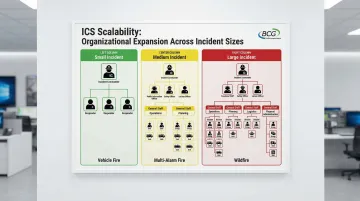
A critical feature of effective incident management is scalability. The same ICS principles that organize a single-ambulance response must expand seamlessly to coordinate hundreds of responders during major disasters.
This modular approach allows agencies to activate only the organizational components needed for each incident's complexity.
Understanding NIMS and the Incident Command System
The National Incident Management System (NIMS) provides the comprehensive nationwide framework, while the Incident Command System (ICS) delivers the operational structure used on scene.
NIMS: The National Framework
Established by Homeland Security Presidential Directive-5 (HSPD-5) in 2003, NIMS is the framework that governs how all emergency responses are managed across the United States. It's not merely guidance—it's a federal requirement.
Federal funding depends on NIMS compliance. HSPD-5 explicitly requires:
"Beginning in Fiscal Year 2005, Federal departments and agencies shall make adoption of the NIMS a requirement, to the extent permitted by law, for providing Federal preparedness assistance through grants, contracts, or other activities."
Jurisdictions must achieve NIMS Implementation Objectives to receive grants like the Emergency Management Performance Grant (EMPG).
ICS: The Operational Component
While NIMS provides the national framework, ICS is the specific on-scene management structure—the organizational chart and procedures used during actual incidents. It provides:
- Common hierarchy that all responders recognize regardless of agency
- Standardized terminology removing confusion between departments
- Clear procedures for resource ordering, communication, and documentation
Three NIMS Guiding Principles
Three core principles guide all NIMS implementation:
- Flexibility — Systems scale from routine incidents (single ambulance) to major disasters (hundreds of responders) without changing fundamental structure
- Standardization — Common organizational structures, terminology, and procedures ensure responders from different agencies integrate smoothly
- Unity of Effort — Multiple agencies with different authorities work toward shared objectives through coordinated action, not competing priorities
Federal Compliance Requirements
The financial stakes are clear: Non-compliant agencies risk losing federal preparedness grant funding.
Beyond financial consequences, inadequate incident management can create liability issues if poor coordination contributes to negative outcomes during emergencies.
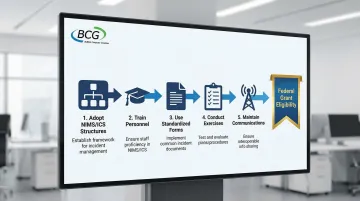
Compliance requires:
- Adopting NIMS/ICS organizational structures
- Training personnel at appropriate ICS levels
- Using standardized forms and documentation
- Conducting regular exercises and after-action reviews
- Maintaining interoperable communications capabilities
Software platforms that align with these federal standards streamline compliance efforts. BCG's DLAN system became the first and only incident management platform evaluated by FEMA's NIMS STEP program as fully compliant with NIMS and ICS principles, helping agencies meet federal requirements while improving operational coordination.
Meeting these requirements involves:
- Adopting NIMS/ICS organizational structures
- Training personnel at appropriate ICS levels
- Using standardized forms and documentation
- Conducting regular exercises and after-action reviews
- Maintaining interoperable communications capabilities
Key Components of Effective Incident Command
Incident Commander and Command Staff
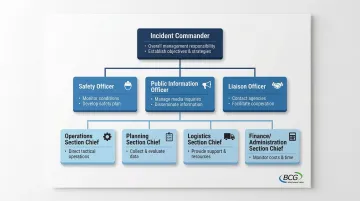
Incident Commander (IC): The single person with overall authority and responsibility for managing the incident. The IC sets objectives, strategies, and priorities.
The first arriving qualified officer typically assumes command, with authority transferring to more qualified personnel as the incident grows.
Unified Command: When multiple agencies share jurisdictional authority (e.g., EMS, fire, and law enforcement at an active shooter incident), designated representatives from each agency form a Unified Command.
They establish common objectives and strategies while maintaining their respective agency authorities.
Command Staff report directly to the IC:
- Safety Officer — Monitors hazards and operational safety, with authority to stop unsafe actions immediately
- Public Information Officer (PIO) — Manages media relations and public communications, ensuring consistent messaging
- Liaison Officer — Coordinates with assisting agencies and organizations not part of the command structure
General Staff Sections
The four General Staff sections handle tactical execution and support:
- Operations Section Chief — Directs all tactical field activities to achieve incident objectives, including patient care, transport coordination, and tactical operations
- Planning Section Chief — Collects incident information, tracks resource status, and develops Incident Action Plans (IAPs) that provide decision-makers with current, accurate intelligence
- Logistics Section Chief — Secures resources, supplies, facilities, and support services when Operations needs additional ambulances, medical supplies, or staging areas
- Finance/Administration Section Chief — Tracks incident costs, time records, procurement, and compensation claims for cost recovery and documentation during extended operations
Modern incident management software platforms support these roles by centralizing information flow, automating resource tracking, and facilitating real-time coordination across all sections.
Management Principles
Unity of Command: Each person reports to one supervisor only, eliminating conflicting orders and confusion about authority.
Span of Control: The optimal ratio is one supervisor to five subordinates (1:5), with an acceptable range of 3-7. If a supervisor has more than seven reporting elements, the organization should expand by adding divisions or branches.
Management by Objectives: Every operational period begins with clear, measurable, time-bound objectives. Strategies and tactics are then defined to achieve those objectives, creating accountability and focus.
Modular Organization: Organizations fill positions only as needed. A simple incident might have only an IC and a few responders, while a complex disaster activates full Command Staff and all General Staff sections. The structure expands and contracts based on incident complexity.
Essential Incident Management Functions for EMS
Resource Management
Effective resource management requires comprehensive tracking through three status categories:
- Assigned: Resources actively working on field assignments
- Available: Resources staged, checked in, and ready for immediate deployment
- Out-of-Service: Resources unavailable due to maintenance, crew rest, or resupply
Beyond tracking, Resource Typing categorizes resources by capability—such as Type 1 Ambulance Strike Team or Advanced Life Support Unit. This ensures incident commanders requesting mutual aid resources receive exactly what they need, not just what's available.
Communications and Information Management
Integrated communications form the backbone of coordinated response:
- Interoperable radio systems that allow cross-agency communication
- Common terminology and plain language instead of agency-specific codes
- Standardized communication protocols across all responding units
Continuous information flow between field units, command posts, and EOCs maintains situational awareness. This keeps all decision-makers working from the same operational picture.
ICS Documentation Forms provide standardized information management:
| Form | Purpose |
|---|---|
| ICS 201 (Incident Briefing) | Initial situation and resource summary |
| ICS 202 (Incident Objectives) | Operational period objectives and strategies |
| ICS 204 (Assignment List) | Resource assignments to divisions/groups |
| ICS 213 (General Message) | Written communications between ICS positions |
| ICS 214 (Activity Log) | Individual position activity records |
Incident Action Planning
The Incident Action Plan (IAP) is the central coordination document. It contains objectives, strategies, tactics, and resource assignments for an operational period (typically 12-24 hours).
Written IAPs are mandatory when operations extend beyond one period, multiple agencies are involved, shift changes require personnel briefings, or incident complexity demands formal documentation. Verbal IAPs work for simple, short-duration incidents, though documenting with ICS Form 201 remains recommended.
Modern incident management systems like BCG's DLAN platform streamline IAP development through template-guided workflows aligned with FEMA guidelines, reducing documentation time while ensuring NIMS compliance.
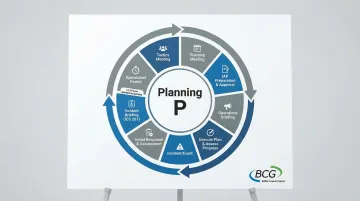
The Planning P Cycle guides this process through operational periods. It ensures continuous planning as incidents evolve and operational priorities shift.
Technology and Tools for Modern Incident Management
Paper-based incident management creates bottlenecks, delays information sharing, and increases documentation errors. Modern software solutions transform coordination through real-time digital capabilities.
Key Technology Features
EMS agencies should prioritize systems offering:
- NIMS/ICS compliance with standardized forms and workflows
- Mobile accessibility for field personnel and command staff
- Real-time resource tracking showing Assigned/Available/Out-of-Service status
- Integrated communications connecting field units, command posts, and EOCs
- Automated reporting generating ICS forms and after-action documentation
- Interoperability with other agency systems (fire, law enforcement, hospitals)
When evaluating systems, federal compliance standards provide crucial validation of functionality and interoperability.
FEMA NIMS STEP Program Compliance
The Supporting Technology Evaluation Program (STEP) evaluates incident management technology against NIMS standards. FEMA has designated DisasterLAN, developed by Buffalo Computer Graphics, as fully compliant with NIMS and ICS principles and interoperability communications standards—the first and only incident management system to achieve this designation.
FEMA-compliant systems help agencies meet federal mandates while providing assurance that technology supports coordinated response.
The Training-Reality Gap
Does the system work identically in training exercises and actual emergencies?
Many agencies practice with simplified tools, then struggle with different systems during real incidents. Technology that functions seamlessly in both contexts eliminates this dangerous disconnect.
Training and Compliance Requirements
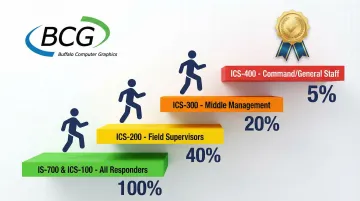
Proper training isn't just recommended for emergency responders—it's required. FEMA establishes a clear training progression that ensures personnel have the appropriate qualifications before assuming ICS roles during incidents.
NIMS Training Curriculum
Baseline Training (All Responders):
- IS-700: NIMS, An Introduction
- ICS-100: Introduction to the Incident Command System
Basic Training (Field Supervisors):
- ICS-200: Basic Incident Command System for Initial Response
Intermediate Training (Middle Management/Supervisors):
- ICS-300: Intermediate ICS for Expanding Incidents
Advanced Training (Command and General Staff):
- ICS-400: Advanced ICS for Command and General Staff in Complex Incidents
Position-Specific Requirements
These training levels align directly with operational roles in the field:
- Field responders: IS-700 and ICS-100
- Supervisors/Unit Leaders: Add ICS-200
- Branch/Division Supervisors: Add ICS-300
- Command Staff and General Staff: Complete through ICS-400
Credentialing and Qualification Standards
The National Qualification System (NQS) provides frameworks for qualifying, certifying, and credentialing personnel. Position Task Books document that individuals have demonstrated necessary competencies for specific roles like Operations Section Chief or Planning Section Chief.
Key credentialing responsibilities include:
- Authority Having Jurisdiction (AHJ) credentials personnel using NQS guidelines
- Local EMS agencies or state emergency management offices typically serve as the AHJ
- Incident management systems like BCG's DLAN support compliance tracking—DLAN is the first and only system evaluated by FEMA's NIMS STEP program as fully compliant with NIMS and ICS principles
Common Challenges in EMS Incident Management
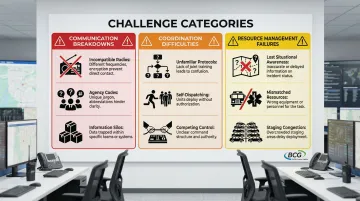
Despite established frameworks like ICS and NIMS, EMS agencies face recurring obstacles during multi-agency responses. These challenges fall into three critical categories that can compromise response effectiveness.
Understanding these common pitfalls helps agencies develop targeted strategies to improve coordination before the next incident.
Communication Breakdowns
Different agencies often use incompatible radio frequencies or encryption, preventing direct communication between units. During the Boston Marathon response, traditional voice communications were overwhelmed.
EMS had limited connectivity in the command bunker, forcing responders to rely on workarounds that delayed critical decisions.
Agency-specific codes and jargon create confusion during joint operations. One agency's "Code 3" may mean something entirely different to another, leading to misinterpreted priorities.
When agencies don't share information effectively, command staff make decisions based on incomplete operational pictures. Modern incident management systems help break down these silos by providing centralized platforms where all responding agencies can access real-time status updates and resource data.
Coordination Difficulties
When agencies first meet during an actual emergency, coordination suffers from unfamiliar command structures and protocols. Joint training exercises build critical working relationships before incidents occur.
Self-dispatching responders who ignore the Incident Commander create safety hazards and duplicate efforts, undermining the entire command structure.
Without clear Unified Command, agencies may work at cross-purposes or compete for control rather than collaborating toward shared objectives.
Resource Management Failures
During complex incidents, agencies lose situational awareness of resource locations and status, creating dangerous gaps in coverage.
Requesting "an ambulance" without specifying ALS vs. BLS capability or transport capacity leads to mismatched resources arriving on scene.
Poor staging area management creates traffic congestion and delays resource deployment when they're needed most, extending response times during critical minutes.
Best Practices for Implementing Effective Incident Management
Establish Formal Mutual Aid Agreements
Develop memorandums of understanding (MOUs) with neighboring EMS agencies, fire departments, law enforcement, and hospitals before incidents occur.
The Emergency Management Assistance Compact (EMAC) provides structure for state-to-state mutual aid. Agreements should outline:
- Resources available for mutual aid
- Request and deployment procedures
- Communication protocols and frequencies
- Cost reimbursement processes
- Liability and workers' compensation coverage
Conduct Regular Training Exercises
Once mutual aid frameworks are established, regular training ensures all personnel can execute coordinated response effectively.
The Homeland Security Exercise and Evaluation Program (HSEEP) provides guiding principles for exercise programs. Agencies should conduct:
- Annual refresher training for all personnel on ICS fundamentals
- Quarterly exercises for command staff practicing IAP development and multi-agency coordination
- Just-in-time training when new personnel join or significant system updates occur
Exercises validate capabilities and identify gaps in a low-risk environment.
They also build critical working relationships between agencies that will coordinate during actual emergencies. Software platforms like BCG's DLAN system—the first and only incident management system fully compliant with FEMA's NIMS STEP program—can streamline training by providing ICS-aligned templates and coordination tools that mirror real-world incident response.
Implement After-Action Reviews
Conduct after-action reviews (AARs) following both exercises and actual incidents. The goal is capturing lessons learned—successes and failures—to improve future performance.
Effective AARs answer three questions:
- What was supposed to happen?
- What actually happened?
- Why were there differences?
Comprehensive AARs should address:
- Communications infrastructure performance
- Interoperability between responding agencies
- Resource allocation and deployment effectiveness
- Documentation and information sharing gaps
Improvement planning should be continuous, with corrective actions monitored and implemented systematically.
Frequently Asked Questions
What's the difference between ICS and NIMS?
NIMS is the comprehensive national framework for incident management covering all phases and stakeholders, while ICS is a specific component focused on the on-scene organizational structure for command, control, and coordination.
What size incidents require formal ICS implementation?
ICS principles apply to all incidents, but formal structure (written IAPs, multiple sections) activates for incidents extending beyond one operational period or requiring multiple agencies. Simple incidents use verbal IAPs with minimal structure.
Who can serve as an Incident Commander for EMS incidents?
The first arriving qualified officer typically assumes IC, with command transferring to more qualified personnel as the incident grows. Qualification requirements scale with incident complexity, from basic ICS-100/200 for Type 5 incidents to ICS-400 and Position Task Books for Type 1.
How does EMS incident management differ from hospital emergency management?
EMS uses ICS for field operations, while hospitals use HICS (Hospital Incident Command System). These systems interface during mass casualty incidents, with field and hospital incident commanders coordinating on patient distribution and capacity.
What are the consequences of not complying with NIMS requirements?
Non-compliance results in loss of federal preparedness grant funding, potentially costing agencies thousands to millions annually. It may also create liability issues if inadequate incident management contributes to poor emergency outcomes.
How often should EMS agencies conduct ICS training?
Annual refresher training for all personnel maintains baseline proficiency. Command staff should participate in quarterly exercises. Additional just-in-time training is recommended when new personnel join or significant system updates occur.
About Buffalo Computer Graphics
Buffalo Computer Graphics (BCG) has provided mission-critical incident management solutions for over 40 years. Their DisasterLAN (DLAN) system is the first and only incident management platform evaluated by FEMA's NIMS STEP program as fully compliant with NIMS and ICS principles and interoperability standards. With 300+ deployments across the United States and customers in 10+ countries, BCG supports emergency management agencies, EMS services, fire departments, and public safety organizations with technology that works identically in training exercises and real-world emergencies. Learn more at bcgeng.com or call (716) 822-8668.