Introduction
Incident response systems are structured frameworks organizations use to detect, manage, coordinate, and resolve emergency incidents across all hazards. These span natural disasters, public safety events, operational disruptions, and technological failures.
These standardized systems provide the foundation for emergency management agencies, healthcare systems, utilities, and government entities to maintain operational continuity, protect lives, and ensure coordinated multi-agency response while meeting NIMS (National Incident Management System) and FEMA compliance requirements.
Many organizations struggle with inconsistent implementation of these frameworks. ICS (Incident Command System) principles, EOC (Emergency Operations Center) activation, and unified command are frequently misunderstood, leading to coordination failures during critical incidents. Research shows that organizations using ICS regularly were significantly more effective during Hurricane Katrina compared to those that did not use it daily, highlighting the critical importance of proper implementation.
This article explains what incident response systems are, how the process works across different incident types, what factors affect effectiveness, and when to activate these frameworks. Whether managing a routine operational incident or coordinating a multi-jurisdictional disaster, understanding these systems is essential.
Key Takeaways
- Incident response systems (NIMS/ICS) provide standardized frameworks for detecting, managing, and resolving all-hazards incidents
- Coordinated multi-agency response protects life and property while meeting federal compliance requirements
- Six-phase process covers preparation through after-action review, ensuring complete incident lifecycle management
- Success requires pre-planning, interoperable communications, trained personnel, and real-time situational awareness
What Is the Incident Response Process?
The incident response process is a structured, standardized approach to managing emergency incidents from initial detection through resolution. It uses frameworks like the Incident Command System (ICS) and National Incident Management System (NIMS) to ensure coordinated, scalable response across multiple agencies and jurisdictions.
These systems are designed to achieve:
- Rapid incident stabilization
- Protection of life and property
- Restoration of normal operations
- Documentation for after-action improvement and regulatory reporting
The result transforms chaotic emergency situations into managed operations with clear command structures, defined roles, and coordinated actions.
Differentiating Emergency Management from Other Frameworks
Incident response systems in emergency management differ fundamentally from cybersecurity incident response and business continuity planning:
- Cybersecurity frameworks (like NIST SP 800-61) focus on detecting and analyzing information security incidents, data breaches, and cyber threats
- Business continuity planning focuses on maintaining operations during disruptions rather than active incident command
- Emergency management frameworks address physical safety, property protection, and stabilizing incidents in the field across all hazards
These frameworks are mandated requirements, not optional best practices. All state governments have officially adopted NIMS through executive order or policy, and federal preparedness funding is strictly contingent on NIMS compliance.
Organizations receiving federal preparedness grants must certify their adherence to specific NIMS implementation objectives, including standardized resource management, credentialing, and inventorying.
Why Incident Response Systems Are Used in Emergency Management
Emergency management agencies adopt these systems because they provide a common organizational structure that enables multiple agencies, jurisdictions, and disciplines to work together effectively during incidents.
When local fire, law enforcement, EMS, public works, and state/federal agencies must coordinate, standardized frameworks become essential for operational success.
What Emergency Management Environments Demand
Incident response systems address critical operational needs:
- Clear chain of command with defined decision-making authority
- Span of control principles (optimal 1:5 supervisor-to-subordinate ratio)
- Unified command across agencies with different jurisdictions
- Standardized terminology eliminating communication confusion
- Scalable organizational structure from small incidents to catastrophic events
- Interoperable communications across different agency systems
What Goes Wrong Without Standardized Systems
The consequences of lacking standardized incident response are severe and well-documented:
- Conflicting commands from multiple agencies creating operational chaos
- Duplicated efforts or critical gaps in coverage
- Communication breakdowns hampering rescue operations
- Inefficient resource allocation and waste
- Unclear accountability and responsibility
- Inability to scale response as incidents grow
Real-World Examples
Hurricane Katrina provides a stark example of these failures. A GAO report noted that lack of interoperable public safety communications hampered rescue efforts and overall operational effectiveness.
Organizations that did not use ICS daily generally failed to effectively implement it during the hurricane response.
The 9/11 Pentagon response demonstrated effective ICS implementation. The Arlington County Fire Department established command presence within minutes, and supporting jurisdictions operated seamlessly within the ICS framework, with even military organizations cooperating fully under explicit Incident Commander guidance.
Federal Mandates and Industry Standards
Incident response systems are not merely recommended—they're required. NIMS compliance is mandatory for federal preparedness funding, representing both legal obligation and operational necessity. Organizations must achieve or actively work toward all NIMS Implementation Objectives and report their status as part of Threat and Hazard Identification and Risk Assessment (THIRA) submissions.
How the Incident Response Process Works (Conceptual Flow)
The incident response process follows a structured lifecycle that transforms preparedness into action and lessons learned. Organizations maintain readiness through planning, training, and system preparation.
When an incident occurs, detection and notification protocols trigger response activation. Personnel establish appropriate ICS organizational structure and command authority. Tactical operations proceed with continuous resource tracking and situational awareness. As the incident stabilizes, resources stand down systematically. After-action review captures lessons learned for future improvement.
What Goes Into the Process
Effective incident response requires multiple inputs:
- Pre-incident planning documents (Emergency Operations Plans, Incident Action Plan templates)
- Trained personnel with ICS certification
- Communication systems enabling multi-agency coordination
- Resource inventories and tracking systems
- Mutual aid agreements with neighboring jurisdictions
- Situational awareness tools providing real-time information
What Happens During Core Operations
Once these inputs are in place, tactical operations begin. The Incident Commander establishes a command post, assesses the situation, and determines objectives. Teams organize resources into ICS structure with Operations, Planning, Logistics, and Finance/Administration sections activated as needed.
The command team develops and executes the Incident Action Plan with specific objectives, tactics, and resource assignments for each operational period. Regular briefings and status updates maintain situational awareness. Unified command partners coordinate activities, and strategy adjusts as the incident evolves.
How the Process Is Controlled
Control mechanisms ensure coordinated, effective response:
- Incident Action Plans define operational periods with specific objectives and resource assignments
- Span of control principles maintain manageable supervisor-to-subordinate ratios (optimal 1:5, acceptable 1:3 to 1:7)
- Regular operational briefings ensure shared situational awareness
- Documentation requirements maintain accountability and support reimbursement
- NIMS principles provide consistent framework across all incidents
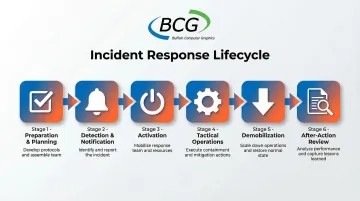
Step 1: Preparation and Planning
Preparation activities include:
- Developing Emergency Operations Plans that define roles, responsibilities, and procedures
- Training personnel in ICS principles through FEMA courses (ICS-100, 200, 300, 400 for progressively advanced roles)
- Conducting exercises and drills to test procedures and build proficiency
- Establishing mutual aid agreements with neighboring jurisdictions
- Pre-positioning resources based on anticipated needs
- Implementing incident management software systems supporting NIMS-compliant workflows
BCG's DisasterLAN is the first and only incident management system evaluated by FEMA's NIMS STEP program as fully compliant. Its template-guided workflows align with federal standards, reducing implementation barriers while ensuring regulatory compliance.
Step 2: Detection, Notification, and Activation
Incident detection occurs through monitoring systems, public reports, or automatic alerts. Notification protocols activate appropriate personnel through alerting systems with multi-channel delivery (SMS, email, in-app notifications).
Initial assessment determines incident type, severity, and required response level. Decision-makers determine whether to activate the Emergency Operations Center or establish a field Incident Command Post. An Incident Commander assumes authority and establishes initial command structure.
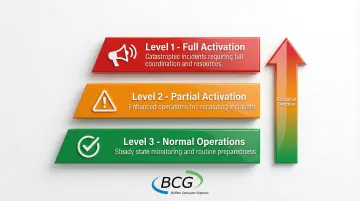
EOC activation can occur at three levels: Level 3 (Normal Operations/Steady State), Level 2 (Enhanced Steady State/Partial Activation), and Level 1 (Full Activation). Full activation is often required immediately upon specific threshold events or when rapid escalation is indicated.
Step 3: Tactical Operations and Demobilization
Tactical operations execute Incident Action Plans through defined operational periods (typically 12-24 hours). Resources are managed and tracked with assignments documented. Teams maintain situational awareness through continuous status updates and operational briefings. Unified command partners coordinate activities and share information.
As the incident stabilizes, transition to recovery operations begins. Resources stand down systematically to avoid premature release. After-action review captures lessons learned, documents successes and challenges, and identifies improvements for future response.
Where Incident Response Systems Are Applied
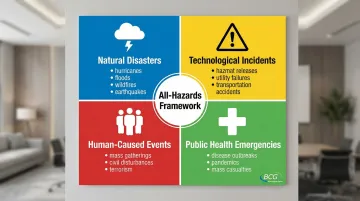
Incident response systems are "all-hazards" frameworks designed to manage any type of emergency. NIMS applies to all incidents, regardless of cause, size, location, or complexity, making these systems versatile tools for diverse scenarios.
Types of Incidents
- Natural disasters: Hurricanes, floods, wildfires, earthquakes, tornadoes
- Technological incidents: Hazardous materials releases, utility failures, transportation accidents
- Human-caused events: Mass gatherings, civil disturbances, terrorism
- Public health emergencies: Disease outbreaks, pandemics, mass casualty incidents
- Planned events: Large public events, parades, sporting events requiring incident management structure
Emergency Management Lifecycle
Incident response systems operate mainly during the response phase (active incident management), but also support preparedness (planning and training) and recovery (transition from response to restoration).
Some incidents require sustained activation over days or weeks, with EOCs potentially operating for extended periods during major disasters or public health emergencies.
When Systems Are Activated
Understanding lifecycle phases helps clarify when activation occurs. Typical triggers include:
- Incidents exceeding routine operational capacity
- Multi-jurisdictional events requiring coordination
- Threats to life safety or critical infrastructure
- Events requiring unified command across multiple agencies
- Incidents where federal assistance may be needed
While activation is condition-based, the framework remains in constant readiness through ongoing preparedness activities and training cycles.
Key Factors That Affect the Incident Response Process in Emergency Management
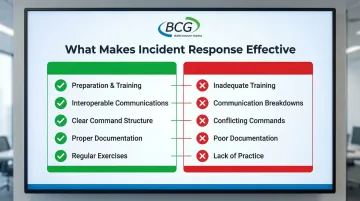
The effectiveness of incident response systems depends on several interconnected factors. Understanding these elements helps organizations identify gaps and strengthen their emergency management capabilities.
Preparation and Training
Organizations with strong pre-incident preparation respond more effectively when emergencies occur:
- High-quality Emergency Operations Plans that align with ICS principles
- Regular training programs for personnel on ICS roles and responsibilities
- Frequent exercises and drills that test plans under realistic conditions
- Maintained systems and resources ready for immediate deployment
Organizations that use ICS regularly during planned events demonstrate higher proficiency during actual emergencies.
Communication and Interoperability
Seamless information flow across agencies is critical during multi-jurisdictional incidents:
- Radio systems that work across different agencies and departments
- Common terminology and standardized procedures
- Real-time information sharing platforms
- Situational awareness tools that provide unified operational pictures
FEMA NIMS STEP compliant systems meet interoperability standards through built-in compliance with NIEM and NIST guidelines.
Organizational Structure and Personnel
The human element determines how effectively an incident management framework operates:
- Sufficient ICS-trained personnel available for deployment
- Clear command structure with appropriate span of control
- Effective unified command when multiple jurisdictions respond together
- Proper activation of ICS functional sections (Operations, Planning, Logistics, Finance/Administration)
Incident Complexity Variables
Different incidents require different response capabilities:
- Geographic scope (localized vs. regional disasters)
- Number of jurisdictions and agencies involved
- Resource requirements and availability
- Incident duration and potential for escalation
- Need for specialized capabilities (hazmat, technical rescue, mass care)
Documentation and Compliance
Proper documentation serves operational and regulatory purposes:
- Incident Action Plan development and distribution
- Resource tracking throughout the incident lifecycle
- Cost documentation for FEMA reimbursement eligibility
- Regulatory reporting obligations
- Maintaining NIMS compliance for federal funding
Template-guided systems help ensure consistent documentation aligned with FEMA standards.
Training verification remains a persistent challenge across jurisdictions. Some agencies cannot produce records showing personnel received required NIMS training, which underscores the importance of documented training programs and compliance tracking.
Common Issues and Misconceptions
"ICS is only for large-scale disasters"
This is incorrect. NIMS is explicitly designed to be scalable, flexible, and adaptable for all incidents, from day-to-day occurrences to large-scale disasters. ICS principles scale from small incidents with a single Incident Commander to complex events with full organizational structure.
Using consistent frameworks for all incidents builds muscle memory and proficiency, making the system second nature when major incidents occur.
"ICS creates bureaucracy and slows response"
Properly implemented ICS actually clarifies decision-making authority, eliminates conflicting commands, and enables faster resource mobilization through clear organizational structure.
The modular organization allows the structure to expand and contract based on incident needs—only required functions are activated, preventing unnecessary bureaucracy.
"Establishing incident command versus activating EOC"
Confusion exists between establishing incident command structure (which should happen quickly at the incident scene) and activating a full Emergency Operations Center (reserved for incidents requiring broader coordination and support).
Field incidents may only require an Incident Commander and small team, while EOC activation provides strategic coordination, resource support, and multi-agency coordination for complex or prolonged incidents.
"Technology replaces trained personnel"
Incident management software supports but does not substitute for ICS knowledge, established procedures, and practiced coordination among agencies. Technology enables faster information sharing and better documentation, but human expertise, decision-making, and coordination remain essential.
When Incident Response Systems May Not Be Appropriate
Situations Not Requiring Full ICS Activation
Full ICS structure may be unnecessary for:
- Routine operational incidents handled by a single agency within normal span of control
- Incidents managed through standard operating procedures without formal command structure
- Very brief incidents resolved before formal ICS activation would provide value
Constraints Limiting Effectiveness
Even when ICS would be beneficial, certain constraints can prevent effective implementation:
- Insufficient trained personnel to fill ICS positions
- Incompatible communications systems between agencies
- Organizational cultures resistant to unified command across agencies
- Remote locations where formal command structure is impractical
Applying ICS Principles Flexibly
Even when full ICS structure is not activated, core principles remain valuable. Clear command, manageable span of control, and coordinated action can be applied at any scale.
Organizations should scale ICS structure to match incident complexity. This flexible approach ensures appropriate coordination without unnecessary overhead.
Conclusion
Incident response systems provide the standardized framework emergency management organizations use to detect, manage, and resolve all-hazards incidents through structures like ICS and NIMS.
These systems enable coordinated multi-agency response, clear command and control, and scalable operations from routine events to catastrophic disasters.
Effective implementation delivers measurable benefits:
- Protects lives through faster, coordinated response
- Ensures efficient resource allocation across agencies
- Maintains operational continuity during disruptions
- Satisfies federal compliance requirements for preparedness funding
Organizations receiving federal preparedness funding must demonstrate NIMS compliance. Software platforms like BCG's DLAN system—the first and only incident management solution evaluated by FEMA's NIMS STEP program as fully compliant—help agencies meet both operational and regulatory requirements while coordinating real-world response efforts.
Frequently Asked Questions
What is the difference between ICS and NIMS in incident response?
NIMS (National Incident Management System) is the comprehensive national framework that includes ICS (Incident Command System) as its operational component, along with communications standards and resource management protocols. ICS specifically refers to the on-scene organizational structure with defined roles and command hierarchy.
How long does it take to activate an incident response system?
Initial incident command can be established within minutes with a single Incident Commander. Full Emergency Operations Center activation typically takes 30 minutes to several hours depending on notification procedures, personnel availability, and setup complexity.
Do small organizations need formal incident response systems?
Small organizations benefit from adopting ICS principles and NIMS compliance because it ensures interoperability when requesting mutual aid, satisfies federal funding requirements, and provides a scalable framework that grows with incident complexity.
What training is required for incident response roles?
FEMA offers free ICS training courses for different roles: ICS-100/200 for basic and supervisory personnel, ICS-300 for management positions, and ICS-400 for command staff. Many jurisdictions require specific certifications based on anticipated roles.
How do incident response systems handle multi-jurisdictional incidents?
Unified command allows multiple jurisdictions to share command authority while maintaining their respective responsibilities. Joint objectives and coordinated Incident Action Plans respect each agency's legal authorities, enabling effective coordination without compromising accountability.
What role does technology play in incident response systems?
Incident management software supports situational awareness, resource tracking, Incident Action Plan development, documentation for compliance, and inter-agency communication. Technology accelerates processes but doesn't replace trained personnel and coordinated planning.