Introduction
When disaster strikes, the difference between chaos and coordinated response often comes down to one critical factor: an effective emergency management system. Between 2018 and 2024, the number of U.S. disasters costing over $1 billion nearly doubled from 14 to 27 events—with federal disaster assistance totaling at least $448 billion over the past decade.
This comprehensive guide explores the essential components, frameworks, and technologies that make up modern emergency management systems.
You'll discover how these integrated systems coordinate activities across prevention, mitigation, preparedness, response, and recovery—protecting lives, minimizing property damage, and ensuring community resilience when it matters most.
TLDR:
- Systems integrate people, processes, and technology across five phases: prevention, mitigation, preparedness, response, and recovery
- NIMS and ICS compliance is mandatory for federal funding and ensures standardized response across agencies
- EOCs use technology platforms to maintain real-time situational awareness and coordinate multi-agency resources
- Incident management software cuts response time and streamlines FEMA reimbursement documentation
- Effective programs require comprehensive planning, regular training, and technology that scales with organizational needs
What is an Emergency Management System (EMS)?
Definition and Core Purpose
An Emergency Management System (EMS) is a comprehensive framework that coordinates activities across prevention, mitigation, preparedness, response, and recovery phases.
EMS integrates people, processes, technology, and resources to manage emergencies effectively—regardless of cause, size, or complexity.
The National Incident Management System (NIMS) provides the nationwide template that enables partners across all levels of government, nongovernmental organizations, and the private sector to work together seamlessly.
NIMS uses an all-hazards approach that applies to everything from traffic accidents to terrorist attacks to natural disasters.
Modern EMS operates at the intersection of public safety, healthcare, emergency management, and public health—requiring coordination among diverse stakeholders with different authorities, capabilities, and priorities.
Why Emergency Management Systems Matter
Disasters create massive economic and human costs. Effective EMS delivers measurable impact:
- Coordinated response reduces casualties through faster mobilization and better resource allocation
- FEMA-funded mitigation projects in Texas avoided over $330 million in losses from Hurricane Harvey alone
- Loss avoidance studies show 277% ROI for mitigation acquisition projects (Gays Mills, Wisconsin)
- Proper documentation and coordination reduce recovery time and ensure federal reimbursement eligibility
- Systematic preparedness builds community capacity to withstand and recover from disruptions
FEMA approved over two million households for federal disaster assistance in 2024 alone—a reminder that real people depend on coordinated, effective response systems.
Core Components of Emergency Management Systems
The Five Phases of Emergency Management
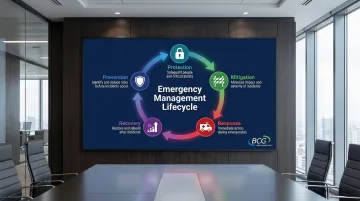
The emergency management lifecycle consists of five interconnected mission areas that form a continuous cycle:
Prevention includes capabilities to avoid, prevent, or stop acts of terrorism or imminent threats through intelligence gathering, threat assessment, and proactive intervention.
Protection secures the homeland against terrorism and disasters through physical security, access controls, and infrastructure hardening.
Mitigation reduces loss of life and property by lessening disaster impact through long-term risk reduction strategies.
Response saves lives, protects property and the environment, and meets basic human needs after incidents through rapid mobilization and tactical operations.
Recovery assists communities in recovering through short-term relief and long-term rebuilding.
These phases work cyclically. Lessons from recovery inform mitigation strategies, preparedness activities enable effective response, and prevention efforts reduce the need for response altogether.
Prevention and Mitigation: Reducing Risk Before Disaster Strikes
Prevention and mitigation represent the most cost-effective emergency management investments. Prevention activities include:
- Building codes requiring earthquake-resistant construction
- Zoning laws restricting development in flood-prone areas
- Public education campaigns about fire safety and evacuation
- Intelligence operations to identify and stop terrorist threats
Mitigation reduces long-term risk through infrastructure improvements and resource management:
- Flood control systems including levees, retention basins, and drainage improvements
- Wildfire management through prescribed burns, fuel reduction, and defensible space creation
- Infrastructure hardening such as elevating buildings above flood levels or reinforcing structures against high winds
The financial case is strong. Research shows every dollar invested in mitigation saves multiple dollars in future disaster costs, with some projects achieving returns exceeding 200%.
Preparedness: Building Capacity Before Crisis
Preparedness activities ensure organizations and communities can respond effectively when disasters occur:
- Developing comprehensive Emergency Operations Plans (EOPs) that define roles, responsibilities, and procedures
- Ensuring personnel understand ICS principles, emergency protocols, and their specific roles through regular training
- Conducting tabletop exercises, functional exercises, and full-scale drills to test plans and identify gaps
- Pre-positioning equipment, supplies, and personnel for rapid deployment
- Establishing redundant communication channels and interoperable systems
The Threat and Hazard Identification and Risk Assessment (THIRA) process helps communities identify risks and determine capability targets, which then inform preparedness investments and training priorities.
Response: Coordinated Action During Crisis
Response activities begin the moment an incident occurs and continue until immediate threats stabilize:
- Standing up Emergency Operations Centers to coordinate strategic decisions and resource allocation
- Establishing Incident Command System structure at tactical sites to manage field operations
- Deploying personnel, equipment, and supplies to affected areas
- Ensuring seamless collaboration among fire, law enforcement, EMS, public works, and other responding agencies
- Providing timely, accurate information to affected populations
Modern incident management systems like DLAN help coordinate these response activities by providing NIMS-compliant platforms for multi-agency collaboration. Survey data shows 88% of jurisdictions activate their EOCs between 0-5 times annually, typically for severe weather events, hazmat incidents, or situations requiring multi-agency coordination.
Recovery: Building Back Better
Recovery encompasses both short-term and long-term activities to restore communities:
Short-term recovery addresses immediate needs including temporary housing, debris removal, utility restoration, and emergency financial assistance for affected households.
Long-term recovery focuses on rebuilding infrastructure, revitalizing the economy, and restoring community services. The "building back better" concept emphasizes using recovery as an opportunity to enhance future resilience through improved building standards, relocated facilities, and strengthened infrastructure.
Psychological and social recovery require equal attention alongside physical reconstruction.
Communities must address trauma, restore social networks, and rebuild trust in institutions—processes that often take years longer than physical repairs.
The Emergency Operations Center (EOC)
EOC Structure and Function
The Emergency Operations Center serves as the central command facility for coordinating emergency response and ensuring continuity of operations.
Unlike incident command posts that manage tactical field operations, EOCs focus on strategic coordination, resource support, and information management.
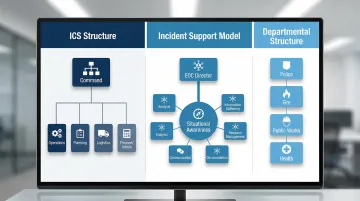
FEMA identifies three common organizational structures for EOCs:
- ICS or ICS-like Structure: Mirrors the on-scene Incident Command System with functional sections (Operations, Planning, Logistics, Finance/Administration), providing familiar structure and clear functional breakdown
- Incident Support Model: Emphasizes information management and resource support, placing the EOC director in direct contact with situational awareness staff
- Departmental Structure: Organizes staff by day-to-day agency roles (Police, Fire, Public Works, Health), requiring less specialized training while emphasizing coordination
Key Functional Roles within the EOC
Regardless of organizational structure, EOCs include these functional areas:
- Command Staff: EOC Director, Public Information Officer, Liaison Officer, and Safety Officer who provide strategic direction and external coordination
- Operations Section: Coordinates tactical operations and implements incident action plans across responding agencies
- Planning Section: Collects and analyzes information, maintains situational awareness, and develops incident action plans
- Logistics Section: Provides resources, facilities, services, and material support to meet incident needs
- Finance/Administration Section: Tracks costs, processes claims, and ensures proper documentation for reimbursement
Clear role definitions and communication protocols prevent confusion during high-stress situations when multiple agencies must coordinate rapidly.
EOC Activation Levels and Protocols
Most jurisdictions use tiered activation levels based on incident severity:
Level 1 (Full Activation) occurs for major incidents requiring maximum coordination across all agencies and functions.
Organizations staff all EOC positions, and the facility operates 24/7 until the incident stabilizes.
Level 2 (Partial Activation) addresses significant incidents requiring coordination but not full mobilization.
Organizations staff key positions, and operations may be limited to standard business hours with on-call coverage.
Level 3 (Monitoring) involves situational awareness and readiness for potential escalation.
Minimal staffing monitors developing situations and maintains communication with field operations.
Activation criteria consider factors including resource shortages, complexity requiring multi-agency coordination, significant weather events, or incidents affecting critical infrastructure.
Communication and Information Management
EOCs serve as information hubs, collecting data from multiple sources and sharing actionable intelligence.
Information management functions include:
- Situation reports: Regular updates summarizing current conditions, response activities, and resource status
- Common operating picture: Real-time visualization of incident locations, resource positions, affected areas, and operational status
- Data visualization: GIS mapping, dashboards, and analytics that transform raw data into actionable intelligence
- Interoperable communications: Systems that enable seamless information sharing across agencies, jurisdictions, and disciplines
Modern EOCs integrate multiple data sources to maintain comprehensive situational awareness. These include weather services, traffic cameras, sensor networks, social media monitoring, and field reports.
Incident Command System (ICS) and NIMS Compliance
Understanding the Incident Command System
ICS provides a standardized, on-scene, all-hazards approach to incident management that scales from routine operations to major disasters. The system establishes common terminology, organizational structure, and processes for multi-agency coordination.
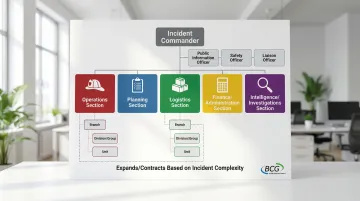
The five major functional areas mirror EOC organization:
- Command: Overall incident management and strategic decision-making
- Operations: Tactical field operations to accomplish incident objectives
- Planning: Information collection, analysis, and resource tracking
- Logistics: Support services including facilities, equipment, and supplies
- Finance/Administration: Cost tracking, procurement, and documentation
ICS uses modular organization that expands or contracts based on incident complexity. Small incidents may require only a single Incident Commander, while major disasters activate all functional areas with multiple branches, divisions, and units.
The National Incident Management System (NIMS)
NIMS provides the comprehensive national framework that includes ICS and extends beyond tactical operations to cover:
- Resource Management: Standardized processes for identifying, typing, ordering, and tracking resources
- Command and Coordination: Structures for managing incidents and coordinating across jurisdictions
- Communications and Information Management: Interoperable systems and common terminology
NIMS compliance is required for federal preparedness funding. Local, state, territorial, and tribal jurisdictions must adopt NIMS to receive federal preparedness grants.
However, self-reported compliance data often masks implementation gaps—independent validation through exercises remains critical.
NIMS Compliance Requirements and Certification
Organizations must meet several requirements for NIMS compliance:
- Adopt ICS for all incident management activities
- Train personnel in NIMS concepts (IS-100, IS-700, and position-specific courses)
- Participate in multi-agency exercises that test NIMS implementation
- Implement resource management systems that support mutual aid
- Establish communications and information systems that support interoperability
The FEMA NIMS Supporting Technology Evaluation Program (NIMS STEP) evaluates incident management systems for full compliance with NIMS and ICS principles. Buffalo Computer Graphics' DisasterLAN (DLAN) became the first incident management system to achieve full NIMS STEP compliance across all 24 NIMS concepts and principles, and remains the only system with this evaluation. With 300+ deployments across government, military, and commercial sectors, DLAN supports organizations working to maintain NIMS compliance.
Benefits of Standardized ICS/NIMS Implementation
Standardization delivers measurable operational benefits:
- Improved interoperability: Common terminology and structure enable seamless coordination during multi-agency responses
- Reduced confusion: Consistent training and procedures eliminate misunderstandings about roles, responsibilities, and protocols
- Scalability: Modular organization adapts to incidents of any size
- Enhanced accountability: Clear command structure and documentation requirements ensure proper oversight and resource tracking
Without standardization, responders using different codes or procedures struggle to coordinate effectively. This creates dangerous gaps during time-critical operations.
Technology and Software Solutions for Emergency Management
Market Growth and Technology Adoption
The global incident and emergency management market reached $131.92 billion in 2024 and is projected to grow to $218.04 billion by 2033. This growth stems from increasing disaster frequency, rapid urbanization, and government investments in public safety infrastructure.
Mass notification systems currently hold the dominant market share, reflecting the critical need for instant, reliable communication during crises.
The market is shifting toward integrated platforms that support the entire emergency management lifecycle through cloud-based deployment, data-driven decision support, and geospatial intelligence.
Essential EMS Technology Categories
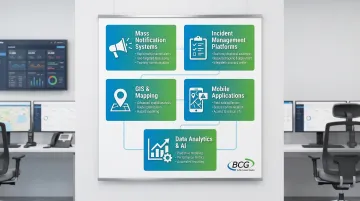
Organizations need multiple technology categories working together to manage incidents effectively:
- Mass notification systems provide rapid public alerting through Wireless Emergency Alerts, sirens, social media, mobile apps, and other channels while activating response teams internally
- Incident management platforms support the full emergency lifecycle with ICS form generation, resource management, situation reporting, task tracking, and audit trails
- GIS and mapping technologies visualize incident locations, resource positions, affected areas, and evacuation routes in real time, integrating weather data and demographic information
- Mobile applications extend EOC capabilities to field personnel with GPS-tagged data collection, offline functionality, and real-time information sharing
- Data analytics and AI enable predictive modeling, resource optimization, and decision support—FEMA is exploring AI systems that could improve disaster survivor assistance efficiency by 30%
Selecting Proven Incident Management Software
When evaluating platforms, organizations should prioritize these factors:
NIMS compliance: Systems must align with FEMA guidelines and support standardized ICS organizational structure.
Buffalo Computer Graphics' DisasterLAN provides template-guided Incident Action Plans aligned with FEMA guidelines, workflow-driven approvals with digital signatures, and NIMS STEP certification—the first and only incident management system to earn this federal validation.
Deployment flexibility: Solutions should offer both cloud and on-premises options to meet organizational security requirements and operational needs.
Scalable licensing: Traditional per-seat pricing creates barriers to widespread adoption.
DLAN's bandwidth-based licensing scales with organizational needs rather than user counts, ensuring all personnel can access the system during activations.
Vendor stability: Choose providers with proven track records and long-term commitment. Buffalo Computer Graphics brings 43 years of experience serving government, military, and commercial sectors with in-house development and 24/7 support.
Integration capabilities: Platforms must integrate with existing systems including CAD, GIS, mass notification, and enterprise authentication systems.
Cybersecurity Considerations
Technology adoption brings increased cybersecurity risks. CISA reports that 63% of operational technology protocols in the Government Services and Facilities sector were exposed to the public internet as of August 2024.
Organizations must address these vulnerabilities:
- Implement cybersecurity performance goals aligned with NIST Cybersecurity Framework
- Conduct regular vulnerability assessments
- Establish access controls and authentication requirements
- Maintain security certifications such as ISO/IEC 27001:2013
- Ensure vendors follow secure development practices
Non-compliance with cybersecurity goals correlates with higher vulnerability, making security a critical evaluation factor for emergency management technology.
Building an Effective Emergency Management Program
Conducting Risk and Vulnerability Assessments
Effective programs begin with comprehensive understanding of risks specific to your jurisdiction or organization. The Threat and Hazard Identification and Risk Assessment (THIRA) process provides the standard methodology for:
- Identifying natural and human-caused hazards using historical data, scientific analysis, and stakeholder input
- Assessing risks to people, property, environment, and operations
- Determining capability targets based on potential impacts
- Prioritizing investments and preparedness activities
The Stakeholder Preparedness Review (SPR) follows THIRA as an annual self-assessment of capability levels against identified targets. Together, these tools create a continuous improvement cycle that informs planning priorities.
Developing Emergency Operations Plans (EOPs)
Building on risk assessments, comprehensive EOPs establish the framework for effective response. Key components include:
- Basic Plan: Overview of authorities, concept of operations, and organizational structure
- Functional Annexes: Specialized plans for communications, mass care, resource management, and other cross-cutting functions
- Hazard-Specific Annexes: Detailed procedures for floods, earthquakes, active shooters, cyber incidents, and other identified threats
Effective plans identify tasks, allocate resources, and establish accountability. The planning process itself is more valuable than plans—the collaborative process of developing EOPs builds relationships and shared understanding that prove critical during actual emergencies.
Modern incident management systems like BCG's DisasterLAN (DLAN) support this planning process with template-guided Incident Action Plans aligned with FEMA guidelines. DLAN is the first and only incident management system evaluated by FEMA's NIMS STEP program as fully compliant with NIMS and ICS principles.
Training, Exercises, and Continuous Improvement
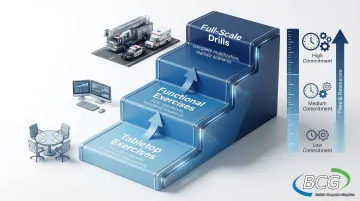
Plans require regular testing. Progressive exercise programs include:
- Tabletop exercises: Bring stakeholders together to discuss roles, responsibilities, and decision-making in hypothetical scenarios; identify gaps in plans and coordination
- Functional exercises: Simulate EOC operations with real-time injects, testing communication systems and information management without deploying resources
- Full-scale drills: Mobilize personnel and equipment to test integrated response across all functions; provide the most realistic capability assessment
After-action reviews following exercises and actual incidents capture lessons learned and drive continuous improvement.
Organizations should incorporate findings into updated plans, additional training, and corrected procedures.
Building Community Resilience and Partnerships
Emergency management cannot succeed as a government-only activity. Effective programs engage:
- Community members through public education campaigns and preparedness initiatives
- Businesses that provide critical services, employ community members, and control significant resources
- Non-profit organizations with specialized capabilities and community connections
- Faith-based organizations that often serve as trusted information sources and volunteer coordinators
The Emergency Management Assistance Compact (EMAC) provides structure for interstate mutual aid, resolving legal issues around liability and reimbursement upfront so states can request and receive assistance quickly during disasters.
Frequently Asked Questions
What is an emergency management system (EMS)?
An emergency management system integrates people, processes, technology, and resources to manage all phases of emergencies—from prevention through recovery. It uses standardized approaches like NIMS and ICS to coordinate activities across all five emergency management phases.
What are the main components of an emergency management system?
The five core components are Prevention, Mitigation, Preparedness, Response, and Recovery. These phases work together as an integrated cycle, with each informing and strengthening the others.
What are the functions of an Emergency Operations Center (EOC)?
EOCs provide centralized coordination, information management, resource allocation, and decision-making support during emergencies. They coordinate multiple agencies and jurisdictions while supporting tactical field operations.
What are examples of emergency management?
Examples include hurricane response (evacuations and sheltering), earthquake preparedness (building codes and public education), hazmat spill containment, power outage coordination across utilities and government, and active shooter response involving multiple agencies.
What is an example of an Incident Command System (ICS)?
During a wildfire, multiple agencies operate under unified command with clear structure. An Incident Commander oversees Operations, Planning, Logistics, and Finance sections, using standardized terminology and procedures for seamless coordination.
What are the key roles of an Emergency Operations Plan (EOP)?
EOPs establish the response framework, define roles and responsibilities, ensure resource readiness, and provide decision-making guidance. They serve as the foundation for training and exercises that build organizational capability.
Building resilient communities demands proven systems, trained personnel, and reliable technology. The emergency management landscape continues to evolve with increasing disaster frequency and growing expectations for coordinated response.
Organizations that invest in comprehensive emergency management systems today will be positioned to protect lives, minimize losses, and recover quickly when disasters strike.
Buffalo Computer Graphics offers DisasterLAN, the first incident management system evaluated by FEMA's NIMS STEP program as fully compliant with NIMS and ICS principles. With flexible deployment options, bandwidth-based licensing, and 43 years of experience serving government and military sectors, BCG supports emergency management agencies nationwide.
Contact BCG at (716) 822-8668 or info@bcgeng.com to learn how DisasterLAN can strengthen your emergency management program.