Introduction
When lives hang in the balance, the software coordinating your emergency response cannot fail. The wrong incident management system creates delayed response times during critical moments, communication breakdowns between agencies when coordination matters most, and non-compliance with federal standards that jeopardizes grant funding.
During COVID-19 response operations, these consequences became measurable reality. Agencies struggled to maintain unified command due to disparate systems and unfamiliarity with NIMS concepts.
Federal audits revealed that manual data transfers between incompatible systems caused delays of 2 to 6 hours in processing resource requests—a lag that could prove catastrophic during life-safety operations. For emergency response agencies, public safety organizations, and institutions protecting communities during crises, selecting the right incident management software is not a technology decision—it's an operational imperative that directly impacts your ability to save lives and protect property.
Key Takeaways
- Incident management software coordinates multi-agency responses, maintains real-time situational awareness, and ensures NIMS/ICS compliance across all-hazards scenarios
- Prioritize verified FEMA NIMS compliance, flexible deployment, cost-effective licensing without per-seat barriers, and proven emergency performance
- Look for template-guided ICS workflows, bandwidth-based pricing models, and vendors with operational emergency management experience
- Seek FEMA NIMS STEP validated systems with documented multi-agency deployments across federal, state, local, and tribal levels
What is Incident Management Software for Emergency Operations?
Incident management software for emergency operations is a comprehensive platform that enables Emergency Operations Centers (EOCs), public safety agencies, and response organizations to manage all-hazards incidents from initial notification through recovery. These systems follow standardized NIMS and ICS protocols.
The platforms collect critical information in real-time collaborative environments, providing situational status, response priorities, and resource deployment data in a common operating picture.
The distinction between IT incident management and emergency incident management is critical. IT service management tools like ServiceNow handle system outages and technical issues. Emergency incident management systems are purpose-built for natural disasters, public safety emergencies, multi-agency coordination, and crisis response following FEMA standards.
These emergency-focused platforms must support no-notice incidents like earthquakes and terrorist attacks, planned events requiring coordination, and the specific forms and workflows defined by the Incident Command System.
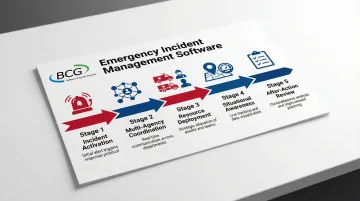
Emergency incident management systems serve as the digital backbone of the EOC—the physical location where coordination of information and resources takes place. Key functions include:
- Multi-agency coordination across jurisdictions and disciplines
- Resource tracking for personnel, equipment, and assets
- Situational awareness through integrated map views and sensor data
- After-action analysis with comprehensive event logging and reporting
Core Components of Emergency Incident Management Software
Without integrated components, incident management becomes fragmented—responders work from different plans, agencies can't share resources, and critical documentation gets lost. Effective software unifies these elements across the complete incident lifecycle from activation through after-action review.
Incident Action Planning (IAP)
IAP functionality provides template-guided workflows aligned with FEMA ICS forms (ICS 201, 202, 203, and others) to help incident commanders develop, document, and distribute standardized incident action plans. These templates ensure all responders understand objectives, strategies, and tactical assignments.
Key IAP capabilities:
- All FEMA ICS forms with pre-built templates
- Workflow-driven approvals and digital signatures
- Automatic version tracking and audit logs
- Rapid report generation across departments
- Real-time collaboration with role-based permissions
Multi-Agency Coordination and Communication
Multi-agency coordination capabilities enable real-time information sharing across multiple responding agencies, jurisdictions, and disciplines—fire, law enforcement, EMS, public works, and utilities.
Critical coordination features:
- Role-based access control for different agencies and positions
- Common operating picture visible to all authorized responders
- Resource sharing and tracking across jurisdictions
- Integrated communication tools maintaining situational awareness
During the COVID-19 pandemic, agencies faced significant difficulties keeping in sync on response efforts and executing unified command due to challenges with distributed operations and unfamiliar stakeholders.
Proper multi-agency coordination software prevents these breakdowns by maintaining unified situational awareness.
Documentation and Compliance
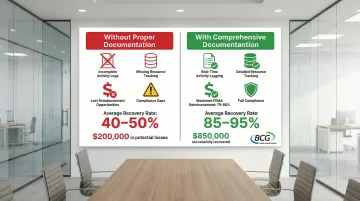
Beyond coordination, comprehensive documentation determines whether agencies can recover costs and learn from incidents. Documentation and compliance features capture all incident-related activities, decisions, resource deployments, and costs in real-time.
This matters financially: FEMA Public Assistance typically covers 75% of eligible costs (potentially rising to 90% for high-impact events), but agencies must provide detailed documentation of labor, equipment, and materials to access these funds.
Essential documentation capabilities:
- Real-time activity logging with timestamps
- Resource tracking (personnel, equipment, materials)
- Cost capture and reporting for reimbursement
- NIMS-compliant record keeping
- After-action report generation
Benefits of Emergency Incident Management Software
Operational Consistency and Speed
Standardized, NIMS-compliant software accelerates response by eliminating confusion about roles, responsibilities, and procedures. Automated workflows reduce time spent on administrative tasks, freeing responders to focus on life-safety operations.
All responders follow proven protocols regardless of incident type or complexity, ensuring consistency and effectiveness.
Real-Time Coordination
Centralized incident information prevents communication breakdowns and information silos that plague emergency response. Real-time situational awareness enables better decision-making, while seamless coordination facilitates mutual aid and multi-jurisdictional response.
When all agencies work from the same information, incidents are resolved faster and more effectively.
Financial and Operational Returns
Beyond operational improvements, financial and operational benefits are substantial:
- Faster incident resolution reduces community impact and recovery costs
- Proper documentation supports FEMA reimbursement for eligible expenses
- The same training environment prepares responders for real incidents
- Automated cost tracking captures data necessary for federal reimbursement
What to Consider When Choosing the Best Incident Management Software
Selecting incident management software requires evaluating factors beyond basic features. Agencies must consider regulatory compliance, deployment models, scalability, integration capabilities, and vendor expertise.
The following factors help emergency managers connect software capabilities to operational outcomes like faster response times, improved multi-agency coordination, regulatory compliance, cost recovery, and organizational resilience.
NIMS and ICS Compliance
FEMA NIMS/ICS compliance is non-negotiable for emergency management agencies. Federal grants often require it, and mutual aid operations depend on standardized processes.
Non-compliant systems create confusion and liability during multi-jurisdictional incidents.
What to look for:
- Software evaluated by FEMA's NIMS STEP program
- Built-in ICS organizational structure
- FEMA ICS form templates (201, 202, 203, 204, and others)
- Adherence to standardized terminology and protocols
While 100% of states and territories report NIMS adoption to maintain federal grant eligibility, FEMA officials admit these self-assessments are often superficial and don't verify actual operational capability.
Decision-makers must look beyond check-box compliance and select software that enforces NIMS/ICS workflows operationally.
Compliant systems ensure seamless integration with state and federal response frameworks, support interoperability during large-scale incidents, and demonstrate due diligence for legal and grant purposes.
FEMA's Preparedness Grants Manual explicitly conditions eligibility on meeting NIMS implementation objectives, making software alignment a financial imperative.
Deployment Flexibility (Cloud vs. On-Premises)
Deployment model affects accessibility, security, cost, and operational continuity. Agencies must weigh specific requirements around data sovereignty, internet connectivity reliability, IT infrastructure, and budget constraints.
Cloud deployment benefits:
- Rapid implementation with immediate access
- Automatic updates without IT overhead
- Access from any location during distributed operations
- Built-in redundancy and disaster recovery
- Reduced infrastructure costs
Cloud considerations: Internet dependency and data residency concerns for sensitive information.
On-premises deployment benefits:
- Complete data control and sovereignty
- Operation during internet outages
- Compliance with certain security policies
- One-time licensing costs
On-premises considerations: IT infrastructure requirements, update management, and maintenance responsibilities.
Cloud-based SaaS solutions offer flexibility but have increased requirements for reliable data communications. For public safety, the ability to operate without internet is critical. Some products allow data caching on devices when networks are unavailable, synchronizing once connectivity is restored.
The best vendors offer both options and can transition agencies between deployment models as needs evolve.
Multi-Agency Coordination Capabilities
Most significant incidents require coordination across multiple agencies, jurisdictions, and disciplines. Software must facilitate information sharing and unified command without creating bottlenecks.
Essential capabilities:
- Role-based access control for different agencies and positions
- Common operating picture visible to all authorized responders
- Resource sharing and tracking across jurisdictions
- Integrated communication tools
A DHS Office of Inspector General audit highlighted that FEMA's WebEOC was not electronically interconnected with state EOCs, forcing staff to manually transfer data and causing delays of 2 to 6 hours during exercises.
These delays could prove catastrophic during real-world operations.
Incidents are resolved faster when all responding agencies work from the same information, understand each other's activities, and can request and deploy resources seamlessly across organizational boundaries.
Licensing Model and Total Cost of Ownership
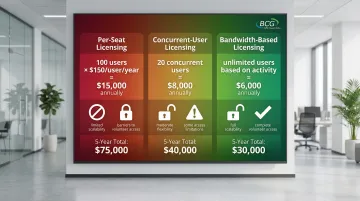
Traditional per-seat licensing can become prohibitively expensive for emergency management agencies. Many need to provide access to dozens or hundreds of potential responders, volunteers, and partner agencies who only use the system during activations.
Bandwidth-based or concurrent-user licensing models better align with emergency management use patterns. Agencies pay for the level of simultaneous activity they need rather than for every potential user, dramatically reducing costs while ensuring access for all responders.
Pricing varies widely across the market. A 2022 DHS market survey documented per-user annual costs ranging from approximately $71 to $675, with jurisdiction-based pricing ranging from $36,000 to $250,000 annually.
Other cost considerations:
- Implementation and training costs
- Ongoing support fees
- Update and upgrade costs
- Integration expenses
- Hidden fees for essential features (some vendors charge extra for mobile access, status pages, or additional modules)
Calculate total cost of ownership over 5 years including all licensing, support, training, and infrastructure costs to make accurate comparisons between vendors.
Proven Track Record in Real Emergency Scenarios
Beyond cost and features, vendor experience matters enormously in emergency management. Software that works well in IT operations or corporate environments may fail under the unique pressures of emergency response—time pressure, high stakes, diverse users, and rapidly changing conditions.
What to evaluate:
- Number of deployments in actual EOCs
- Diversity of incident types managed (natural disasters, public health emergencies, security incidents)
- Customer references from similar agencies
- Years of focus on emergency management (not just general incident tracking)
Vendor support is critical. During a major incident, agencies need responsive technical support from people who understand emergency operations, not just software troubleshooting.
Request customer references from agencies of similar size and type. Ask specific questions about software performance during actual incidents, vendor responsiveness, and long-term satisfaction.
How BCG Can Help
Buffalo Computer Graphics' DisasterLAN (DLAN) is an incident management system specifically designed for emergency operations. With 43 years of engineering experience, DLAN has over 300 deployments across federal, state, local, and tribal agencies managing all-hazards incidents.
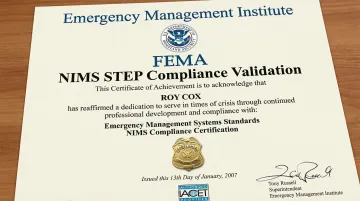
DLAN is the first and only incident management system evaluated by FEMA's NIMS STEP program as fully compliant with NIMS and ICS principles. The October 2010 evaluation found DLAN consistent with all 24 NIMS concepts and principles across emergency support, hazards, preparedness, communications and information management, resource management, and command and management functions.
This compliance ensures seamless integration with federal and state emergency management frameworks and eligibility for grant funding.
BCG's unique advantages include:
- Bandwidth-based licensing that reduces costs while providing access for all responders, volunteers, and partner agencies without per-seat charges
- Flexible cloud or on-premises deployment with the ability to transition between models as organizational needs evolve
- Template-guided Incident Action Plans aligned with all FEMA ICS forms, including workflow-driven approvals and digital signatures
- U.S.-based development and support team with deep emergency management expertise, including staff trained through ICS 400 level with real-world field and EOC experience
- Proven performance in real disasters ranging from hurricanes and wildfires to public health emergencies and security incidents
BCG's operational expertise extends beyond software development. The company provides All Hazard Incident Management Teams, activation support, and emergency management consulting services including workflow analysis, plan development, and exercise support.
This field experience means DLAN is built by professionals who have managed real-world emergency operations.
Conclusion
Selecting incident management software isn't about finding the most feature-rich or popular solution. It's about choosing a system that aligns with emergency management protocols.
The right platform must fit your agency's operational environment and budget while coming from a vendor with proven emergency management expertise.
When chosen correctly, your software becomes a force multiplier during incidents—enabling faster coordination, better decision-making, and improved outcomes. Poor choices create liabilities that slow response and generate frustration when every second counts.
Evaluate incident management software through tabletop exercises or simulations before committing. Prioritize vendors who can demonstrate their system's performance in real emergency scenarios similar to those your agency faces. Systems like BCG's DLAN—the first and only incident management platform evaluated by FEMA's NIMS STEP program as fully compliant—demonstrate this alignment with NIMS/ICS principles in practice. Your investment in the right platform today will prove its value when your community needs you most.
Frequently Asked Questions
What is incident management software for emergency operations?
Emergency incident management software helps EOCs, public safety agencies, and response organizations coordinate all-hazards incidents following NIMS/ICS protocols. Core features include incident action planning, resource tracking, multi-agency coordination, and documentation support throughout the incident lifecycle.
What's the difference between IT incident management and emergency incident management software?
IT incident management tools handle technical system outages and IT operations. Emergency incident management systems are purpose-built for natural disasters and public safety emergencies, following FEMA/NIMS standards with specialized features like ICS forms and EOC coordination.
Why is NIMS compliance important when choosing incident management software?
NIMS compliance ensures interoperability during multi-jurisdictional incidents and is often required for federal grant eligibility. Non-compliant systems create coordination problems during mutual aid operations and may jeopardize federal preparedness funding.
What deployment model is better for emergency management agencies: cloud or on-premises?
The best choice depends on your internet reliability, data sovereignty requirements, IT capabilities, and budget. Cloud deployment offers accessibility and reduced IT overhead, while on-premises provides data control and offline operation.
How much does incident management software typically cost?
Traditional per-seat pricing ranges from $50-200+ per user monthly, while bandwidth-based models may offer better value for agencies needing broad access. Calculate total 5-year cost including implementation, training, support, and feature add-ons.
What should I ask vendors when evaluating incident management software?
Ask about FEMA NIMS STEP evaluation status, deployment options, total cost including all features, implementation timelines, and references from similar agencies. Request details on how many emergency management agencies use the system and for what incident types.