Introduction: Why Emergency Incident Management Systems Matter
Picture this: A Category 3 hurricane makes landfall, flooding major roadways and cutting power to 200,000 residents. Within minutes, your emergency operations center receives simultaneous requests from fire departments, hospitals needing generator fuel, shelters reporting overcapacity, and media demanding updates.
Without a structured system, this scenario turns into chaos—missed communications, duplicated efforts, and delayed response that costs lives.
When emergencies strike, organizations face overwhelming coordination challenges:
- Public safety response coordination
- Resource allocation across multiple agencies
- Media inquiries and public communications
- Employee safety notifications
- Contractor and vendor coordination
The difference between effective response and catastrophic failure often comes down to one factor: whether you have a structured Emergency Incident Management System in place.
These systems provide the framework that transforms chaos into coordinated action. When seconds count, your team knows exactly who does what, where resources are deployed, and how information flows between field teams and command centers.
TLDR: Key Takeaways
- Incident management systems coordinate response activities, resources, and communications during emergencies
- NIMS and ICS are federal frameworks required for U.S. public agencies
- Clear command structures, EOCs, and resource management enable faster, coordinated response
- Successful deployment demands technology selection, personnel training, regular drills, and standards compliance
- FEMA-compliant platforms reduce planning time and improve multi-agency coordination
What is an Emergency Incident Management System?
An Emergency Incident Management System (IMS) is a comprehensive framework of policies, procedures, organizational structures, and technologies designed to manage preparation for, response to, and recovery from emergency incidents. It serves as the operational playbook guiding your organization from incident detection through complete recovery.
IMS vs. ICS: Understanding the Distinction
Many people use these terms interchangeably, but they serve different purposes. IMS represents the broad management framework including planning, training, and recovery activities.
The Incident Command System (ICS), by contrast, is the specific command and control structure activated during tactical response operations. IMS is your comprehensive approach; ICS is the organizational structure you deploy when incidents occur.
How Modern Incident Management Standards Evolved
Hard-learned lessons from multi-agency disasters drove the standardization of incident management. The modern ICS originated in the 1970s with FIRESCOPE (Firefighting Resources of California Organized for Potential Emergencies), developed to manage wildfires involving multiple jurisdictions. By 1982, this became the National Interagency Incident Management System.
The terrorist attacks of September 11, 2001, accelerated the push for national standardization. In March 2004, the Department of Homeland Security issued the National Incident Management System (NIMS) under Homeland Security Presidential Directive-5.
This directive mandated that federal agencies make NIMS adoption a requirement for federal preparedness grants beginning in Fiscal Year 2005.
Why IMS Matters Across Sectors
Different sectors face unique challenges that IMS addresses:
- Emergency services need tactical coordination across fire, police, and EMS agencies responding to the same incident
- Businesses require continuity protection to maintain operations during disruptions
- Healthcare facilities must ensure patient safety while managing surge capacity during mass casualty events
- Utilities need infrastructure resilience to restore critical services quickly
- Educational institutions must coordinate campus safety with local responders
Key Scenarios Requiring IMS
Your organization should implement IMS if you face potential exposure to:
- Natural disasters (hurricanes, earthquakes, floods, wildfires)
- Human-caused incidents (active threats, hazardous material spills, cyberattacks)
- Public health emergencies (pandemics, disease outbreaks)
- Planned events requiring emergency preparedness (large gatherings, sporting events)
Key Components of Incident Management Systems
Incident Command Structure
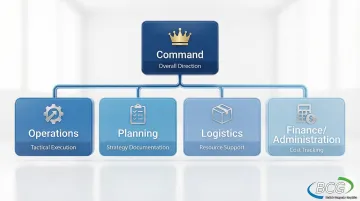
The foundation of effective incident management rests on five major ICS functions that provide clear roles and responsibilities during emergencies.
The Five Major Functions:
- Command - Provides overall incident management, sets objectives, and maintains ultimate responsibility for incident outcomes
- Operations - Executes tactical response activities and directs all operational resources toward achieving incident objectives
- Planning - Tracks resources, collects and analyzes information, maintains documentation, and supports incident action planning
- Logistics - Arranges for resources and services needed to support operations, including equipment, supplies, facilities, and personnel support
- Finance/Administration - Monitors incident costs, provides accounting, handles procurement, tracks time, and conducts cost analyses
Scalability: The Key to Flexible Response
ICS's scalability allows the structure to flex based on incident complexity. Small incidents may require only a single incident commander, while larger events expand the structure from the top down.
A minor facility emergency might involve just an incident commander and a few responders. A major hurricane response could expand to include full command staff, multiple division supervisors, and dozens of units—all following the same organizational principles.
The acceptable span of control ranges from 3 to 7 reporting relationships per supervisor, with five being optimal.
Emergency Operations Center (EOC)
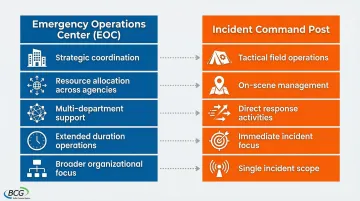
While the incident command structure manages tactical operations in the field, many incidents require strategic coordination at a higher level.
An EOC serves as the physical or virtual location where leadership coordinates strategic decisions, resource allocation, and communications during incidents. Unlike the incident command post at the tactical scene, the EOC focuses on broader coordination and support.
EOC Activation Criteria:
Activate your EOC when incidents involve:
- Significant property damage or potential for extensive impact
- Business disruption requiring coordination across multiple departments
- Multi-agency coordination needs
- Extended duration requiring sustained operations
- Complexity exceeding field management capacity
EOC Setup Requirements:
Effective EOCs require careful planning across multiple dimensions:
- Locations: Identify both primary and alternate facilities with adequate workspace
- Communications infrastructure: Redundant systems including phones, radios, internet, and satellite backup
- Information management systems: Platforms for tracking resources, sharing situational awareness, and documenting decisions
- Supplies and equipment: Computers, displays, maps, forms, and provisions for extended operations
- Staffing roster: Clear roles with primary and backup personnel for all critical positions
Resource Management
Effective resource management ensures you can identify, request, deploy, and track the personnel, equipment, and supplies needed during incidents.
Resource Typing and Tracking:
Resource typing establishes standardized categorization of capabilities, enabling effective requesting and dispatching. Type 1 resources represent the highest capability level, while Type 3 represents basic capability.
This standardization allows you to request "one Type 1 engine company" and receive a resource with known capabilities, regardless of which agency provides it.
The Resource Typing Library Tool (RTLT) provides national definitions for resource types and position qualifications, establishing common language across jurisdictions.
Mutual Aid and External Resources:
No organization can maintain all resources needed for major incidents. Mutual aid agreements establish pre-arranged frameworks for requesting assistance. The Emergency Management Assistance Compact (EMAC) provides federally authorized structure for interstate mutual aid, resolving liability and reimbursement issues upfront.
However, challenges persist. GAO reports indicate that inconsistent resource tracking during multi-agency incidents remains problematic, with FEMA lacking full visibility into state-level implementation effectiveness.
Communications and Information Management
Managing resources effectively requires robust communication systems that keep all partners informed and coordinated.
Coordinated response depends on effective communication and shared situational awareness across all response partners.
Communication Protocols:
Standardized protocols ensure consistent information flow:
- Incident Action Plans define operational period objectives and assignments
- Operational briefings align personnel at shift changes
- Situation reports provide regular status updates to leadership
- Common operating picture ensures all partners see the same information simultaneously
Interoperability Requirements:
Systems must work across organizational boundaries. This requires:
- Compatible communications systems that different agencies can use together
- Common terminology eliminating confusion from jargon
- Standardized forms and reporting formats
- Integrated information management platforms supporting data sharing
Understanding NIMS and ICS Frameworks
The National Incident Management System provides the federal framework establishing standardized approaches to incident management across all jurisdictions and disciplines. Understanding NIMS is essential for any organization implementing incident management capabilities.
NIMS Core Components
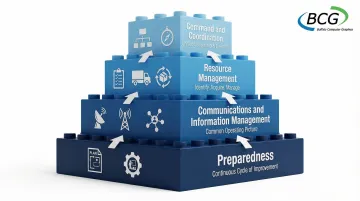
FEMA defines three major components representing a building-block approach:
- Preparedness - Planning, training, and exercises that build capability before incidents occur
- Communications and Information Management - Systems ensuring decision-makers have necessary information through interoperable platforms
- Resource Management - Systems for identifying, typing, tracking, and deploying resources effectively
- Command and Coordination - Leadership roles, processes, and organizational structures including ICS, EOCs, and multiagency coordination groups
ICS Organizational Principles
These core components provide the foundation for the Incident Command System itself. ICS operates on fundamental principles that ensure effective coordination:
- Chain of command - Clear reporting relationships from field personnel through section chiefs to the incident commander
- Unity of command - Each person reports to only one supervisor, eliminating conflicting directions
- Manageable span of control - Supervisors maintain 3-7 direct reports for effective oversight
- Modular organization - Structures expand or contract based on incident needs
- Common terminology - Standardized position titles and resource names across agencies
- Integrated communications - Coordinated communication plans and interoperable systems
ICS Positions and Responsibilities
These principles translate into specific organizational roles. Understanding key positions helps clarify organizational structure:
- Incident Commander - Holds overall authority and responsibility for incident management
- Command Staff - Public Information Officer (media relations), Safety Officer (personnel safety), and Liaison Officer (external agency coordination) report directly to the IC
- General Staff - Section Chiefs lead Operations (tactical response), Planning (documentation and tracking), Logistics (support services), and Finance/Administration (cost tracking)
Compliance Requirements
Government agencies must comply with NIMS to receive federal preparedness grants.
Private sector compliance is voluntary unless mandated by specific regulations like the CMS Emergency Preparedness Rule for healthcare.
However, private organizations benefit significantly from NIMS adoption:
- Enables seamless coordination with public safety agencies during emergencies
- Reduces confusion through common terminology
- Demonstrates preparedness to regulators and stakeholders
Organizations implementing NIMS-compliant incident management systems, such as BCG's DLAN platform (the first and only system evaluated by FEMA's NIMS STEP program as fully compliant), gain additional advantages through standardized workflows and interoperability with federal response frameworks.
Implementing an IMS in Your Organization
Successful IMS implementation follows a structured approach that builds capability step by step.
Conduct Hazard Vulnerability Assessment
Start by identifying potential emergencies your organization faces.
Consider:
- Geographic location (hurricane zones, earthquake faults, flood plains)
- Operational characteristics (hazardous materials, high-value assets, large gatherings)
- Facility features (high-rise buildings, aging infrastructure, limited egress)
- Community risks (proximity to chemical plants, transportation routes, critical infrastructure)
Prioritize scenarios based on likelihood and potential impact, focusing implementation efforts on your highest-risk situations.
Develop Foundational Plans
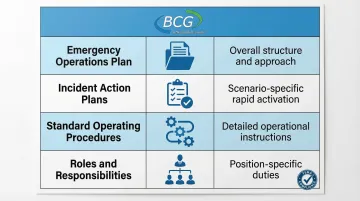
Build a comprehensive planning framework covering all incident management scenarios:
| Plan Type | Purpose |
|---|---|
| Emergency Operations Plan | Defines overall approach, organizational structure, and general procedures |
| Incident Action Plan Templates | Pre-formatted plans for specific scenarios enabling rapid activation |
| Standard Operating Procedures | Detailed instructions for IMS activation, EOC operations, and position-specific responsibilities |
| Roles and Responsibilities Documentation | Clear descriptions of what each position does during incidents |
Template-guided approaches aligned with FEMA guidelines help ensure consistency across all plans.
Establish Organizational Structure
Once plans are documented, assign personnel to key roles:
- Identify primary and alternate personnel for all critical roles
- Create position-specific job action sheets listing key responsibilities
- Define reporting relationships and span of control
- Establish clear activation and notification procedures
Integrate with Existing Systems
IMS shouldn't operate in isolation. Ensure alignment with:
- Business continuity plans addressing operational resilience
- Crisis communication protocols for stakeholder notifications
- Safety programs covering employee protection
- Security operations managing physical and cyber threats
Proper integration ensures IMS complements rather than conflicts with established procedures, reducing confusion during actual incidents.
Choosing the Right IMS Technology and Tools
Technology significantly enhances incident management capabilities, but selecting appropriate solutions requires careful evaluation.
Software vs. Manual Systems:
Small organizations may start with paper-based ICS forms and manual tracking using whiteboards and spreadsheets. This approach works for simple incidents but becomes overwhelming as complexity increases.
Larger organizations or those facing complex multi-agency coordination scenarios need dedicated incident management software. These platforms provide real-time information sharing, automated resource tracking, and comprehensive documentation.
Key Technology Features:
When evaluating platforms, prioritize these capabilities:
- Incident action planning tools - Templates, workflows, and approval processes for creating FEMA-compliant IAPs
- Resource management databases - Tracking for personnel, equipment, and supplies with status visibility
- Situational awareness dashboards - Real-time displays showing incident status, resource locations, and key metrics
- Communications integration - Unified messaging across email, SMS, and other channels
- Mobile accessibility - Field access through smartphones and tablets, including offline capability
- Reporting and documentation - Automated generation of situation reports and after-action documentation
- Interoperability - Exchanges data with external systems using industry standards
Deployment Models:
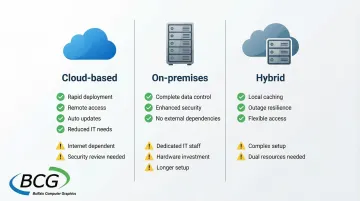
Each deployment model offers distinct trade-offs:
| Deployment Type | Key Benefits | Key Considerations |
|---|---|---|
| Cloud-based | Rapid deployment, remote accessibility, automatic updates, reduced IT infrastructure | Requires internet connectivity, data storage security review |
| On-premises | Complete data control, enhanced security, no external dependencies | Needs dedicated IT staff, hardware investment, longer setup time |
| Hybrid | Local caching with cloud sync, network outage resilience, flexible access | More complex configuration, requires both local and cloud resources |
Compliance and Standards:
Organizations coordinating with government agencies should verify that solutions support NIMS/ICS compliance. Buffalo Computer Graphics' DisasterLAN (DLAN) is the first and only incident management system evaluated by FEMA's NIMS STEP program as fully compliant. DLAN offers template-guided Incident Action Plans aligned with FEMA guidelines and supports all three deployment models—cloud, on-premises, and hybrid.
Training and Testing Your Incident Management System
Even the best plans and technology fail without trained personnel and regular testing.
Build Progressive Training Programs
Effective training builds capability through three distinct levels, each serving a specific purpose in your organization's preparedness:
Awareness training introduces IMS concepts to all personnel, ensuring everyone understands basic principles and their role during incidents.
Position-specific training provides detailed instruction for incident management team members on their specific responsibilities, tools, and procedures.
ICS certification courses through FEMA's Emergency Management Institute establish standardized competency.
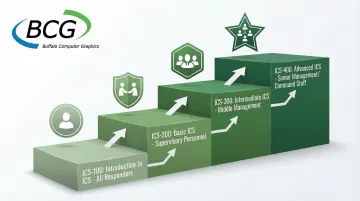
Core certifications include:
- ICS-100: Introduction to ICS for all responders
- ICS-200: Basic ICS for supervisory personnel
- ICS-300: Intermediate ICS for middle management
- ICS-400: Advanced ICS for senior management and command staff
Test Through Regular Exercises
Regular exercises validate your plans and identify gaps through two complementary approaches:
Discussion-based exercises test plans and procedures without deploying resources:
- Tabletops gather key personnel to discuss scenarios and decision-making
- Workshops develop new plans or policies through facilitated sessions
Operations-based exercises test actual response capabilities:
- Drills practice specific skills or procedures
- Functional exercises test multiple functions in simulated conditions
- Full-scale exercises deploy personnel and resources in realistic scenarios
Schedule exercises at least annually with increasing complexity over time. However, GAO found that FEMA completed after-action reviews for only 29% of disasters from 2017-2019, highlighting the challenge of maintaining consistent exercise and evaluation cycles.
Close the Loop with Continuous Improvement
After-action reviews transform lessons into lasting improvements. Following each exercise or real incident, conduct structured reviews that:
- Identify strengths to sustain and areas needing improvement
- Develop corrective action plans with assigned responsibilities and timelines
- Update plans and procedures incorporating lessons learned
- Track implementation of improvements before the next exercise
Frequently Asked Questions
What is the difference between IMS, NIMS, and ICS?
NIMS is the federal standard framework, IMS is your comprehensive program implementing those standards across all incident phases, and ICS is the tactical organizational structure you activate during operations. Think of it as: NIMS provides the standards, IMS is your program, and ICS is the structure you deploy.
Do private sector organizations need to comply with NIMS?
Federal agencies and grant recipients must comply. Private sector compliance is voluntary unless mandated by specific regulations—healthcare facilities must comply with CMS Emergency Preparedness Rules, for example. Voluntary adoption is recommended for organizations coordinating with public agencies, as standardization enables seamless integration.
How long does it take to implement an incident management system?
Basic framework development and initial training typically requires 3-6 months, while full implementation with technology deployment extends to 6-12 months. However, IMS requires continuous refinement through exercises and real-world application—view it as an ongoing program rather than a one-time project.
What size organization needs a formal IMS?
Any organization facing potential emergencies benefits from IMS, regardless of size. The system's scalability allows simple implementations for small organizations or comprehensive systems for large ones. Base your decision on hazard exposure, regulatory requirements, and coordination needs rather than size alone.
How much does incident management system software cost?
Costs vary widely based on organization size, features, and deployment model. Some solutions use per-seat licensing while others, like Buffalo Computer Graphics' DLAN, offer bandwidth-based pricing for greater flexibility. Factor in licensing, implementation, training, and ongoing support when budgeting.
What training is required for incident management team members?
All team members need ICS-100 and ICS-200. Command and general staff should complete ICS-300 and ICS-400, plus position-specific training for specialized roles. Many organizations also require IS-700 (NIMS Introduction) and IS-800 (National Response Framework), with regular refresher training and exercise participation to maintain proficiency.
Ready to implement a comprehensive incident management system? Buffalo Computer Graphics offers DLAN, the FEMA NIMS STEP-certified incident management platform (the first and only system to achieve this certification), with flexible deployment options and expert implementation support. Contact us at (716) 822-8668 or info@bcgeng.com to schedule a demo and see how DLAN can transform your emergency response capabilities.