Introduction
Picture a massive wildfire tearing through populated areas, forcing evacuations across three counties. Fire departments, law enforcement, emergency medical services, the National Guard, and federal agencies arrive at the scene. Without a standardized coordination framework, this multi-agency response could quickly descend into chaos—conflicting orders, duplicated efforts, and dangerous communication breakdowns that cost lives.
This is precisely why the Incident Command System (ICS) exists. ICS is the standardized framework that transforms potential chaos into coordinated action, enabling agencies with different authorities, capabilities, and protocols to work seamlessly toward common objectives.
Whether managing a structure fire, hurricane evacuation, hazardous materials spill, or pandemic response, ICS provides the organizational structure that saves lives and protects property.
This guide covers ICS fundamentals, the five core components that structure every response, key principles that make ICS effective, and practical strategies for implementing ICS in your organization.
TLDR:
- ICS is the federally mandated framework for coordinating emergency response across all agencies and jurisdictions
- Five core components (Command, Operations, Planning, Logistics, Finance/Admin) scale from small incidents to major disasters
- Key principles include unity of command, common terminology, manageable span of control, and management by objectives
- Free FEMA ICS training courses (100-400 levels) are required for emergency responders
- FEMA-compliant platforms like DLAN provide ICS templates and real-time coordination
What is the Incident Command System (ICS)?
ICS is a standardized, flexible framework for command, control, and coordination of emergency response. It provides a common organizational structure that enables agencies from different jurisdictions and disciplines to work together effectively, regardless of incident size or complexity.
The Origin Story: From Wildfire Chaos to National Standard
The Incident Command System was born from tragedy. In 1970, a series of devastating wildfires swept through Southern California over 13 days, claiming 16 lives and destroying 700 homes.
The failures weren't due to lack of resources—they stemmed from severe coordination breakdowns. Agencies used incompatible radio frequencies, non-standard terminology that created confusion, and operated independently without consolidated action plans.
In response, California created the Firefighting Resources of Southern California Organized for Potential Emergencies (FIRESCOPE) program to develop a better system. By 1978, the Pacoima Fire became the first large-scale incident officially managed using ICS, proving the system's effectiveness.
Evolution to National Adoption
ICS transitioned from a regional wildfire tool to the national standard through several policy milestones:
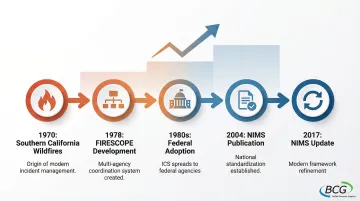
- 1980s: The National Wildfire Coordinating Group adopted ICS for all federal land management agencies
- 2003: Homeland Security Presidential Directive 5 mandated a single, comprehensive national incident management system
- 2004: FEMA published the National Incident Management System (NIMS), formally integrating ICS as the standard for all levels of government
- 2017: NIMS was updated to reinforce ICS principles and improve resource management guidance
Why ICS Matters
This historical development led to universal adoption across U.S. emergency response agencies. Today, ICS isn't optional.
FEMA's Preparedness Grants Manual explicitly conditions eligibility for federal funding programs on meeting NIMS implementation objectives, making compliance mandatory for jurisdictions seeking Homeland Security Grant Program (HSGP) and Emergency Management Performance Grant (EMPG) funding.
Beyond compliance, ICS delivers measurable operational benefits:
- Eliminates confusion through clear command structure and standardized terminology
- Enables resource sharing across jurisdictional boundaries without surrendering authority
- Improves accountability with defined roles and documentation requirements
- Scales seamlessly from single-resource responses to multi-state disasters
- Enhances safety through structured supervision and dedicated safety officer roles
ICS applies to incidents of any size or complexity—from a single-vehicle accident to Hurricane Katrina-scale disasters—providing the organizational backbone that transforms individual agency capabilities into coordinated emergency response.
The Five Core Components of ICS
ICS organizes emergency response around five major functional areas that are modular and scalable. Organizations activate only the positions needed for the specific incident, expanding or contracting the structure as situations evolve.
Command
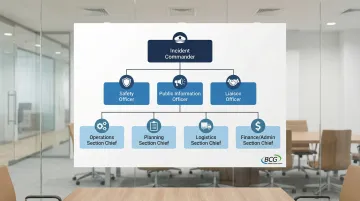
The Command function provides overall incident management and sets objectives. The Incident Commander (IC) has ultimate responsibility for all incident activities, including developing objectives, strategies, and priorities.
In single-jurisdiction incidents with no functional agency overlap, one IC manages the entire response.
Command Staff report directly to the IC and handle critical functions:
- Safety Officer: Monitors incident operations and advises the IC on all safety matters, including responder health and safety
- Public Information Officer: Coordinates with media and the public, releasing coordinated information about the incident
- Liaison Officer: Serves as the point of contact for representatives from other agencies, NGOs, and private sector organizations
Unified Command is used when incidents involve multiple jurisdictions or agencies with shared authority. Instead of a single commander, designated officials from involved agencies jointly determine objectives and strategies without surrendering individual agency authority.
The Deepwater Horizon oil spill utilized Unified Command with the U.S. Coast Guard and BP managing the massive response, while the 2017 Thomas Fire employed Unified Command involving CAL FIRE, Ventura County Fire, and local agencies to coordinate thousands of personnel.
Operations Section
Once Command establishes objectives and strategies, Operations executes them. This section handles all tactical activities directly related to achieving incident objectives, with the Operations Section Chief directing resources and implementing the Incident Action Plan.
Operations is organized by:
- Divisions: Geographic areas (North Division, South Division)
- Groups: Functional assignments (Search and Rescue Group, Medical Group)
Typical Operations activities include:
- Search and rescue operations
- Fire suppression and containment
- Medical triage and treatment
- Evacuation coordination
- Hazardous materials mitigation
- Security and law enforcement operations
Planning Section
The Planning Section collects, evaluates, and displays incident information. It then develops the Incident Action Plan (IAP) that guides coordinated response efforts.
The Planning Section Chief oversees critical units:
- Situation Unit: Tracks incident status, collects and analyzes information, prepares situation reports
- Resources Unit: Tracks all personnel and equipment, maintains resource status information
- Documentation Unit: Maintains accurate incident records, archives documents for after-action review
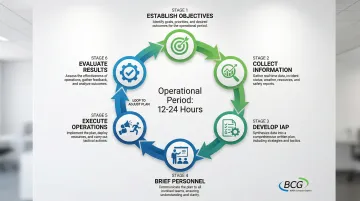
The planning cycle typically operates on 12-24 hour operational periods. The Planning Section prepares IAPs that define objectives, strategies, tactics, and resource assignments for each period, ensuring all responders work toward common goals.
Logistics Section
Logistics provides resources, facilities, services, and materials needed for incident response. The section chief manages two branches:
Service Branch:
- Communications support (radios, networks, IT infrastructure)
- Food services for responders
- Medical support for emergency personnel
Support Branch:
- Supply procurement and distribution
- Facilities management (base camps, staging areas)
- Ground support (vehicles, equipment maintenance, fueling)
Logistics ensures responders have what they need when they need it, from communications equipment and personal protective gear to meals and rest facilities during extended operations.
Finance/Administration Section
Finance/Administration tracks costs, manages contracts, handles compensation and claims, and provides cost analysis. This section is typically activated for:
- Longer-duration incidents with significant financial implications
- Incidents requiring extensive procurement or contracting
- Events where cost documentation is needed for FEMA reimbursement or insurance claims
Key Finance/Administration functions include:
- Time tracking for personnel compensation
- Procurement documentation and contract management
- Cost analysis and financial reporting
- Compensation and claims processing
Proper financial documentation ensures accountability and supports reimbursement processes critical for agencies managing limited budgets.
Key Principles That Make ICS Effective
Beyond organizational structure, ICS effectiveness depends on management principles that guide decision-making and operations.
Unity of Command
Each person reports to only one supervisor, eliminating conflicting orders and confusion. This enhances accountability and safety during high-stress operations.
When personnel receive direction from multiple sources, conflicting priorities create dangerous situations and undermine coordinated response.
Common Terminology
ICS requires standardized terms, position titles, and resource descriptions across all responding agencies. Radio codes (like "10-codes") are prohibited because different agencies use them differently, creating confusion.
Standard ICS terminology includes:
- Position titles: Incident Commander, Operations Section Chief, Strike Team Leader
- Resource descriptions: Type 1 Engine, Task Force, Strike Team
- Facilities: Incident Command Post (ICP), Staging Area, Base Camp
- Time references: Operational Period, Briefing Time
Modular Organization
ICS expands and contracts based on incident needs. Small incidents may require only an Incident Commander. As complexity grows, additional positions are activated—first Command Staff, then Section Chiefs, then Branch Directors and Unit Leaders.
Only necessary positions are staffed, maintaining efficiency without bureaucracy.
Manageable Span of Control
One supervisor should manage 3-7 resources, with 5 being optimal. This prevents supervisor overload and ensures effective oversight.
When span of control exceeds 7:1, the organization must expand by creating new Divisions, Groups, or Branches to maintain safety and accountability.
Incident Action Plans (IAPs)
IAPs serve as the roadmap for each operational period, defining:
- Incident objectives: What will be accomplished
- Strategies: Overall approach to the incident
- Tactics: Specific actions to implement strategies
- Resource assignments: Who does what and where
IAPs can be written or verbal depending on incident complexity. Written IAPs are required for hazardous materials incidents and when incidents extend beyond a single operational period or involve multiple jurisdictions.
Standard ICS forms structure written IAPs:
- ICS 202: Incident objectives and safety considerations
- ICS 203: Organization chart with personnel assignments
- ICS 204: Specific tactical assignments for Divisions/Groups
- ICS 205: Radio communications plan
- ICS 206: Medical plan for responder safety
Management by Objectives
ICS operates through a clear process: establish measurable objectives, develop strategies to achieve them, implement tactics, then evaluate results.
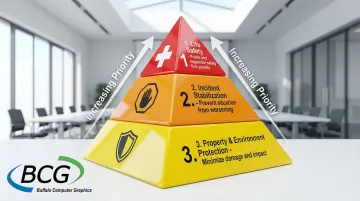
Objectives are prioritized consistently:
- Life safety (public and responder safety comes first)
- Incident stabilization (prevent the situation from worsening)
- Property and environment protection (minimize damage and impact)
These priorities ensure consistent decision-making even when different agencies bring different perspectives to Unified Command.
Implementing ICS in Your Organization
Successful ICS implementation requires more than understanding the structure—it demands deliberate preparation, training, and relationship-building before emergencies occur.
Pre-Incident Planning and Preparation
ICS effectiveness depends on planning and training before incidents occur. Organizations should:
- Define ICS structure, roles, and coordination protocols in Area Contingency Plans
- Pre-designate personnel for key ICS positions based on qualifications
- Establish mutual aid agreements clarifying ICS implementation protocols
- Conduct tabletop exercises and full-scale drills with partner agencies
Regular exercises reveal gaps in plans, protocols, and training while building the working relationships that enable effective Unified Command during actual emergencies.
Integration with Technology Solutions
Technology strengthens ICS implementation when paired with proper training. Modern incident management software supports this by:
- Automating IAP generation with FEMA-aligned templates
- Providing real-time resource tracking for Operations and Logistics
- Enabling integrated communications across agencies and jurisdictions
- Maintaining documentation with version control and audit trails
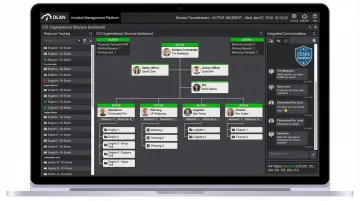
FEMA-compliant systems like DisasterLAN provide standardized platforms that align with NIMS and ICS principles. Buffalo Computer Graphics' DLAN became the first and only incident management system evaluated by FEMA's NIMS STEP program as fully compliant with ICS principles and interoperability standards.
The platform includes all FEMA ICS forms, supports role-based workflows for each ICS position, and provides template-guided Incident Action Plans that reduce preparation time from hours to minutes.
Technology benefits include:
- Reduced manual paperwork and administrative burden
- Improved situational awareness through real-time dashboards and GIS integration
- Enhanced decision-making speed with instant access to current information
- Seamless coordination across distributed teams and agencies
Building Multi-Agency Partnerships
Beyond technology and training, effective ICS relies on trust, communication, and shared commitment to common objectives. Organizations must establish these relationships before emergencies strike.
Recommended partnership-building activities:
- Conduct joint training sessions with partner agencies
- Develop memoranda of understanding that clarify roles, responsibilities, and authorities
- Participate in regional planning committees and working groups
- Share resources and best practices during non-emergency periods
- Understand each agency's capabilities, constraints, and legal authorities
When command staff from different agencies have worked together during exercises and planning sessions, establishing Unified Command during actual incidents becomes natural rather than awkward.
ICS Training and Certification Requirements
Effective incident response depends on properly trained personnel who understand ICS structure and their specific roles. FEMA's Emergency Management Institute provides the official curriculum for ICS training through a progressive pathway that builds knowledge and skills systematically.
Overview of ICS Course Levels
| Course Level | Target Audience | Format | Key Content | Typical Requirement |
|---|---|---|---|---|
| ICS-100 | All emergency responders and support personnel | 3-4 hour online (free) | ICS history, features, principles, basic concepts | Foundation for all higher-level training |
| ICS-200 | Personnel likely to assume supervisory positions | Online (free) | Leadership, management, ICS structure, resource management | Required for all emergency responders |
| ICS-300 | Middle management and supervisors | Classroom-based (G-Course) | IAP development, resource management, multi-agency coordination | Required for supervisory roles in complex incidents |
| ICS-400 | Senior command and general staff | Classroom-based (G-Course) | Area Command, MACS, complex incident management | Required for Command and General Staff positions |
Position-Specific Training
After completing foundational courses, emergency personnel need specialized training for their anticipated ICS roles. Position Task Books (PTBs) document the competencies and tasks personnel must demonstrate to be qualified for specific positions.
The qualification process involves:
- Completing required training courses
- Working with a coach/evaluator during incidents or exercises
- Demonstrating all tasks in the PTB through observed performance
- Receiving certification from the Authority Having Jurisdiction
This qualification process ensures qualified personnel possess consistent capabilities regardless of their home agency.
Ongoing Training and Exercises
ICS proficiency requires regular refresher training and practical application. Organizations should:
- Conduct annual refresher training for all ICS-qualified personnel
- Participate in exercises at local, state, and federal levels
- Rotate personnel through different ICS positions during exercises to build versatility
- Document lessons learned and adjust training based on exercise outcomes
Research confirms that ICS effectiveness depends on consistent training and organizational culture alignment, making ongoing practice essential for maintaining proficiency. Many agencies use FEMA NIMS-compliant incident management software during exercises to provide realistic training environments that mirror actual incident operations, helping teams build familiarity with the tools they'll use during real emergencies.
Benefits of ICS for Emergency Management
Organizations that fully implement ICS realize measurable improvements in emergency response effectiveness. These benefits span coordination, scalability, and safety:
- Clearer command structure eliminating confusion across agencies
- Flexible scaling from single-agency incidents to multi-state disasters
- Enhanced responder safety through formal accountability systems
Enhanced Coordination and Communication
ICS eliminates confusion by establishing clear command structure, common terminology, and integrated communications. Research confirms that ICS delivers clearer leadership and improved interagency coordination, leading to faster decisions and more effective resource deployment.
When all agencies use the same organizational structure, position titles, and communication protocols, personnel from different jurisdictions integrate seamlessly into unified operations.
This interoperability becomes critical during major disasters when mutual aid resources arrive from across the country.
Scalability and Flexibility
ICS works for incidents of any size—from single-agency local emergencies to multi-state disasters. The modular structure allows organizations to scale up or down as needed, activating only the positions required for current objectives.
The 2017 Thomas Fire demonstrated this scalability, with ICS successfully managing thousands of personnel across local, state, and federal agencies through Unified Command.
The same system that manages a structure fire with five personnel expands to coordinate disaster response involving thousands.
Improved Safety and Accountability
ICS principles enhance responder safety through:
- Unity of command ensuring personnel receive clear direction from one supervisor
- Manageable span of control preventing supervisor overload
- Dedicated Safety Officer focused exclusively on identifying and mitigating hazards
- Formal safety planning through ICS 208 Safety Plans
Clear documentation and resource tracking ensure accountability throughout the response, from initial deployment through demobilization and after-action review. ICS-compliant incident management systems help agencies maintain this documentation trail while supporting real-time coordination during active incidents.
Frequently Asked Questions
How does the Incident Command System (ICS) work?
ICS uses five core functions—Command, Operations, Planning, Logistics, and Finance/Administration—working together under standardized procedures. The Incident Commander sets objectives, Planning develops action plans, Operations executes tactics, while Logistics and Finance provide support and cost tracking.
What are the main components of the Incident Command System (ICS)?
The five main components are Command (overall management and objective-setting), Operations (tactical response execution), Planning (information collection and action planning), Logistics (resources and support services), and Finance/Administration (cost tracking and administrative functions).
How long is the ICS 100 course?
ICS-100 is typically a 3-4 hour online course offered free by FEMA, covering ICS basics including history, principles, and organizational structure. It's required for all emergency response personnel as the foundation for higher-level ICS training.
When should an organization use Unified Command instead of a single Incident Commander?
Unified Command is used when multiple agencies or jurisdictions share authority and responsibility for an incident—such as when a hazmat spill crosses county lines, when federal and state agencies respond to the same disaster, or when an incident requires coordination between fire, law enforcement, and public health agencies with overlapping jurisdictions.
What is an Incident Action Plan (IAP) and why is it important?
An IAP defines incident objectives, strategies, tactics, and resource assignments for a specific operational period (typically 12-24 hours). It ensures all responders work toward common goals, coordinating efforts across agencies. Systems like BCG's DLAN provide template-guided IAPs aligned with FEMA guidelines to streamline this critical planning process.