Introduction
Picture this: A multi-vehicle collision on a major interstate triggers a cascade of 911 calls. Within minutes, fire engines, ambulances, law enforcement units, and utility crews converge on the scene from three different jurisdictions.
The incident commander arrives to find responders from six agencies, each with their own radio channels, tactical worksheets, and command protocols. Resources are deployed, personnel accountability boards fill up with magnetic tags, and someone scrambles to find a dry-erase marker that actually works.
This scenario plays out daily across emergency response operations nationwide. Traditional paper-based Incident Command System (ICS) methods—tactical worksheets, whiteboards, and radio communications—create information silos that slow decision-making and compromise safety.
Research demonstrates that paper-based triage methods are "time-consuming and error-prone," often resulting in incomplete information transmission to command posts. ICS mobile apps address these challenges by digitizing command and control, enabling real-time collaboration across agencies, and ensuring NIMS compliance through standardized digital platforms accessible from any smartphone or tablet on scene.
TLDR:
- ICS mobile apps digitize traditional command operations, replacing paper forms with real-time digital platforms
- Mobile systems complete triage 18 minutes faster than paper methods with higher accuracy
- Offline functionality is essential—wireless outages increased from 189 to 1,079 incidents over three years
- NIMS compliance ensures interoperability across jurisdictions and agencies
- Automated documentation reduces post-incident administrative burden
What Are ICS Mobile Apps for Emergency Response?
ICS mobile apps are digital platforms that bring the Incident Command System structure to smartphones and tablets, enabling field-based emergency management without paper documentation constraints.
These applications digitize the tactical worksheets, resource tracking boards, and communication logs that incident commanders have used for decades.
The National Incident Management System (NIMS) defines ICS as a standardized approach to command, control, and coordination that allows personnel from different organizations to work together effectively. Modern ICS mobile apps translate these principles into software that runs on devices already in responders' pockets.
Key digitized components include:
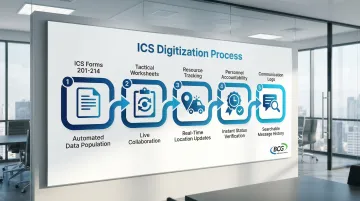
- ICS forms (201, 202, 203, 204, 205, 214) with automated data population
- Tactical worksheets with real-time updates across all devices
- Resource tracking with GPS location integration
- Personnel accountability with automated time-stamping
- Communication logs with searchable incident history
From Paper to Mobile: The Digital Evolution
The shift from paper to digital has accelerated dramatically. Early command boards required physical presence at the command post, while web-based platforms remained tethered to laptops.
Today's mobile-capable systems work online and offline, synchronizing data automatically when connectivity returns. This proves critical when major carrier outages can last 12+ hours.
This technological evolution has driven real-world implementations across emergency management agencies. Buffalo Computer Graphics' DisasterLAN (DLAN) demonstrates this progression. Since 2002, when Erie County emergency managers requested a digital alternative to paper systems, DLAN has grown into a comprehensive platform serving agencies across the U.S. and Canada.
In 2011, DLAN became the first and only incident management system evaluated by FEMA's NIMS STEP program as fully compliant with all 24 NIMS concepts and principles.
Key Benefits of ICS Mobile Apps in Emergency Management
Enhanced Real-Time Situational Awareness
Traditional command posts operate with delayed information. Radio reports arrive intermittently, paper logs require manual updates, and tactical worksheets become outdated the moment conditions change.
ICS mobile apps eliminate these delays by providing live operational pictures accessible from anywhere on scene.
Research confirms that digital systems allow command posts to receive information in real-time, enabling critical decisions to be made sooner compared to radio/paper methods where updates are intermittent. Incident commanders can view resource locations, personnel assignments, weather conditions, and changing incident parameters on a single dashboard that updates automatically as field personnel enter data.
Beyond speed, shared visibility transforms coordination. When all responders view the same dashboard, information gaps between command post, field supervisors, and EOC staff disappear.
Key capabilities include:
- Real-time asset and weather visualization through integrated GIS mapping
- Live dashboards accessible to all authorized personnel
- Simultaneous monitoring of multiple incident locations
- Automatic updates as field personnel enter data
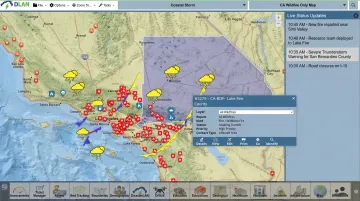
DLAN's Common Operating Picture delivers these capabilities, allowing teams to maintain unified situational awareness throughout complex incidents.
Improved Multi-Agency Coordination
Multi-jurisdictional incidents expose the weaknesses of agency-specific systems. Each organization arrives with different forms, protocols, and communication methods, turning unified command into a negotiation over whose paperwork to use.
ICS mobile apps solve this by providing standardized NIMS-compliant platforms that all responding agencies can access regardless of their home organization. NIMS guides all levels of government, nongovernmental organizations, and the private sector to work together using common terminology and management structures.
Standardized platforms enable:
- Common operational picture across all responding agencies
- Role-based access controls that protect sensitive information
- Shared terminology and management structures
- Seamless collaboration without sacrificing operational security
During the 2015 Toronto PanAm Games, the City of Toronto used DLAN to coordinate security, transportation, and emergency services across multiple venues and jurisdictions—demonstrating how standardized platforms enable complex coordination in practice.
Stronger Personnel Accountability and Safety
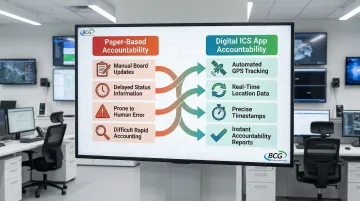
NFPA 1561:2020 explicitly requires emergency services organizations to "adopt and routinely use a system to maintain accountability for all resources" and implement "a process for the rapid accounting of all responders at the incident scene." Yet NIOSH fatality investigations identified "lack of accountability" as a contributing factor in 41 firefighter deaths between 2010-2018.
Digital accountability systems address these failures through automated tracking that doesn't rely on manual updates during high-stress incidents.
ICS mobile apps track personnel assignments, entry times, and location data with GPS integration. DLAN's Asset Tracking system provides real-time personnel monitoring through the Mobile Responder App, creating automatic assignment logs and location histories that incident commanders can access instantly.
Digital logging extends these safety advantages to critical event documentation. Mayday calls, evacuation orders, and personnel accountability reports create auditable records with precise timestamps—essential for both immediate response coordination and post-incident investigation.
Faster Decision-Making with Better Data
Speed matters in emergency response. In controlled studies, emergency personnel using mobile apps were significantly faster—over 18 minutes on average—when triaging 30 patients compared to paper tools. The study concluded that app-based systems enable triage to be completed "more quickly, easily, and accurately."
This speed comes from instant access to critical information. Incident commanders can query resource inventories, view facility pre-plans, check weather forecasts, and review tactical objectives without radio requests or phone calls. DLAN integrates external data sources including weather services, GIS layers, and sensor feeds directly into dashboards, eliminating the need to switch between multiple systems.
Automated time-stamping reduces administrative burden during active incidents. Instead of manually logging every resource request and tactical decision, the system captures this information automatically as users complete tasks and update status—preserving data for immediate decision support and future analysis.
Streamlined Post-Incident Reporting and Compliance
FEMA guidance states that documentation creates historical records, supports cost recovery, and addresses insurance needs. Yet compiling after-action reports from paper logs, radio transcripts, and scattered notes consumes hours of administrative time.
ICS mobile apps automatically generate after-action reports from data captured during incidents. DLAN is "after-action ready by default," capturing incident data, actions, and decisions as events unfold. The Analytics & Reporting module turns operational data into exportable PDF and Excel reports without manual compilation.
This automated approach ensures compliance with NIMS documentation requirements while freeing command staff to focus on operational priorities rather than paperwork. The archived incident data supports training exercises, policy improvements, and regulatory compliance—creating value long after the incident concludes.
Essential Features of ICS Mobile Apps
Modern ICS mobile applications must deliver specific capabilities to support effective emergency response. Understanding these essential features helps agencies evaluate platforms and ensure their technology investment meets operational needs.
NIMS/ICS Compliance and Standardization
FEMA NIMS compliance isn't optional—it's the foundation for interoperability during mutual aid responses. NIMS provides the framework for standardized processes including common terminology, modular organization, and unified command structures.
Quality ICS mobile apps generate standard NIMS ICS forms (202, 203, 205, 208) that form core parts of Incident Action Plans. The forms must follow FEMA templates while allowing digital efficiency improvements like auto-population and data validation.
DisasterLAN (DLAN) by Buffalo Computer Graphics stands alone as the first and only incident management system evaluated by FEMA's NIMS STEP program as fully compliant with NIMS and ICS principles. This October 2010 evaluation confirmed DLAN's consistency with all 24 NIMS concepts and principles across emergency support, hazards, preparedness, communications, resource management, and command functions—establishing it as the gold standard for agencies requiring certified interoperability.
Offline Functionality and Data Synchronization
Network reliability during disasters is questionable at best. GAO reported that mobile wireless outages increased substantially from 189 to 1,079 over a multi-year period, and a nationwide AT&T outage in February 2024 lasted at least 12 hours.
Quality ICS apps must provide full functionality without internet connectivity. DLAN's Mobile Responder App operates completely offline, storing data locally through "store and forward" capability.
Field personnel can complete damage assessments, resource requests, and spot reports in remote locations, with all data automatically synchronizing once connectivity returns.
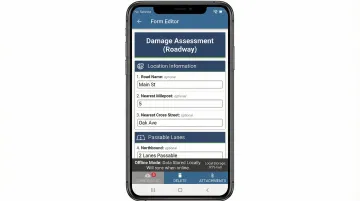
This offline-first architecture ensures operational continuity regardless of network conditions—a non-negotiable requirement for disaster response when infrastructure is most likely to fail.
Mobile-Optimized Interface for Tablets and Smartphones
NIST research emphasizes that "typing on small onscreen keyboards will not be possible for first responders wearing protective gloves" and recommends avoiding soft keyboards for primary input in moving vehicles or field conditions.
Effective mobile ICS apps require touch-friendly interfaces designed for use with gloves, in vehicle mounts, and under challenging environmental conditions. Responsive design ensures consistent functionality whether responders use iPads, Android tablets, or smartphones.
The Mobile Responder App works across iOS, Android, and Windows platforms with interfaces optimized for field operations. The simple form interface allows rapid data entry even in disaster areas, with GPS-tagged photo and video uploads that capture location data automatically.
Real-Time Collaboration and Communication Tools
Information sharing can't wait for shift briefings. ICS mobile apps need built-in communication features—status boards, tactical messaging, resource requests, and shared operational pictures—that keep all responders informed simultaneously.
DLAN provides unified communication workflows across entire organizations with role-based access controls ensuring appropriate information visibility for different command positions.
The Status Board combines information from multiple internal and external sources into interactive dashboards, displaying everything from DLAN reports to ArcGIS feeds and social media monitoring in one unified view.
Integration with CAD, RMS, and Emergency Systems
Beyond internal communication, effective systems must connect with the broader technology ecosystem. Duplicate data entry wastes time and introduces errors.
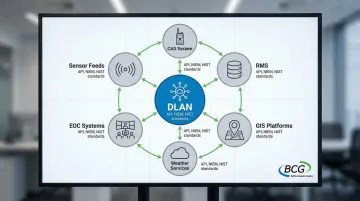
Quality ICS mobile apps integrate with existing computer-aided dispatch, records management systems, and EOC platforms to eliminate redundant work:
- Automatic incident data transfer from CAD systems eliminates manual entry
- API connections with RMS, GIS platforms, and external data sources ensure data consistency
- Pre-incident imports of facility plans, contact lists, and resource inventories provide immediate access to critical information
Modern incident management software commonly integrates with CAD systems to receive incident data automatically.
DLAN's integration architecture follows NIEM and NIST guidelines with common protocols for meaningful information exchange. This standards-based approach ensures compatibility across multiple platforms and agencies.
Customizable Forms, Templates, and Workflows
Agencies need flexibility to adapt ICS forms and workflows to specific operational procedures while maintaining NIMS compliance. DLAN supports custom forms created either by Buffalo Computer Graphics' engineering team or through their premium administrative toolset.
Template-guided Incident Action Plans streamline plan development using FEMA-aligned templates that agencies can customize for organizational needs. The Ticket Wizard provides step-by-step guided data entry for specialized task types, helping infrequent users complete forms correctly without extensive training.
Real-World Applications and Use Cases
ICS mobile apps prove their value across diverse emergency scenarios, from natural disasters to tactical operations. Understanding these applications helps agencies recognize how mobile command capabilities can improve their specific operational contexts.
Wildfire and Natural Disaster Response
Wildfire Incident Action Plan maps are the primary tool for field operations, essential for firefighter safety and communicating objectives. Digital IAP maps on mobile devices display assignments and safety concerns for strike teams operating across vast geographic areas.
DLAN's wildfire management tools include satellite fire detection, thermal hotspot analysis, drone imagery integration, and evacuation route planning.
The Mobile Responder App's offline functionality allows field personnel to work in remote locations without connectivity, automatically syncing data when they return to base camp.
During hurricane, flood, and earthquake responses, mobile command capabilities support coordination despite damaged infrastructure. Rochester Emergency Management used DLAN to turn static flood-plain data into dynamic map layers during a major rain event, improving decision-making when traditional communication systems were strained.
Multi-Agency Law Enforcement and Tactical Operations
Complex operations demand the same real-time coordination, whether responding to natural disasters or law enforcement incidents. SWAT teams, active shooter responses, and special events security require seamless coordination across law enforcement, fire, and EMS agencies.
ICS mobile apps provide critical capabilities:
- Tactical planning functions for multi-agency operations
- Resource management across jurisdictional boundaries
- Secure, role-based access controls protecting sensitive information
- Unified command support during civil disturbances
The City of Toronto's successful deployment during the 2015 PanAm Games demonstrated how DLAN manages multiple venues, agencies, and resources for major events.
Hazmat Incidents and Industrial Emergencies
Hazmat teams need instant access to chemical data, decontamination tracking, and hot zone entry time monitoring. Mobile apps provide critical information on emergency response procedures, potential medical hazards, and isolation zones for HazMat/CBRNE events.
The platform integrates facility pre-plans, SDS information, and resource inventories into mobile interfaces, supporting coordination with industrial facility emergency response teams during chemical releases or industrial accidents.
GPS-tagged documentation creates precise records of response activities for regulatory compliance and post-incident investigation.
Healthcare and Mass Casualty Incident Management
In mass casualty incidents, mobile triage systems have proven "at least as useful and reliable" as paper tools, with significant speed advantages. DLAN's HICS-compliant templates support hospitals and EMS agencies managing surge capacity, tracking patient flow, and coordinating with public health during pandemics or mass casualty events.
The platform's hospital bed availability tracking, medical stockpile management, and multi-facility coordination capabilities proved essential during COVID-19. Broome County Office of Emergency Services built custom DLAN dashboards to manage point-of-distribution logistics and supply tracking throughout the pandemic response.
How to Choose the Right ICS Mobile App for Your Agency
Selecting an ICS mobile app requires careful evaluation of operational needs, compliance requirements, and long-term costs. These decision factors help agencies make informed choices that support both immediate needs and future growth.
Assess Your Agency's Specific Needs and Incident Types
Start by documenting typical incident types, mutual aid partnerships, required compliance standards, and existing technology infrastructure. Fire departments need different capabilities than law enforcement agencies, and rural operations face different challenges than urban environments.
Identify must-have features versus nice-to-have capabilities based on operational priorities and budget constraints.
Agencies responding primarily to structure fires need robust personnel accountability, while those managing large geographic areas require strong GIS integration and offline functionality.
Evaluate NIMS Compliance and Interoperability Standards
Prioritize platforms that support standardized ICS forms, NIMS terminology, and interoperable data exchange with partner agencies. FEMA NIMS STEP evaluation provides third-party validation of compliance and interoperability capabilities.
DLAN's distinction as the only platform fully evaluated and approved by FEMA's NIMS STEP program offers agencies confidence in certified interoperability—particularly valuable for departments participating in mutual aid networks or multi-jurisdictional responses where standardization is essential.
Consider Total Cost of Ownership and Licensing Models
Pricing models vary widely across the industry:
- Per-user licensing: $10-$120 per user/device annually
- Setup fees: $1,500-$6,000 depending on vendor
- Subscription-based pricing with recurring costs
- Alternative bandwidth-based models
Buffalo Computer Graphics offers a unique bandwidth-based licensing model rather than per-seat pricing, potentially providing cost advantages for agencies with variable staffing or large mutual aid networks.
This approach allows unlimited users within bandwidth parameters, eliminating the need to purchase additional licenses as personnel rosters change.
Review Security, Support, and Vendor Stability
ISO/IEC 27001 certification, data encryption, and secure hosting options (cloud or on-premise) protect sensitive incident information. Buffalo Computer Graphics holds ISO/IEC 27001:2013 certification. The company offers both cloud-based SaaS deployment and secure on-premise options for agencies with data sovereignty requirements.
Look for vendors with proven track records, U.S.-based development and support teams, and long-term stability. BCG's 43 years in emergency management software, continuous operation since 2002 with DLAN, and 24/7 customer support demonstrate the stability essential for mission-critical systems. The company's privately-held structure ensures they answer to customers rather than external stakeholders—an important distinction when long-term product support matters.
Frequently Asked Questions
What is the difference between an ICS mobile app and emergency management software?
ICS mobile apps focus specifically on field-based incident command following NIMS/ICS structure, optimized for on-scene use. Emergency management software covers broader functions including preparedness planning and training. Comprehensive platforms like DLAN include both mobile field operations and EOC coordination capabilities.
Do ICS mobile apps work without internet or cell service?
Quality ICS mobile apps offer full offline functionality, storing data locally and synchronizing automatically when connectivity returns. DLAN's Mobile Responder App operates completely offline through "store and forward" capability, ensuring field operations continue regardless of network conditions.
How long does it take to train personnel on ICS mobile apps?
User-friendly ICS apps require minimal training (2-4 hours) for personnel already familiar with ICS principles, focusing on the digital interface rather than new command concepts. Platforms like DLAN offer comprehensive training services including exercise support for ongoing proficiency.
Can ICS mobile apps integrate with our existing CAD and RMS systems?
Modern ICS platforms use open APIs to connect with CAD, RMS, EOC software, and GIS systems. DLAN follows NIEM and NIST guidelines for meaningful information exchange, and Buffalo Computer Graphics provides custom engineering services for specialized integration needs.
What does NIMS compliance mean for ICS mobile apps?
NIMS compliance means adherence to FEMA's National Incident Management System standards including ICS organizational structure, common terminology, standardized forms, and interoperable communications. DLAN is the only platform evaluated as fully compliant with all 24 NIMS concepts through FEMA's NIMS STEP program.
How much do ICS mobile apps typically cost?
Pricing varies based on agency size, features, deployment model, and licensing structure. Options range from subscription-based per-user models to Buffalo Computer Graphics' bandwidth-based pricing, which offers advantages for agencies with variable staffing. Total cost of ownership includes licensing, training, maintenance, and integration.