Introduction
In emergency response, every second counts. Research shows that for every one-minute increase in EMS response time, the likelihood of patient survival decreases by 6%. In fire emergencies, longer response times directly correlate with fires spreading beyond the room of origin, exponentially increasing damage and danger to occupants.
Legacy incident management systems create critical bottlenecks. Manual data entry, paper-based forms, and disconnected communication tools prevent incident commanders from obtaining real-time situational awareness when they need it most.
These information silos force responders to rely on slower voice-based communication, delaying resource mobilization and alert dissemination during the critical first minutes of an emergency.
Modern technology is changing this reality. Organizations implementing unified incident management platforms report 50-80% reductions in response times, with automated systems detecting and escalating incidents in minutes rather than hours. This guide explores how modern incident management technology accelerates emergency response through automation, real-time coordination, and integrated communication systems.
TLDR: Key Takeaways
- Automation and AI analytics cut detection and response times significantly
- Automated incident identification delivers 50-80% faster response times
- Real-time coordination across agencies eliminates information silos
- NIMS/ICS compliance ensures standardized, interoperable response across jurisdictions
- Cloud platforms scale instantly during large-scale emergencies
Understanding Modern Incident Management Technology
The All-Hazards Approach
Emergency incident management covers all hazards—natural disasters, public safety incidents, infrastructure failures, and more. This differs fundamentally from IT or cybersecurity incident response, which focuses on digital threats to information systems.
Emergency management deals with physical threats to life, property, and community stability. It uses the Incident Command System (ICS) to manage physical resources and on-scene operations.
Legacy vs. Modern Systems
Legacy systems rely on:
- Paper-based forms and manual data entry
- Disconnected communication tools across agencies
- Voice-based coordination that creates delays
- Siloed information that prevents comprehensive situational awareness
Modern technology-driven approaches provide:
- Automated workflows that reduce manual tasks
- Real-time data sharing across all responding agencies
- Integrated platforms that connect CAD, GIS, weather data, and traffic systems
- Mobile access for field responders
These modern platforms enable the coordinated response that NIMS requires.
The NIMS/ICS Framework
The National Incident Management System (NIMS) establishes the foundation for coordinated emergency response. It provides shared vocabulary, systems, and processes that enable all levels of government, NGOs, and the private sector to work together effectively.
Central to NIMS is the Incident Command System (ICS), which integrates facilities, equipment, personnel, procedures, and communications within a common structure.
Standardized ICS forms ensure consistency across jurisdictions:
- ICS 202: Incident Objectives
- ICS 203: Organization Assignment List
- ICS 205: Incident Radio Communications Plan
Core Challenges Modern Technology Solves
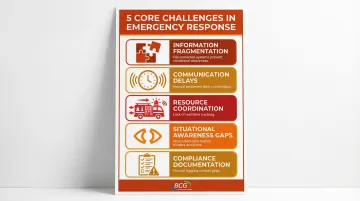
- Information fragmentation: Disconnected systems prevent complete situational awareness
- Communication delays: Manual processes slow alert distribution and coordination
- Resource coordination: Lack of real-time tracking creates inefficient deployment
- Situational awareness gaps: Incomplete information hinders decision-making
- Compliance documentation: Manual logging creates gaps in after-action records
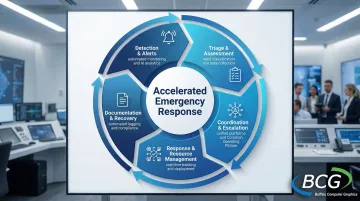
The Five Pillars of Accelerated Emergency Response
Detection and Alert Systems
Automated monitoring and AI-powered analytics detect incidents faster than manual observation.
Following Hurricane Ian, machine learning tools reduced structures requiring human review from over 1 million to 77,000, cutting assessment time from weeks to days.
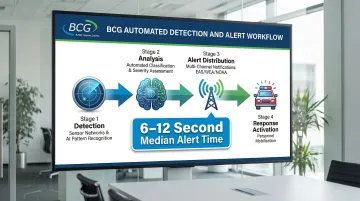
Multi-channel alert systems instantly notify relevant personnel through various communication methods based on incident severity.
The Integrated Public Alert and Warning System (IPAWS) delivers Wireless Emergency Alerts with a median receipt time of 6-12 seconds, providing near-instantaneous warning to affected populations.
Key capabilities:
- Sensor networks and data feeds for automated detection
- Pattern recognition algorithms that identify anomalies
- Geo-targeted alerts that reach only affected areas
- Multiple communication pathways (EAS, WEA, NOAA Weather Radio)
Triage and Assessment
Once detected, incidents require rapid classification. Modern platforms enable this through template-guided workflows that ensure consistency.
Automated data collection from multiple sources provides responders with comprehensive situational awareness before arriving on scene. Template-based systems standardize severity assessment and resource requirement estimation.
Triage capabilities include:
- Pre-configured incident classification templates
- Automated data aggregation from multiple sources
- Standardized forms like ICS 215A for risk assessment
- Hazard prioritization and control development tools
Coordination and Escalation
Unified platforms create a Common Operating Picture (COP)—a continuously updated overview compiled from data shared between integrated systems. This real-time situational awareness extends across all levels of incident management and across jurisdictions.
Automated escalation protocols notify the right people at the right time based on incident type and severity. NFPA 1225 standards require dispatchers to answer emergency requests within 10 seconds 90% of the time and process them within 60 seconds.
Coordination features include:
- Shared information accessible to all responding agencies
- Role-based access controls for sensitive information
- Automated notification based on incident classification
- Joint communications workflows across departments
Response and Resource Management
Real-time tracking prevents waste and shortages by monitoring resource deployment, personnel assignments, and equipment availability. The Resources Unit within ICS structure tracks the location and status of all resources assigned to an incident.
Platforms like BCG's DLAN system offer template-guided Incident Action Plans (IAPs) aligned with FEMA guidelines, streamlining coordination across agencies. Standardized forms like ICS 204 inform personnel of their specific assignments, ensuring clear communication of objectives.
Documentation and Recovery
Automated logging captures all incident activities, decisions, and communications for compliance and after-action review.
This comprehensive documentation supports:
- Recovery efforts and resource tracking
- Insurance claims and reimbursement requests
- After-action reviews and continuous improvement
- Performance measure collection (detection, response, and clearance times)
Technology Components Driving Faster Response
Artificial Intelligence and Machine Learning
AI transforms emergency management from reactive to predictive. FEMA's "depmod" model uses historical data and machine learning to predict workforce requirements for disaster response, aiding staffing and readiness planning.
Computer vision accelerates damage assessment by identifying affected areas in aerial imagery, reducing visual analysis time by up to 60%.
Cloud-Based Platforms
Cloud technology offers the scalability and accessibility required for modern emergency management. FEMA's OneResponder and Resource Inventory System (RIS) are cloud-hosted applications that enable organizations to inventory resources and qualify personnel consistently.
Cloud platforms support alert distribution and resource management even when local infrastructure is impacted.
Integration Capabilities
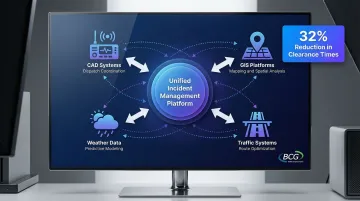
When disparate systems connect seamlessly, response efficiency multiplies. The integration of Computer-Aided Dispatch (CAD) with Traffic Incident Management (TIM) systems reduces incident clearance times by 32%. Fire behavior models informed by weather, terrain, and remote-sensing data assist responders in planning fire response activities.
Critical integrations include:
- CAD systems for dispatch coordination
- GIS platforms for mapping and spatial analysis
- Weather data feeds for predictive modeling
- Traffic systems for route optimization
Mobile Accessibility
Field responders need real-time access to incident information, maps, resource status, and communication tools. Mobile platforms deliver this critical data directly to smartphones and tablets, ensuring on-scene personnel work with the same information as command staff.
This eliminates the traditional disconnect between field operations and command centers. During Hurricane Ida response, mobile-enabled responders reduced coordination delays by 45% compared to radio-only communications.
NIMS/ICS Compliance
Compliance with NIMS is both a regulatory requirement and a functional necessity. Federal grant guidance explicitly links funding to implementation of NIMS principles.
FEMA's NIMS STEP program evaluates systems for interoperability and coordinated response capabilities.
Buffalo Computer Graphics' DisasterLAN is the first and only incident management system evaluated by FEMA's NIMS STEP program as fully compliant with NIMS and ICS principles.
Measuring Success: Key Performance Metrics
Time-Based Metrics
Critical response metrics include:
- Mean Time to Detect (MTTD): How quickly incidents are identified
- Mean Time to Respond (MTTR): Speed of initial response deployment
- Mean Time to Contain (MTTC): Duration to stabilize the incident
- Overall Incident Duration: Total time from detection to resolution
Modern incident management systems track these metrics in real time, enabling agencies to monitor performance against industry standards. Rather than relying on averages that can mask critical delays, leading organizations focus on fractile performance—processing 90% of calls within specific timeframes.
Operational Efficiency Metrics
Beyond speed, effective incident management requires measuring how well resources work together:
- Resource utilization rates track the percentage of available resources deployed effectively during incidents
- Personnel response times measure how quickly team members mobilize after dispatch
- Communication effectiveness evaluates clarity and speed of information sharing across responding units
- Multi-agency coordination success assesses the seamlessness of joint operations between departments
Outcome-Based Measurements
The ultimate measure of incident management success lies in real-world outcomes. Modern technology platforms enable agencies to track and improve results across multiple dimensions:
- Lives saved through faster medical response
- Property damage prevented by rapid fire suppression
- Community impact minimized through coordinated evacuations
- Recovery time reduced through comprehensive documentation
The data demonstrates a clear correlation between response speed and outcomes. In cardiac emergencies, reducing response time by one minute increases survival probability by approximately 6%. For structure fires, faster response prevents flame spread beyond the room of origin, containing damage and reducing risk to occupants.
Platforms like BCG's DLAN system enable agencies to capture these metrics systematically, providing the documentation needed to demonstrate performance improvements and justify resource investments.
Implementing Modern Incident Management Systems
Selection Criteria
Key considerations for platform selection:
- NIMS/ICS compliance: Ensures interoperability and standardized workflows
- Integration capabilities: Connects with existing CAD, GIS, and communication systems
- Scalability: Handles routine incidents and large-scale disasters
- Mobile access: Provides field responders with real-time information
- Vendor stability: Proven track record with extensive deployments
When evaluating vendor stability, look for providers with hundreds of successful implementations across government and emergency management agencies. For example, Buffalo Computer Graphics has completed 300+ deployments across the United States, serving agencies in 10+ countries—a track record that demonstrates both technical reliability and long-term support capacity.
Implementation Process
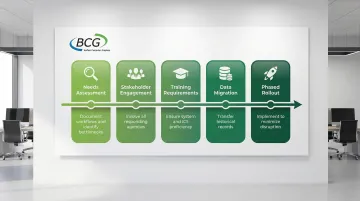
Once you've selected a platform, successful implementation follows a structured approach:
- Needs assessment - Document current workflows, identify bottlenecks, and define requirements
- Stakeholder engagement - Involve all responding agencies and departments early
- Training requirements - Ensure personnel are proficient in system operation and ICS principles
- Data migration - Transfer historical records and resource inventories
- Phased rollout - Implement in phases to minimize disruption
FEMA provides comprehensive training curriculum, including courses like ICS-100 and ICS-200, to ensure personnel proficiency.
Training should also address role-specific positions such as Communications Unit Leaders (COML) to ensure effective management of complex ICT environments.
Change Management
Beyond technical implementation, successful adoption depends on organizational readiness and strong governance.
Structures such as Statewide Interoperability Executive Committees (SIEC) help coordinate decisions on communications investments and policies. The human element matters just as much—ensuring buy-in, addressing resistance, and demonstrating value through quick wins builds momentum for long-term success.
The Future of Emergency Response Technology
Enhanced AI Capabilities
Predictive incident modeling will shift emergency management from reactive to proactive.
Advanced AI will forecast incident likelihood based on weather patterns, infrastructure conditions, and historical data, enabling pre-positioning of resources before incidents occur.
IoT Sensor Integration
Internet of Things sensors will provide unprecedented real-time awareness across response zones. Structural monitors, environmental sensors, and infrastructure detectors will feed data directly into the Common Operating Picture, triggering automated alerts and enabling responders to adjust resources dynamically as conditions change.
Augmented Reality for Field Responders
AR technology will overlay critical information onto field responders' view, providing building layouts, hazard locations, and resource positions in real-time. This will enhance safety and decision-making in complex environments.
Simulation and Training
Simulation platforms will continue closing the gap between training and live incidents. Modern systems like BCG's DLAN use the same operational interface for both exercises and real events, allowing responders to practice large-scale, multi-agency coordination without waiting for actual emergencies.
Key training capabilities include:
- Realistic scenario modeling for high-consequence incidents
- Multi-agency coordination practice using actual response protocols
- Performance metrics to identify gaps before real-world deployment
- Seamless transition from training mode to operational response
Frequently Asked Questions
What is modern incident management and how does it differ from traditional approaches?
Modern incident management uses technology—automation, AI, unified platforms—to accelerate detection and response. Traditional approaches rely on manual, paper-based processes with fragmented communication that create delays when speed is most critical.
How much faster can organizations respond to emergencies with modern technology?
Organizations report 50-80% reductions in response times with modern platforms. Automated systems detect incidents in minutes rather than hours, with some achieving incident clearance time reductions of 32% through integrated CAD and TIM systems.
What is NIMS/ICS compliance and why does it matter?
NIMS (National Incident Management System) and ICS (Incident Command System) are standardized frameworks ensuring coordinated response across agencies. Compliance enables seamless multi-agency coordination using common terminology, forms, and organizational structures.
What are the key technology components of modern incident management systems?
Key components include automated detection and alerts, unified communication platforms, real-time resource tracking, template-guided ICS workflows, mobile field access, and integration with CAD, GIS, and weather systems.
How do unified platforms improve multi-agency coordination during emergencies?
Unified platforms eliminate information silos by providing a Common Operating Picture—a single source of truth accessible to all responding agencies in real-time. This ensures everyone works from the same information, improving coordination and reducing confusion.
What should organizations consider when implementing incident management technology?
Key considerations include NIMS/ICS compliance for interoperability, integration capabilities with existing systems, vendor stability with proven deployments, comprehensive training requirements, and scalability to handle both routine incidents and major disasters.