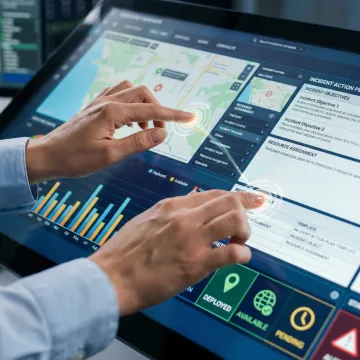
What types of damage can your emergency management system track?
BCG's DLAN platform tracks all types of incident-related damage including infrastructure damage (roads, bridges, utilities), property damage (residential and commercial structures), environmental impacts, casualties and injuries, resource deployment, and operational costs. The system provides customizable damage assessment forms aligned with FEMA guidelines and supports photo/video documentation, GPS coordinates, and real-time damage severity mapping for comprehensive situational awareness.
Is the system compliant with NIMS and ICS standards?
Yes. BCG's DLAN is the first and only incident management system evaluated by FEMA's NIMS STEP program as fully compliant with NIMS and ICS principles and interoperability communications standards. The platform supports standardized ICS organizational structures, role-based access controls, template-guided Incident Action Plans aligned with FEMA guidelines, and seamless documentation for federal reimbursement processes.
Can the damage tracking system integrate with our existing emergency management tools?
Absolutely. BCG offers comprehensive interoperability and integration services to connect DLAN with your existing systems including CAD/RMS platforms, GIS mapping tools, mass notification systems, weather monitoring services, and resource management databases. Our in-house engineering team has decades of experience developing custom integrations, and if a requested integration benefits multiple customers, it may be developed at reduced or no cost.
What deployment options are available for the system?
BCG offers flexible deployment options including cloud-hosted solutions for rapid deployment and ease of maintenance, or on-premises installations for organizations with strict data sovereignty or security requirements. Both options are backed by ISO/IEC 27001:2013 certification and can be configured to meet your specific security policies, compliance requirements, and IT infrastructure constraints.
What level of training is required to use the damage tracking system?
BCG provides comprehensive role-based training tailored to your organization's needs. Training includes system basics for all users, advanced modules for administrators and planners, scenario-based exercises using your actual response plans, and specialized ICS training delivered by trainers certified through ICS 400 level with real-world emergency management experience. The platform also includes built-in help tools, training videos, and step-by-step guides accessible anytime.
What support is available during an actual emergency activation?
Support varies by maintenance package. Silver level includes 2 cases per year of 24/7 emergency activation phone support. Gold level provides 4 cases per year with 24/7 patching support. Platinum level offers 8 cases per year plus 8 hours of onsite support annually. Additionally, our Activation Support service can deploy Incident Management Teams (IMT/IMAT/IMST) directly to your EOC during large-scale incidents to supplement staff and provide just-in-time assistance.
How does your licensing model work compared to per-user pricing?
BCG uses a bandwidth-based licensing model rather than per-seat pricing, which means you pay based on system capacity rather than the number of individual users. This approach eliminates concerns about user limits during large-scale activations when you need to quickly bring additional personnel online. Your license flexes with your organizational needs, allowing unlimited users to access the system during critical incidents without incurring additional per-seat costs or license violations.
How quickly can the system be deployed and operational?
Deployment timelines vary based on your requirements, but BCG's cloud-hosted solution can be activated within days for rapid deployment scenarios. A typical implementation including custom configuration, integration, and comprehensive training takes 4-8 weeks. For complex deployments requiring extensive customization or on-premises installation, timelines extend to 8-12 weeks. BCG's experienced implementation team works closely with you to establish a realistic timeline that minimizes disruption while ensuring thorough training and system validation.