Introduction
In 2025, enterprise crisis management spans an unprecedented spectrum of threats—from sophisticated cyberattacks and natural disasters to operational disruptions and public safety emergencies. With FEMA issuing 92 major disaster declarations in FY 2024 alone, averaging a new declaration every 1.8 days, the operational tempo of modern emergency response has reached critical levels.
The financial stakes are equally severe. Large enterprises face average downtime costs of $23,750 per minute: over $1.4 million per hour of delayed response.
Enterprise-level organizations require integrated incident response solutions that enable seamless coordination across departments, agencies, and jurisdictions while maintaining real-time situational awareness. Yet many organizations lack adequate crisis management platforms capable of handling this complexity.
The challenge isn't just managing individual incidents—it's coordinating multi-agency responses, maintaining regulatory compliance, and ensuring interoperability across disparate systems during the most critical moments.
To address these challenges, this guide evaluates the top incident response solutions built for enterprise-level crisis management, focusing on platforms that support government agencies, healthcare systems, critical infrastructure operators, and large corporations facing today's complex threat landscape.
Key Takeaways
- Incident response platforms unify cybersecurity, emergency operations, and business continuity for enterprise crisis management
- Selection criteria include NIMS/ICS compliance, multi-agency coordination, real-time integration, and disaster-scale scalability
- Leading platforms serve specialized needs—from government emergency management to healthcare coordination and cybersecurity operations
- Interoperability and support for both planned events and no-notice emergencies separate enterprise platforms from basic tools
Overview of Incident Response in Enterprise Crisis Management
Enterprise incident response now extends far beyond IT security breaches. Organizations face cybersecurity attacks, natural disasters, public safety emergencies, operational disruptions, and mass casualty events—each requiring coordinated, multi-stakeholder responses.
The market landscape reflects this shift. Organizations need solutions covering emergency operations centers, mass notification, resource management, and multi-jurisdictional coordination—not just IT security tools.
The global incident and emergency management market is projected to grow from $137.45 billion in 2024 to $196.20 billion by 2030, driven by increasing disaster frequency and security threats. This growth stems partly from stricter regulatory requirements.
Regulatory frameworks drive enterprise adoption:
- FEMA NIMS/ICS standards require government agencies and their partners to use systems that support standardized incident command structures and interoperability
- HIPAA requirements mandate that healthcare organizations maintain secure communication and patient tracking during emergencies
- CIRCIA (Cyber Incident Reporting for Critical Infrastructure Act) requires covered entities to report cyber incidents to CISA, driving demand for platforms with automated compliance reporting
- Industry-specific mandates for critical infrastructure sectors like energy (NERC CIP-008-6) and maritime (MTSA) require specialized incident reporting and coordination capabilities
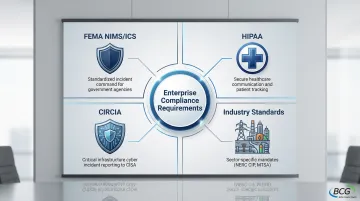
The right platform must manage incidents effectively while maintaining compliance and integrating with existing systems. This combination of operational capability and regulatory alignment separates enterprise-grade solutions from basic incident management tools.
Top Incident Response Solutions for Enterprise-Level Crisis Management
Enterprise incident response requires solutions that can scale across distributed teams, maintain compliance with national standards, and coordinate multiple agencies during high-stakes crises.
The following platforms represent the most robust options available, each evaluated on deployment scale, regulatory compliance, integration capabilities, and proven performance in real-world emergency scenarios.
Buffalo Computer Graphics DisasterLAN (DLAN)
Buffalo Computer Graphics (BCG) is a 43-year engineering firm that developed DisasterLAN specifically for emergency management agencies. The platform has 300+ deployments and is the first and only FEMA NIMS STEP compliant incident management system.
Core Strengths:
DLAN achieved full FEMA NIMS STEP compliance in 2010, validated as consistent with all 24 NIMS concepts and principles. With ISO/IEC 27001:2013 certification and proven use by FEMA, Coast Guard, and military organizations, the platform delivers reliable crisis coordination for high-stakes scenarios.
Key advantages include:
- Bandwidth-based licensing rather than per-user pricing, eliminating costly per-seat fees
- In-house US-based development and support with ICS-certified experts
- Role-based access controls for secure multi-jurisdictional coordination
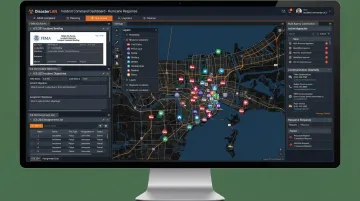
- ESRI-based GIS mapping providing unified common operating picture
- Modular architecture that scales from routine calls to extended multi-agency disasters
| Key Features | Template-guided IAPs with FEMA ICS forms, ESRI-based GIS mapping with real-time data layers, comprehensive resource tracking (personnel, equipment, supplies), multi-agency collaboration with secure information sharing, voice/data/video integration across communication channels | | Compliance & Certifications | FEMA NIMS STEP compliant (first and only system), ISO/IEC 27001:2013 certified, full ICS principles adherence, supports FEMA reimbursement documentation | | Ideal For | Government emergency management, public safety agencies, military and defense operations, healthcare systems and coalitions, utilities and critical infrastructure, multi-jurisdictional coordination centers |
Everbridge Critical Event Management
Everbridge is a global leader in critical communications and enterprise safety with solutions deployed across Fortune 500 companies and government agencies worldwide, serving over 6,500 customers.
Communication-First Approach:
Everbridge excels in mass notification with multi-channel alerting (SMS, email, voice, mobile app), risk intelligence from global threat feeds, and IT service alerting for cyber incidents. FedRAMP authorized in 2018, it maintains ISO 27001 and SOC 2 Type II certifications.
The system automates response to IT outages, cyberattacks, severe weather, and operational disruptions. For multinational corporations, it provides unified crisis communication templates and coordination across geographic regions and business units.
| Key Features | Multi-channel mass notification (SMS, email, voice, app), risk intelligence feeds and threat monitoring, IT service alerting and incident automation, travel tracking and duty-of-care management, crisis communication templates and workflows | | Compliance & Certifications | SOC 2 Type II, ISO 27001, FedRAMP authorized options, SAFETY Act designation | | Ideal For | Large enterprises with distributed operations, multinational corporations, organizations requiring integrated cyber and physical security response, companies with significant travel and remote workforce management needs |
Juvare (WebEOC)
Juvare's WebEOC is a widely-adopted emergency operations center platform used by government agencies and healthcare systems for situational awareness and decision support, with deployments in all 50 U.S. states and 700+ emergency management agencies.
Customization and Healthcare Focus:
WebEOC provides customizable EOC dashboards and status boards that adapt to diverse organizational workflows. Healthcare-specific modules support hospital bed tracking, patient flow management, and coalition coordination.
With FedRAMP High and DoD Impact Level 5 authorizations, WebEOC serves sensitive national security missions alongside state and local operations. HIPAA-compliant configurations make it particularly effective for healthcare coalitions managing patient surge during mass casualty events.
| Key Features | Customizable EOC boards and status displays, hospital bed tracking and patient flow management, comprehensive resource management with audit trails, situation status boards with real-time updates, extensive integration hub for third-party systems | | Compliance & Certifications | HIPAA compliant configurations, StateRAMP authorized, FedRAMP High authorized, DoD Impact Level 5, FEMA/NIMS-aligned workflows | | Ideal For | Healthcare coalitions and hospital systems, state and local emergency management agencies, public health departments, organizations requiring high-security federal authorizations |
IBM Resilient (Now IBM Security QRadar SOAR)
IBM Resilient is an enterprise-grade security orchestration, automation and response platform focused on cybersecurity incident management with playbook-driven response and 300+ two-way integrations.
AI-Powered Cybersecurity Orchestration:
QRadar SOAR differentiates through automated playbooks that orchestrate response workflows across security tools, AI-assisted case management and triage, and extensive integration with security and IT infrastructure. IBM Cloud's SOC 2 Type II and ISO 27001 certifications provide enterprise-grade security.
For organizations with complex security tool stacks, it serves as the central orchestration layer—automating repetitive tasks and reducing mean time to respond. Support for over 200 regulations including GDPR, HIPAA, and PCI-DSS simplifies compliance documentation.
| Key Features | Automated playbooks and workflow orchestration, AI-assisted case management and triage, 300+ security tool integrations with AppHost infrastructure, threat intelligence feeds and contextualization, privacy and compliance reporting automation | | Compliance & Certifications | SOC 2 Type II, ISO 27001, supports GDPR/HIPAA/PCI-DSS compliance reporting, operational certification for SaaS deployment | | Ideal For | Enterprise security operations centers, organizations prioritizing cybersecurity incident response, companies with complex security tool ecosystems, regulated industries requiring automated compliance documentation |
Perimeter Platform
Perimeter is a modern crisis management platform focused on visual collaboration through GIS-based mapping for emergency response coordination and public communication, serving municipalities including El Dorado County and Merced County, California.
Public Communication Emphasis:
Perimeter's core strength lies in public crisis mapping—enabling community members to access real-time evacuation zones, shelter locations, and road closures without app downloads or logins. WAI-ARIA accessibility compliance ensures inclusive access during emergencies.
For local government, it bridges internal response coordination and public communication. Officials can publish real-time evacuation zones directly to public-facing websites, improving transparency and reducing call volume during active incidents.
| Key Features | Public crisis mapping accessible without login, zone-based notifications with geographic targeting, road closure management and visualization, evacuation zone mapping and updates, incident collaboration with visual interfaces | | Compliance & Certifications | WAI-ARIA accessibility compliant for inclusive access | | Ideal For | Local government emergency management, municipalities and counties, public safety agencies focused on community communication, organizations prioritizing public transparency during emergencies |
How We Chose the Best Incident Response Solutions
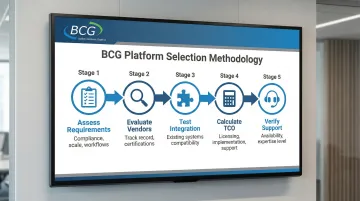
Our evaluation methodology focused on avoiding common procurement mistakes. Many organizations select tools based solely on brand recognition without assessing actual enterprise needs, compliance requirements, or integration capabilities with existing systems.
This approach often results in expensive platforms that don't align with operational workflows or require costly customization.
Key evaluation factors included:
Adherence to national frameworks: NIMS/ICS compliance is essential for multi-agency coordination and FEMA grant eligibility. We prioritized platforms with proven compliance certifications.
Scalability to handle enterprise-level incidents: Platforms must scale from routine operations to major disasters without performance degradation. We evaluated deployment scale and architectural design for concurrent operations.
Proven track record with similar organizations: Implementation success varies by industry. We assessed vendor experience in specific verticals like government emergency management, healthcare, and corporate security.
Technical support quality and availability: During critical incidents, responsive expert support is non-negotiable. We evaluated support availability, expertise level, and customer satisfaction indicators.
Total cost of ownership including licensing models: Licensing structures dramatically impact long-term costs. Per-user models can become expensive for large deployments, while bandwidth-based licenses offer better predictability.
The best solution varies by organization type. Government agencies prioritize FEMA compliance and multi-jurisdictional coordination. Healthcare systems need HIPAA compliance and patient tracking capabilities. Enterprises need cyber-physical security integration.
All organizations need solutions that align with their operational workflows and existing technology investments rather than forcing process changes to accommodate inflexible software.
Conclusion
Effective enterprise crisis management requires selecting incident response solutions aligned with organizational mission, regulatory requirements, and operational complexity—not just choosing the most recognized vendor. The platforms examined here represent proven solutions serving different enterprise needs, from government emergency management to healthcare coordination to cybersecurity operations.
Decision-makers should evaluate solutions based on compliance certifications relevant to their industry, integration capabilities with existing systems, scalability to handle their largest potential incidents, and quality of ongoing support and training.
The financial stakes are clear: with downtime costing large enterprises $23,750 per minute, investing in the right incident response platform delivers measurable ROI through faster response, better coordination, and reduced recovery time.
For organizations in government, emergency management, healthcare, and critical infrastructure sectors, proven NIMS/ICS compliance is particularly important. BCG's DisasterLAN is the only platform with FEMA NIMS STEP certification, offering specialized capabilities for multi-agency coordination and federally-aligned incident management.
With 43 years of engineering experience, in-house US-based development and support, and a bandwidth-based licensing model that eliminates costly per-user fees, DLAN provides a proven solution for organizations requiring enterprise-grade emergency management capabilities.
Frequently Asked Questions
What is an incident response platform?
Incident response platforms are integrated software systems that enable organizations to detect, manage, and resolve critical incidents—from cybersecurity breaches to natural disasters. These platforms provide centralized communication, situational awareness, and resource management that connect field teams, command centers, and support staff during crises.
Is NIMS only used during large scale incidents?
No—NIMS and ICS frameworks apply to incidents of any size, from routine operations to major disasters. Organizations use NIMS-compliant tools for planned events and small emergencies to maintain consistent processes that transfer seamlessly when larger incidents occur.
What's the difference between cybersecurity incident response and emergency management incident response?
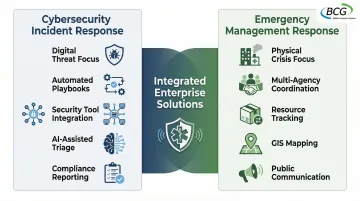
Cybersecurity incident response addresses digital threats like malware and breaches, while emergency management handles physical crises like natural disasters and infrastructure failures. Modern enterprises increasingly need integrated solutions for both, as cyberattacks can cause physical failures and physical disasters impact digital operations.
How much do enterprise incident response solutions typically cost?
Pricing ranges from $10,000s annually for small deployments to $100,000s for enterprise implementations, depending on organization size, deployment model, and features. Licensing models vary—per-user pricing, bandwidth-based models, or site licenses. Total cost should include implementation, integration, training, and maintenance.
What compliance certifications should I look for in an incident response platform?
Government agencies should prioritize FEMA NIMS STEP compliance and FedRAMP/StateRAMP authorization. Healthcare needs HIPAA compliance, while all enterprises should verify ISO 27001 and SOC 2 Type II certifications. Critical infrastructure sectors require additional standards like NERC CIP for energy or SAFETY Act designation.
Can incident response platforms integrate with existing emergency notification systems?
Yes—modern platforms offer open APIs to connect with mass notification systems, GIS tools, weather services, and IT infrastructure. Integration quality varies by vendor, with some offering 300+ pre-built connections. Verify compatibility with protocols like CAP (Common Alerting Protocol), EDXL, and IPAWS during evaluation.