Introduction
Emergency communications centers process an estimated 240 million 911 calls annually in the United States. When seconds determine outcomes, the technology supporting these centers directly impacts response times, resource allocation accuracy, and coordination across multiple agencies.
Modern 911 management software has evolved beyond basic call routing to include integrated platforms that combine computer-aided dispatch (CAD), incident management, real-time resource tracking, and multi-jurisdictional coordination.
This guide examines the top software solutions designed specifically for emergency communications centers, evaluating them based on compliance standards, deployment flexibility, and proven operational track records.
Key Takeaways
- Modern platforms unify call-taking, CAD, incident tracking, and multi-agency coordination
- NIMS/ICS compliance, seamless integrations, and flexible deployment are standard features
- BCG DisasterLAN, Hexagon, CentralSquare, Motorola Solutions, and Mark43 lead the market
- Evaluate vendors on compliance, total cost, stability, and integration compatibility
- Typical implementation takes 6-18 months based on complexity and data migration
Overview of 911 Management Software for Emergency Communications Centers
Emergency communications centers face mounting pressure to coordinate multiple agencies, process multimedia data, and reduce response times—all while managing legacy systems that weren't built for modern demands. 911 management software addresses these challenges through integrated systems including CAD platforms, incident management tools, records management systems, and resource tracking capabilities.
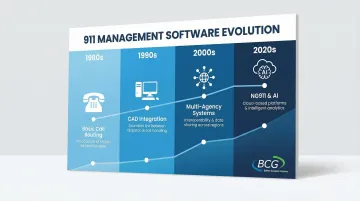
Modern platforms have transformed from basic telephone routing systems to sophisticated solutions integrating real-time data, AI-assisted decision-making, automatic vehicle location (AVL), and cross-agency communication tools.
Research shows that integrating AVL with CAD systems reduces unit arrival times by optimizing routing recommendations based on actual unit locations rather than static beat assignments.
The transition to Next Generation 911 (NG911) represents a fundamental shift from legacy Time Division Multiplexing architectures to IP-based networks capable of handling multimedia data including text, video, and photos.
This guide profiles five leading software solutions, evaluating them on feature completeness, compliance standards, deployment flexibility, and proven track records in emergency communications environments.
Best 911 Management Software for Emergency Centers
Selecting the right 911 management software requires evaluating compliance credentials, operational capabilities, and proven track records. These five solutions represent the most widely-adopted platforms serving emergency centers across North America.
BCG DisasterLAN (DLAN)
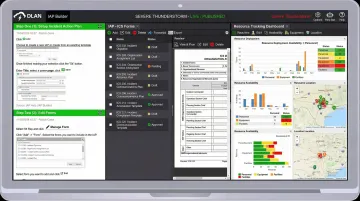
Buffalo Computer Graphics has operated as an engineering firm for 43 years, with DisasterLAN evolving from a 2002 pilot project with Erie County into a comprehensive all-hazards incident management system now deployed in 300+ locations across the USA and Canada. This track record demonstrates long-term stability and continuous platform refinement.
DLAN stands apart as the first and only incident management system evaluated by FEMA's NIMS STEP program in October 2010. The evaluation confirmed full compliance with all 24 NIMS concepts and principles. The platform offers template-guided Incident Action Plans aligned with FEMA guidelines, bandwidth-based licensing that scales with organizational needs rather than per-seat pricing, and flexible deployment options for both cloud and on-premise environments.
| Category | Details |
|---|---|
| Key Features | All-hazards incident management, FEMA-compliant Incident Action Plans with ICS forms, real-time resource tracking, multi-agency coordination, mass notification integration (NY-ALERT), integrated GIS platform |
| Deployment & Compliance | Cloud or on-premise options, ISO/IEC 27001:2013 certified, FEMA NIMS STEP compliant (evaluated October 2010), used by FEMA and DoD training programs |
| Licensing Model | Bandwidth-based licensing that scales with organizational needs rather than per-seat pricing, enabling unlimited users during emergency operations, U.S.-based development and 24/7 technical support |
Hexagon US Federal (formerly Intergraph CAD)
Hexagon has established itself as a major public safety technology provider with decades of CAD experience, serving large-scale 911 centers and regional dispatch operations through its HxGN OnCall portfolio. The platform excels at comprehensive CAD capabilities with strong GIS integration, extensive customization options, and proven scalability for high-volume dispatch centers. DuPage County, Illinois consolidated 18 PSAPs into 2 using Hexagon's CAD and RMS, creating a shared system for 62 police and fire agencies handling 600,000 annual calls.
| Category | Details |
|---|---|
| Key Features | Advanced CAD with GIS integration, Smart Advisor assistive AI, automatic call distribution, mobile CAD for field units, AVL tracking, multi-jurisdictional dispatch support |
| Deployment & Integration | On-premise, customer-managed cloud, or fully managed SaaS options, integrates with major RMS and records systems, supports PSAP consolidation efforts |
| Target Agencies | Large metropolitan 911 centers, regional dispatch consolidations, agencies requiring extensive GIS and mapping capabilities |
CentralSquare (formerly TriTech/Superion)
CentralSquare formed through mergers of leading public safety software companies, positioning itself to serve mid-to-large agencies with integrated CAD, RMS, and mobile solutions through its ONESolution platform.
This unified public safety suite combines CAD, records, mobile, and jail management into a cohesive ecosystem with strong market presence in municipal agencies. CentralSquare recently unveiled cloud-native CAD and NG911 call handling at their 2024 ENGAGE conference, demonstrating their commitment to next-generation capabilities.
| Category | Details |
|---|---|
| Key Features | Integrated CAD/RMS platform, mobile data terminals, call-taking and dispatching, automated reporting, analytics dashboards, Vertex NG911 solution |
| Deployment & Integration | Cloud, on-premise, or hybrid deployment through AWS partnership, integrates with third-party 911 systems, API-enabled for custom integrations |
| Target Agencies | Mid-size to large municipal agencies, consolidated dispatch centers, agencies seeking unified CAD/RMS/mobile platforms |
Motorola Solutions CommandCentral
Motorola Solutions leverages its legacy in public safety communications with CommandCentral, representing their cloud-native, AI-enhanced approach to emergency management and dispatch operations. Motorola's VESTA 9-1-1 solution serves more than 60% of all U.S. PSAPs.
CommandCentral features cloud-first architecture, AI-powered call analysis and resource recommendation, strong integration with Motorola's radio and communication infrastructure, and focus on next-generation 911 capabilities. Palm Beach County Sheriff's Office awarded Motorola a $14 million contract for the full PremierOne suite, integrating CAD, Mobile, and Records.
| Category | Details |
|---|---|
| Key Features | Cloud-native CAD, AI-assisted dispatching, real-time crime center integration, video and sensor data fusion, predictive analytics, PremierOne and Spillman Flex platforms |
| Deployment & Integration | Cloud-based SaaS model, local or geo-diverse deployment options, seamless integration with Motorola radio systems, NG911 ready, API-based third-party integration |
| Target Agencies | Agencies prioritizing cloud deployment, organizations with existing Motorola communications infrastructure, NG911 early adopters, federal installations (VESTA 9-1-1 Federal is DoD certified) |
Mark43 CAD and RMS
Mark43 entered the public safety market as a newer entrant focused on modern, cloud-based software with emphasis on user experience, mobile-first design, and rapid deployment timelines compared to legacy systems.
Mark43 sets itself apart through modern cloud architecture built on AWS GovCloud, intuitive user interface designed with officer feedback, faster implementation timelines than legacy systems (some modules deploying in under 30 days), and strong mobile capabilities. Mark43 achieved FedRAMP High authorization and ISO/IEC 27001 certification, validating its security posture for federal and state agencies.
| Category | Details |
|---|---|
| Key Features | Cloud-native CAD and RMS, mobile-responsive design, real-time collaboration tools, automated workflows, modern user interface, open API for custom integrations |
| Deployment & Integration | Cloud-only SaaS platform on AWS GovCloud, faster implementation than legacy systems (typically 6-12 months), API-driven integration approach, FedRAMP High authorized |
| Target Agencies | Progressive agencies seeking modern platforms, departments frustrated with legacy system limitations, agencies prioritizing officer user experience, Camden County consolidated police and fire dispatch with Mark43 CAD |
How We Chose the Best 911 Management Software
Agencies often make the mistake of selecting software based primarily on brand recognition or lowest initial cost, without properly evaluating long-term total cost of ownership, vendor stability, compliance requirements, and integration complexity.
A recent San Francisco CAD replacement saw annual maintenance costs increase to $1.8 million, a $1.4 million increase over the legacy system, illustrating how ongoing costs can exceed initial projections.
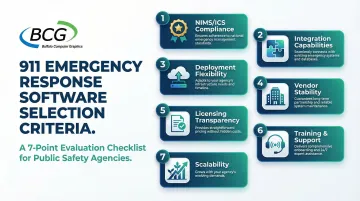
To avoid these pitfalls, our evaluation criteria included:
- NIMS/ICS compliance and FEMA alignment — Critical for agencies receiving federal preparedness grants
- Integration capabilities — Compatibility with existing phone systems, GIS platforms, RMS, and mobile data terminals
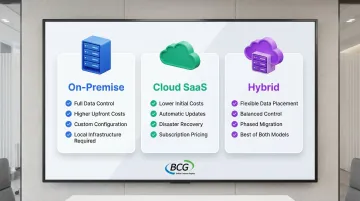
- Deployment flexibility — Options for cloud, on-premise, or hybrid models based on security requirements
- Vendor track record and financial stability — Long-term viability for multi-year commitments
- Licensing model transparency — Understanding total cost including implementation, training, and maintenance
- Training and support quality — 24/7 availability and response times during critical incidents
- Scalability — Ability to grow with consolidating agencies or expanding operations
The best choice depends on agency size, existing technology ecosystem, budget constraints, compliance requirements, and whether the agency prioritizes cutting-edge features or proven stability.
Agencies should note that NG911 transition costs are estimated at $9.5-12.7 billion over 10 years nationwide, emphasizing the importance of selecting platforms with clear NG911 roadmaps.
Conclusion
Selecting 911 management software represents a multi-year commitment affecting every aspect of emergency operations. It's critical to evaluate vendors not just on features but on long-term viability, support quality, and alignment with operational philosophy.
The stakes are high—AI call automation has reduced non-emergency call volumes by up to 40% at pilot agencies, demonstrating how the right technology directly addresses dispatcher burnout and staffing shortages.
When evaluating solutions, agencies should:
- Prioritize compliance standards, especially FEMA NIMS for organizations receiving federal funding
- Assess total cost of ownership including training and maintenance beyond initial licensing
- Conduct hands-on demonstrations with actual dispatchers who will use the system daily
- Verify vendor references from agencies with similar size and operational complexity
For agencies focused specifically on incident management and EOC coordination (rather than primary 911 call-taking), BCG's DisasterLAN provides FEMA NIMS-compliant software with 43 years of proven stability. As the only NIMS STEP-evaluated platform fully compliant with all 24 NIMS concepts and principles, it offers flexible deployment options and transparent licensing for emergency management operations. Contact BCG at (716) 822-8668 or info@bcgeng.com to discuss your incident management needs.
Frequently Asked Questions
What is the best end-to-end 911 management software for emergency centers?
The best solution varies by agency size, compliance needs, and integration requirements. Comprehensive platforms like BCG DisasterLAN, Hexagon HxGN OnCall, and CentralSquare ONESolution offer full-spectrum capabilities from call-taking through incident resolution. BCG's DLAN is the only FEMA NIMS STEP-evaluated system fully compliant with all NIMS principles.
What is the difference between CAD software and incident management software?
CAD (Computer-Aided Dispatch) handles call-taking, resource dispatching, and real-time unit tracking for routine emergency response. Incident management software covers broader operations like multi-agency coordination, Incident Action Plans, and NIMS/ICS compliance for complex emergencies requiring unified command structures.
How much does 911 management software typically cost?
Annual costs range from $50,000 for small agencies to $500,000+ for large regional centers, based on size, deployment model, and licensing structure. Total cost of ownership includes implementation, training, and maintenance—often exceeding 50% of long-term costs beyond licensing fees.
What is NIMS compliance and why does it matter for 911 software?
NIMS (National Incident Management System) is a FEMA framework for standardized incident response. Compliance ensures software supports ICS principles and interoperability—critical for agencies receiving federal preparedness grants. Local, state, territorial, and tribal jurisdictions must adopt NIMS to qualify for federal funding.
Should we choose cloud-based or on-premise 911 software?
Cloud deployment offers lower upfront costs, automatic updates, and disaster recovery benefits. On-premise provides more data control, customization, and connectivity independence. Many agencies choose hybrid models—maintaining dispatch on-premise for resilience while hosting analytics in the cloud.
How long does it take to implement new 911 management software?
Implementation timelines range from 6-18 months based on system complexity, data migration, and training scope. Modern cloud platforms like Mark43 report deployments in under 30 days for some modules, while complex consolidations require multi-year phased approaches.