Introduction
A 911 dispatcher in a rural area receives a call from a hiker lost in remote terrain. Within seconds, cloud-native technology pinpoints their exact location to within 10 meters, streams live video from their smartphone, and automatically routes the emergency to the nearest search and rescue team—all while maintaining seamless communication across multiple agencies.
Modern emergency response powered by cloud-native 911 technology makes this scenario possible today. Traditional 911 systems, built on decades-old infrastructure, struggle to meet current emergency response demands.
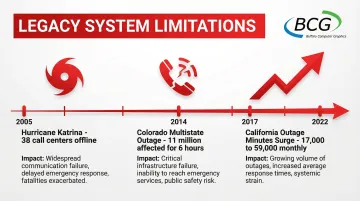
With wireless calls accounting for about 74% of 911 volume and outage minutes surging from 17,000 per month in 2017 to over 59,000 in 2022 in California alone, the limitations of legacy systems are increasingly dangerous. Cloud-native technology represents a fundamental shift in how emergency communications are delivered, offering unprecedented scalability, reliability, and integration capabilities that are transforming how communities protect their citizens.
TLDR:
- Location accuracy improves from several miles to within 3 meters with cloud-native 911 systems
- IP-based Next Generation 911 enables multimedia communications including text, images, and video from any connected device
- Cloud infrastructure automatically scales during mass casualty events and provides geographic redundancy that legacy systems lack
- AI-powered call routing and prioritization reduce non-emergency volume by up to 40% and improve response times
- Unified situational awareness emerges through integration with incident management platforms from initial call through resolution
The Evolution from Legacy to Cloud-Native 911 Systems
Understanding Legacy System Limitations
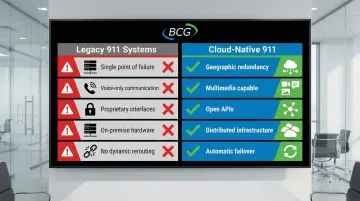
Legacy 911 systems, often rooted in 1960s technology, present severe operational and financial constraints. These systems rely on proprietary interfaces that create vendor lock-in, making integrations with new tools expensive and difficult.
On-premise servers require significant capital investment, with maintenance costs increasing over time as hardware ages and vendors discontinue support.
Critical vulnerabilities include:
- Single points of failure with no dynamic rerouting capabilities
- Voice-only communication channels incompatible with modern devices
- Inability to share information seamlessly across jurisdictions
- Known cybersecurity vulnerabilities in unsupported hardware
- Limited scalability during high-volume emergencies
History shows these fragilities. During Hurricane Katrina, 38 call centers went offline and two critical switches in New Orleans were destroyed by flooding. A 2014 multistate outage left 11 million people without 911 service for up to six hours when a service provider's call-routing facility in Colorado failed.
Defining Cloud-Native 911 Architecture
Cloud-native 911 refers to emergency communication systems built specifically for cloud infrastructure using microservices architecture, containerization, and API-first design—not legacy systems simply moved to the cloud.
These solutions use Software-as-a-Service (SaaS) models, offering greater bandwidth, security, and operational flexibility than traditional Emergency Services IP Networks (ESInets).
This technology powers Next Generation 911 (NG911), defined by the FCC as an IP-based system that ensures interoperability and security, employs commonly accepted standards, and enables PSAPs to receive, process, and analyze all types of requests including voice, text, images, video, and data.
The technical foundation is the NENA i3 Standard (NENA-STA-010.3-2021), which standardizes the architecture for NG911, defining software services, databases, and network elements required to process multimedia emergency calls.
From CapEx to OpEx: The Financial Transformation
Cloud-native systems eliminate costly on-premise hardware refresh cycles and reduce maintenance overhead through predictable subscription-based pricing. While specific comparative figures vary by agency size, the trend is clear: operating and maintaining legacy systems becomes increasingly expensive over time, with many PSAPs struggling to provide basic services due to rising costs and insufficient funding.
The estimated cost to deploy and operate NG911 nationwide over ten years is $13.5 billion to $16.1 billion, yet in 2022, states collected $3.9 billion in 911 fees but spent only $512 million on NG911-related items. Cloud models help bridge this gap by spreading costs over time and eliminating large upfront capital expenditures.
Regulatory Drivers and Timeline
FCC mandates and real-world disasters have accelerated the evolution to cloud-native 911:
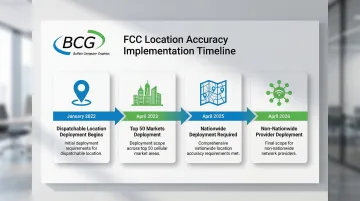
FCC Location Accuracy Timeline:
- January 2022: Providers must deliver dispatchable location with wireless 911 calls if technically feasible
- April 2023: Nationwide providers deploy dispatchable location or z-axis technology in top 50 markets
- April 2025: Nationwide deployment required
- April 2026: Non-nationwide providers must deploy throughout their footprint
These mandates, combined with increasing 911 call volumes from mobile devices and demand for multimedia communications demonstrated during COVID-19, have created urgent pressure to modernize infrastructure.
Key Benefits of Cloud-Native 911 Technology
Enhanced Location Accuracy and Caller Information
Device-Based Hybrid (DBH) technologies like Google's Android Emergency Location Service (ELS) and Apple's Hybridized Emergency Location (HELO) now locate approximately 80% of wireless 911 calls, meeting the FCC's ±3-meter accuracy standard. This represents a dramatic improvement from legacy systems that could only approximate locations within several miles.
The impact on outcomes is measurable. FCC-cited studies estimate that location accuracy improvements could save approximately 10,120 lives annually, particularly for cardiac emergencies where response time directly correlates with mortality rates.
Cloud platforms also pull rich contextual data:
- Medical history from health information exchanges
- Building floor plans and access points
- Prior calls from the location
- Real-time IoT sensor data from smart buildings or connected vehicles
Scalability and Reliability
Cloud infrastructure automatically scales to handle call volume spikes during mass casualty events, natural disasters, or major incidents without system degradation. IP-based routing allows traffic to be dynamically rerouted around failures—a capability legacy TDM systems lack.
Redundancy advantages:
- Geographically distributed data centers
- Automatic failover without manual intervention
- Ability to maintain operations even if primary facility is compromised
- No single point of failure in the network architecture
Real-Time Data Sharing and Interoperability
Cloud-native platforms enable seamless information sharing across multiple PSAPs, law enforcement, fire departments, EMS, and hospitals through standardized APIs and data formats. This breaks down traditional information silos that have historically hindered coordinated response.
Integration with Computer-Aided Dispatch (CAD), Records Management Systems (RMS), and incident management platforms creates a unified emergency response ecosystem.
Systems like BCG's DisasterLAN incident management platform integrate with cloud-native 911 technology to provide comprehensive situational awareness from initial call through incident resolution. This enables multi-agency coordination with shared workflows and controlled access across jurisdictions.
Advanced Communication Channels
In 2021, 38 states reported receiving 507,969 Text-to-911 messages, a steady increase from 188,646 in 2018. Cloud-native systems natively support Text-to-911, Real-Time Text (RTT) for accessibility, video calling, and data transmission from IoT devices and connected vehicles.
Telecommunicators can receive photos, videos, and sensor data from callers' smartphones, providing "eyes on scene" before first responders arrive.
Preliminary analysis suggests video data significantly improves dispatchers' situational awareness, allowing them to tailor instructions for complex scenarios like pediatric emergencies or trauma more effectively than with audio alone.
Continuous Innovation and Updates
Cloud-native platforms receive automatic updates and new features without downtime or manual installations, ensuring PSAPs always have access to the latest capabilities and security patches. AI and machine learning capabilities can be rapidly deployed to provide:
- Call prioritization based on severity
- Predictive analytics for resource allocation
- Real-time language translation
- Automated triage for non-emergency calls
How Cloud Technology Enhances Emergency Response Operations
Intelligent Call Routing and Prioritization
AI-powered algorithms analyze incoming calls in real-time based on location, nature of emergency, caller data, and available resources to route calls to the most appropriate PSAP and responder unit.
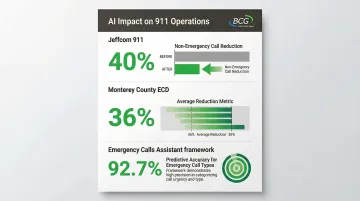
The impact is measurable:
- 40% reduction in non-emergency call volume at Jeffcom 911 in Colorado
- 36% average reduction at Monterey County ECD
- 92.7% accuracy in the Emergency Calls Assistant (ECA) framework for predicting emergency types
After implementing an AI chatbot in December 2022, Jeffcom 911 met NENA's standard of answering 90% of calls within 15 seconds for six months in 2023—a target it had missed for the previous 22 consecutive months. The system uses Natural Language Processing to provide pre-arrival instructions while calls are being routed.
Multi-Agency Coordination and Situational Awareness
Cloud platforms provide unified dashboards that give all responding agencies real-time visibility into ongoing incidents, resource deployment, and emerging situations across jurisdictional boundaries.
During large-scale emergencies requiring mutual aid, multiple agencies and jurisdictions must work together seamlessly. Cloud-native coordination eliminates the dangerous information gaps that have historically plagued these responses.
A Common Operating Picture integrates data from ESRI GIS, weather services, sensor feeds, and camera systems, ensuring all stakeholders see the same information simultaneously.
Mobile and Remote Capabilities
Cloud-native systems enable dispatchers to handle 911 calls from anywhere with internet connectivity. This supports remote work, backup operations during facility evacuations, and distributed emergency operations centers.
During COVID-19, this flexibility allowed agencies to maintain operations when traditional call centers faced staffing challenges and social distancing requirements.
Mobile applications for first responders receive real-time updates, incident details, and multimedia information directly from cloud-native 911 platforms while en route or on scene. GPS-tagged data capture with automatic synchronization ensures field personnel can share photos, videos, and reports even in areas with limited connectivity.
Analytics and Performance Optimization
Beyond real-time operations, cloud platforms continuously collect and analyze data to drive long-term improvements.
Key analytics capabilities include:
- Identifying trends in call patterns and response times
- Optimizing staffing levels based on demand forecasting
- Measuring KPIs like call answer times and dispatch intervals
- Generating after-action reports with detailed incident timelines
Predictive analytics forecast call volumes based on historical patterns, weather events, and community activities to ensure appropriate staffing and resource allocation. Agencies shift from reactive responses to proactive planning.

Integration with Smart City Infrastructure
Emerging capabilities enable cloud-native 911 systems to integrate with smart city sensors, traffic management systems, surveillance cameras, and environmental monitors to provide automatic alerts and enhanced situational awareness before citizens even call 911. For example, gunshot detection systems can automatically notify dispatchers with precise location data, or flood sensors can trigger pre-positioned response protocols.
Implementation Considerations and Best Practices
Assessment and Planning Phase
Successful cloud-native 911 implementation requires careful evaluation of your current infrastructure. Start by assessing integration requirements with existing CAD/RMS (Computer-Aided Dispatch/Records Management Systems) and determining whether pure cloud or hybrid deployment best fits your agency's needs.
Agencies with specific security requirements or existing infrastructure investments often benefit from hybrid approaches that leverage cloud advantages while maintaining on-premise control.
Your assessment should include:
- Current system capabilities and limitations
- Integration points with existing platforms
- Bandwidth and connectivity requirements
- Security and compliance obligations
- Budget and funding sources
Vendor Selection Criteria
Choose vendors with proven public safety expertise, robust security certifications, and documented successful implementations.
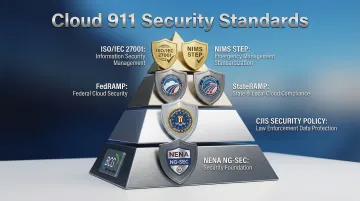
Critical certifications and compliance standards include:
- NENA NG-SEC (NENA-STA-040.2-2024): Establishes minimal guidelines for protecting NG911 assets, mandating vendor-provided mechanisms for audit logging, access control, and encryption (AES 256)
- CJIS Security Policy: FBI's policy mandating strict controls for cloud environments handling Criminal Justice Information
- FedRAMP & StateRAMP: Standardized approaches for authorizing cloud products based on NIST 800-53 standards
Look for vendors who maintain certifications like ISO/IEC 27001:2013 and proven compliance with FEMA standards. BCG's DisasterLAN earned distinction as the first and only incident management system evaluated by FEMA's NIMS STEP program as fully compliant with NIMS (National Incident Management System) and ICS (Incident Command System) principles.
Change Management and Training
Successful deployment extends beyond technology—it requires preparing dispatch personnel and IT staff for new workflows. Build change management into your implementation plan:
- Comprehensive training programs for all user roles
- Parallel operations during transition to minimize risk
- Ongoing training to maximize platform capabilities
- Clear communication about benefits and changes
- Feedback mechanisms to address concerns
Overcoming Challenges in Cloud 911 Adoption
Security and Privacy Concerns
Enterprise-grade cloud platforms often provide superior security compared to on-premise systems. They deliver advanced encryption, continuous monitoring, automated threat detection, and compliance with stringent public safety standards.
NG911 architectures offer inherent security advantages including isolated ESInets that limit lateral movement of malicious actors, end-to-end encryption, and network segmentation.
A global survey indicated that 81% of respondents believed their cloud provider's native security capabilities exceeded what their internal teams could deliver on-premise. Cloud providers invest heavily in security infrastructure that individual agencies cannot match affordably.
Bandwidth and Connectivity Requirements
Beyond security, cloud systems depend on robust network infrastructure. Cloud-native 911 systems require reliable, redundant internet connections to function effectively.
Strategies for ensuring continuity during network outages include:
- Cache critical data locally for immediate access
- Fail over automatically to backup connections
- Integrate with multiple carrier networks for redundancy
- Deploy offline-capable mobile apps that sync when connectivity returns
These redundancy measures ensure that emergency operations continue even when primary connectivity is compromised.
Funding Considerations and Procurement Strategies
Agencies can leverage federal grants like the NG911 Advancement Act, which authorized $115 million with over $109 million awarded to 34 states and two tribal nations.
Beyond federal funding, agencies can pursue:
- Phased implementations to spread costs over time
- Building business cases demonstrating long-term ROI through reduced infrastructure costs
- Highlighting improved operational efficiency and enhanced public safety outcomes
- Exploring state and regional pooled procurement approaches
Frequently Asked Questions
What is cloud-native 911 technology?
Cloud-native 911 refers to emergency communication systems built specifically for cloud infrastructure, enabling multimedia communications, real-time data sharing, and automatic scaling that traditional on-premise systems cannot efficiently deliver.
How does cloud technology improve 911 response times?
Cloud technology improves response times through enhanced location accuracy (within 3 meters versus several miles), intelligent AI-powered call routing, and real-time information sharing. First responders receive critical incident details including photos and video before arriving on scene.
Is cloud-based 911 technology secure and compliant?
Yes. Reputable cloud-native 911 platforms meet or exceed stringent public safety security standards including CJIS compliance, NENA NG-SEC, and FedRAMP/StateRAMP authorization with enterprise-grade encryption, continuous monitoring, and automated threat detection.
What is the difference between cloud-native and traditional 911 systems?
Traditional systems are hardware-based with limited scalability and voice-only capabilities. Cloud-native platforms are software-based, infinitely scalable, multimedia-capable (text, images, video), and seamlessly integrated across agencies using standardized protocols.
How much does it cost to migrate to cloud-based 911?
Costs vary based on agency size and requirements, but cloud models typically reduce upfront capital expenses while providing predictable operational costs. Federal grant programs can help offset implementation costs.
What is Next Generation 911 (NG911) and how does cloud enable it?
NG911 is the IP-based infrastructure allowing 911 systems to receive text, images, video, and data from any connected device while ensuring interoperability. Cloud-native architecture enables NG911 by handling diverse data types, scaling dynamically during emergencies, and providing geographic redundancy.