Introduction: Understanding the Crisis Management Software Landscape
When crisis strikes, organizations can no longer rely on phone trees and email chains. Modern emergencies—whether cyberattacks, natural disasters, or public health crises—demand integrated command centers that coordinate response across multiple channels, jurisdictions, and stakeholder groups in real time.
Crisis management software provides unified platforms for emergency response coordination, communication, and recovery. These systems serve as digital command centers, enabling organizations to send simultaneous alerts, track incident progress, manage resources, and maintain audit trails.
All of this happens from a single interface accessible to distributed teams.
This article examines the crisis management software market through a strategic lens: current market size and growth projections, core capabilities that define modern platforms, technology trends reshaping the industry, evaluation criteria for decision-makers, and future outlook.
Whether you're a government agency, healthcare provider, or corporate risk manager, understanding this landscape is essential for making informed investment decisions.
TLDR:
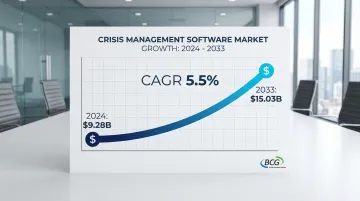
- Global crisis management software market valued at $9.28 billion in 2024, projected to reach $15.03 billion by 2033 (5.5% CAGR)
- COVID-19 accelerated adoption as organizations realized existing business continuity plans couldn't handle prolonged, distributed crises
- North America leads adoption; Asia-Pacific shows fastest growth driven by urbanization and disaster preparedness mandates
- Market shifting from "nice-to-have" to essential infrastructure as regulations mandate adoption in healthcare, education, and critical sectors
Market Size & Growth: Crisis Management Software by the Numbers
The crisis management software market has achieved critical mass, transitioning from optional spending to mission-critical infrastructure investment. The numbers tell the story.
Current Market Valuation
The global market was valued at approximately $9.28 billion in 2024, with projections reaching $15.03 billion by 2033—a compound annual growth rate (CAGR) of 5.5%. This represents stable, mature growth rather than volatile early-stage expansion.
What's Driving Market Growth
Three forces are pushing organizations toward crisis management platforms:
- COVID-19 fundamentally changed procurement behavior. A survey of over 420 local emergency management agencies revealed measurable ROI from crisis management systems
- Healthcare providers participating in Medicare/Medicaid must comply with CMS Emergency Preparedness Rules, requiring comprehensive communication plans
- Natural disasters, cyber threats, and operational disruptions occur more frequently, making crisis preparedness non-negotiable
Regional Market Dynamics
- North America currently holds the largest market share, driven by mature disaster preparedness infrastructure and stringent regulatory frameworks
- Asia-Pacific is projected as the fastest-growing region, fueled by rapid urbanization and government investment in preparedness
- Government and defense sectors capture the largest share, with heavy investment to mitigate risks from terrorism, natural disasters, and cyber threats
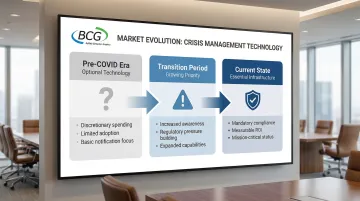
From Optional to Essential
The market is no longer viewed as optional technology. Regulatory expansion across healthcare, education, and critical infrastructure sectors is forcing broader adoption.
Organizations now recognize that crisis management platforms deliver measurable ROI through faster response times, reduced recovery costs, and improved regulatory compliance.
Core Capabilities That Define Modern Crisis Management Software
Effective crisis management platforms must function as central command centers, not merely communication tools. They integrate multiple functions to support the entire incident lifecycle—from initial alert through recovery and after-action review.
Real-Time Multi-Channel Communication
Modern crisis management systems deliver instant alerts across multiple channels simultaneously, ensuring critical information reaches all stakeholders regardless of location or device preference.
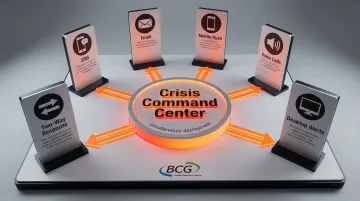
Instant Alert Capability: Platforms send notifications via SMS, email, mobile push, voice calls, and desktop alerts in a single action.
This redundancy is critical—if one channel fails or a recipient doesn't have access to one device, messages still get through via alternate routes.
Two-Way Communication: Recipients must be able to confirm receipt, report their status, and provide ground-level intelligence back to command centers.
This bidirectional flow transforms passive notification into active situational awareness, enabling incident commanders to make decisions based on real-time field data rather than assumptions.
Contact Management: Effective systems automatically synchronize with HR databases and support customizable contact groups. Role-based alert targeting ensures the right people receive the right information—executives get strategic updates, field responders get tactical instructions, and the public receives safety information.
Incident Logging and Audit Trails
Every action, decision, and communication is automatically logged with permanent timestamps, creating a defensible record for multiple purposes.
Compliance Value: Automated logging eliminates the "he said, she said" problem that plagues manual crisis response.
When regulatory agencies or legal teams review your response, you have concrete evidence that proper procedures were followed.
This is particularly critical for government agencies subject to FEMA after-action reporting requirements and healthcare providers facing CMS audits.
Integration with Reporting: These logs feed directly into after-action reports (AARs), which FEMA mandates following incidents or exercises. Rather than spending hundreds of hours manually reconstructing timelines from email chains and meeting notes, organizations can generate comprehensive reports automatically from system logs, identifying strengths and improvement areas with data-driven precision.
Technology Trends Reshaping Crisis Management
Three technological shifts are transforming crisis management from reactive response to proactive resilience.
AI and Predictive Analytics
Machine learning algorithms now analyze historical incident data, weather patterns, social media signals, and other data sources to provide early warning of potential crises before they fully develop.
Research indicates that AI-enhanced early warning systems improve prediction accuracy by 37% and reduce false alarms by 42% compared to traditional models.
Vendors are integrating generative AI to automatically summarize vast amounts of communication data and provide incident commanders with actionable intelligence.
IoT Integration
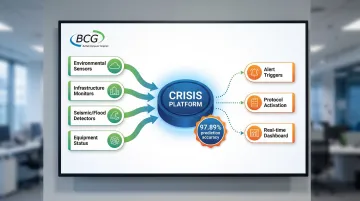
Connected sensors feed real-time data into crisis platforms from multiple sources:
- Air quality and environmental conditions
- Structural integrity of critical infrastructure
- Seismic activity and flood levels
- Equipment status and performance metrics
This enables proactive rather than reactive response. Studies show up to 97.89% accuracy in disaster prediction models using hybrid neural networks fed by sensor data.
When a sensor detects an anomaly, automated workflows can trigger immediate notifications and initiate predefined response protocols.
Mobile-First Design Evolution
Modern platforms are built for mobile devices first, recognizing that crisis responders are rarely at desks. They need full functionality from smartphones and tablets in the field, including offline modes that sync data once connectivity is restored.
Mobile apps are now standard components of crisis management solutions, facilitating real-time interaction for distributed teams operating in degraded environments.
Evaluating Solutions: What to Look For in Crisis Management Software
Selecting the right crisis management platform requires careful evaluation across multiple dimensions. Decision-makers should prioritize:
Start with Compliance Requirements
For government agencies and first responders, verify the platform meets FEMA NIMS (National Incident Management System) and ICS (Incident Command System) standards. Software must support standard ICS forms (ICS 201, 202, 214) for incident action planning and accommodate the modular, scalable organizational structure NIMS defines.
This ensures true interoperability with other agencies during multi-jurisdictional incidents requiring mutual aid.
Examine the Licensing Model
Traditional per-seat pricing can become prohibitively expensive as organizations scale. Consider bandwidth-based or consumption-based models that offer better long-term value and flexibility.
Some vendors now offer hybrid models that scale with message volume rather than user count, significantly reducing costs for organizations with large contact databases but intermittent usage.
Assess Deployment Flexibility
Evaluate whether cloud-based, on-premise, or hybrid deployment best fits your security requirements. Cloud deployment holds the largest market share due to faster deployment, lower upfront costs, and automatic updates—ideal for most organizations.
Government agencies often require FedRAMP authorization, with 67% of federal cloud solutions procured being FedRAMP compliant. Law enforcement agencies must adhere to CJIS security policies, which will determine the choice between government-cloud instances and on-premise solutions.
Stress Vendor Stability and Support
The market is consolidating through mergers and acquisitions, making vendor stability critical. Look for providers with:
- Proven longevity (10+ years in business)
- US-based development and support teams for government/critical infrastructure applications
- Demonstrated customer base in your sector
- Presence on federal contract vehicles like GSA Schedules
For instance, Buffalo Computer Graphics (BCG) has maintained 43 years of continuous operation and holds the distinction of being the first and only FEMA NIMS STEP-compliant incident management system—the kind of standards-focused track record that reduces implementation risk for mission-critical applications.
Evaluate Integration Capabilities
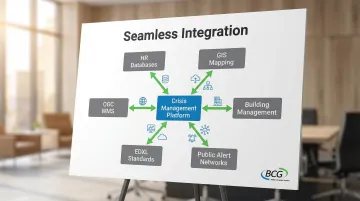
The platform should connect seamlessly with existing systems—HR databases, GIS mapping, building management systems, public alert networks—rather than creating another data silo.
Platforms often use OGC Web Map Service (WMS) standards to display geo-registered map images and track assets. The Emergency Data Exchange Language (EDXL) suite enables sharing resource status, hospital availability, and routing information between disparate systems.
The Road Ahead: Future Outlook for Crisis Management Software
Three major trends will shape the crisis management software market over the next decade. These shifts will impact how organizations approach incident response, compliance, and operational resilience.
Continued Market Consolidation:
Mergers and acquisitions will continue as enterprise software companies recognize crisis management as a strategic priority. Major players like Everbridge have aggressively acquired specialized firms to broaden capabilities from simple notification to comprehensive critical event management.
Top vendors control significant market share, with acquisitions driving the integration of niche capabilities like risk intelligence and physical security information management.
Regulatory Expansion:
More industries will face mandatory crisis preparedness requirements. Current regulations include:
- Healthcare: CMS Emergency Preparedness Rules
- Education: Clery Act requirements
- Utilities: NERC CIP standards
This regulatory expansion will drive broader adoption across sectors that previously viewed crisis management as optional. Organizations seeking compliance-ready solutions benefit from platforms like BCG's DLAN, the first and only incident management system evaluated by FEMA's NIMS STEP program as fully compliant with NIMS and ICS principles.
Technology Convergence:
Crisis management platforms will increasingly merge with business continuity, risk management, and operational resilience tools into unified "resilience management" suites. While these remain distinct disciplines, software platforms now offer modules covering the entire spectrum:
- Crisis management: Immediate incident response (ISO 22320)
- Business continuity: Maintaining operations during disruptions (ISO 22301)
- Risk assessment and recovery planning
This convergence allows organizations to manage the full lifecycle from risk identification through response to recovery.
Frequently Asked Questions
What is crisis management software and who needs it?
Crisis management software centralizes communication, coordination, and documentation to help organizations prepare for, respond to, and recover from emergencies. It's used by government agencies, first responders, healthcare, education, utilities, corporate, and any organization facing operational disruption risks.
What's the difference between crisis management and business continuity software?
Crisis management handles immediate incident response during active emergencies (minutes/hours), while business continuity focuses on maintaining operations during disruptions (days/weeks/months). Modern platforms increasingly combine both in unified resilience suites.
How much does crisis management software typically cost?
Small organizations pay $5,000-$10,000 annually for basic cloud platforms, mid-market solutions range $25,000-$100,000, and enterprise deployments exceed $200,000 depending on user count and features. Public sector mass notification systems start at $1,600-$5,000+ annually.
What does FEMA NIMS compliance mean and why does it matter?
FEMA's National Incident Management System (NIMS) standardizes incident command and multi-agency coordination protocols. NIMS-compliant software ensures seamless integration with other agencies during large-scale incidents—critical for government, first responders, and organizations coordinating with public sector partners.
Cloud vs. on-premise: which deployment model is right for my organization?
Cloud solutions offer faster deployment, lower costs, automatic updates, and remote access—ideal for most organizations. On-premise deployments provide maximum control for highly sensitive government/defense applications with strict data sovereignty or CJIS compliance requirements.
How long does implementation typically take?
Basic cloud implementations with standard configurations can be operational in 2-4 weeks. Mid-complexity deployments with custom integrations typically require 2-3 months. Large enterprise implementations with extensive system integration and change management can take 6-12 months. Multi-agency or statewide implementations may extend to 24-30 months with phased rollouts.