Introduction
In the 2021-22 school year, 96% of public schools had written active shooter plans and conducted lockdown drills, yet K-12 administrators still struggle to bridge the gap between written plans and real-world execution. Having a plan on paper doesn't guarantee effective response during an actual crisis.
School administrators face a critical challenge: selecting emergency management software that meets FEMA compliance standards, fits constrained budgets, and—most importantly—actually gets used by staff during high-stress emergencies.
With regulatory mandates like Alyssa's Law now requiring silent panic alarms in multiple states including Florida, New Jersey, New York, and Texas, the pressure to implement comprehensive solutions has intensified.
To help navigate these requirements, this guide compares the top 5 emergency management solutions specifically designed for K-12 school safety, including evaluation criteria to help district leaders make informed decisions that protect students and staff while meeting compliance requirements.
Key Takeaways
- Covers all crisis phases: lockdowns, evacuations, natural disasters, medical emergencies
- Top platforms provide FEMA NIMS compliance, real-time alerts, and student accountability tracking
- Must be mobile-accessible, crisis-ready, and cost-effective for K-12 budgets
- Compare 5 solutions to find the best fit for your district's safety needs
Overview of Emergency Management Solutions in K-12 Schools
School districts face mounting pressure to protect students while managing complex emergency scenarios. Emergency management software coordinates the entire emergency lifecycle—from initial threat detection through after-action reporting—unlike simple notification systems that only send alerts.
These platforms support all phases of emergency response: prevention, preparedness, response, and recovery.
Schools must comply with an expanding regulatory framework:
- State-specific requirements like Alyssa's Law
- FEMA guidelines for educational facilities
- Department of Education recommendations for high-quality emergency operations plans
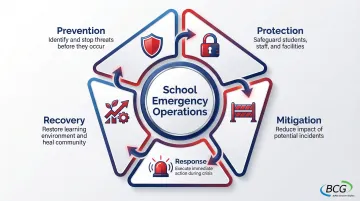
- Five mission areas per the Guide for Developing High-Quality School Emergency Operations Plans: prevention, protection, mitigation, response, and recovery
Federal funding creates additional requirements. School districts must adopt the National Incident Management System (NIMS) to qualify for federal Preparedness grants.
This makes FEMA compliance a financial necessity, not just a best practice.
With these regulatory and operational demands in mind, we evaluated 5 solutions with proven track records in K-12 environments, focusing on school-specific features like student reunification, drill management, and integration with student information systems.
Top 5 Emergency Management Solutions for School Safety
We selected these 5 solutions based on K-12 market presence, FEMA compliance, school-specific features, user reviews from education customers, and demonstrated effectiveness in real school emergencies.
BCG DisasterLAN (DLAN)
Buffalo Computer Graphics brings 43 years of engineering experience to emergency management. DisasterLAN was developed in 2002 specifically for emergency operations centers and now serves 300+ deployments including K-12 schools like Hillsborough County Public Schools.
DLAN holds a unique distinction: it's the first and only incident management system evaluated by FEMA's NIMS STEP program as fully compliant with NIMS and ICS principles. This makes it ideal for schools requiring federal compliance for grant eligibility.
The October 2010 evaluation confirmed consistency with all 24 NIMS concepts and principles.
Key advantages for schools:
- Bandwidth-based licensing (not per-seat pricing) — more cost-effective for districts with many users
- All software engineering done in-house by U.S.-based team
- Reliable support with rapid response to customer needs
| Feature Category | Details |
|---|---|
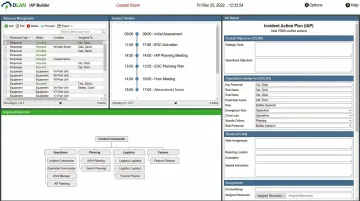
| Key Features for Schools | Template-guided Incident Action Plans aligned with FEMA guidelines, resource management (buses, medical supplies, staff), real-time incident tracking across multiple buildings, mass notification integration, drill and exercise management with compliance reporting |
| Compliance & Certifications | FEMA NIMS STEP compliant, ISO/IEC 27001:2013 certified, meets Department of Education emergency operations plan guidelines |
| Deployment & Support | Flexible cloud or on-premises deployment, U.S.-based development and technical support team, proven in government and education sectors, 24/7 responsive support |
| Mobile Capabilities | Mobile Responder App with offline functionality and automatic sync, GPS-tagged data capture, photo/video documentation from field |
Raptor Technologies
Founded in 2002, Raptor Technologies is trusted by over 5,000 U.S. school districts and 60,000 schools globally, making it one of the most widely adopted K-12 safety platforms. Built on a strong visitor management foundation, Raptor now delivers comprehensive emergency response capabilities.
Raptor's primary differentiator is its fully integrated safety ecosystem connecting visitor management with emergency response and reunification tools.
The platform includes built-in workflows for the Standard Response Protocol (SRP) and Standard Reunification Method (SRM) licensed through the "I Love U Guys" Foundation, providing nationally recognized best practices.
Raptor Connect integrates with PA systems, door locks, and visual messaging for single-action emergency activation, reducing response time during critical incidents. The 911 Direct feature provides enriched incident data directly to emergency dispatchers.
| Feature Category | Details |
|---|---|
| Key Features for Schools | Raptor Alert mobile panic app, centralized drill scheduling and compliance reporting, dynamic rosters with real-time student/staff status, reunification software with guardian identity verification and sex offender screening, 911 Direct connection |
| Pricing Model | Modular subscription pricing (specific rates not publicly disclosed), bundled safety suite options available |
| Implementation & Training | Customized implementation plan with staff training, public safety official training, includes live reunification exercise, ongoing support included |
| Integration Capabilities | PowerSchool, Infinite Campus, Skyward SIS integration, PA systems and access control through Raptor Connect |
Navigate360
Navigate360 serves more than 30,000 schools nationwide with a holistic approach that combines physical safety with mental health and behavior threat assessment tools. The company recently launched a unified Safety & Security Suite that integrates visitor, volunteer, and emergency management.
Navigate360's standout feature is its EOP Wizard, which provides a user-friendly interface to create FEMA-compliant Emergency Operations Plans using state-specific templates.
This addresses one of the most challenging aspects of school emergency preparedness: creating documentation that meets regulatory requirements without overwhelming staff.
The platform offers wearable panic buttons that trigger complete incident command workflows. This integration between panic hardware and comprehensive response protocols sets Navigate360 apart from solutions that treat alerts and response as separate functions.
| Feature Category | Details |
|---|---|
| Key Features for Schools | EOP Wizard with state-specific templates, wearable panic badges with incident command workflows, drill management with compliance tracking, digital reunification workflows, interactive site mapping for first responders, Roll Call integration with SIS |
| Pricing Model | Subscription-based safety suite pricing, often bundled with training and other safety solutions (specific rates available upon request) |
| Implementation & Training | Comprehensive onboarding with platform training, typically 4-8 weeks depending on district size, includes policy development support |
| Integration Capabilities | Student Information Systems for accountability, wearable badges and wall-mounted panic buttons, visitor management integration |

Rave Mobile Safety (Motorola Solutions)
Founded in 2004, Rave Mobile Safety serves over 10,000 customers worldwide, including thousands of K-12 schools. With state-wide implementations in Oklahoma, Delaware, and Arkansas, Rave has proven scalability for large educational deployments.
Rave's strongest differentiator is its deep integration with 911 infrastructure. The Rave Panic Button app simultaneously calls 911 and notifies on-site staff while delivering critical data—including floor plans and precise location—directly to dispatchers. This public safety heritage ensures first responders receive actionable intelligence immediately.
The platform includes five emergency button types (active assailant, fire, medical, police, other) and status check polling features that provide visual representation of people impacted during emergencies, helping administrators quickly account for students and staff.
| Feature Category | Details |
|---|---|
| Key Features for Schools | Five-button panic app (active assailant, fire, medical, police, other), multimodal mass notification (text, email, voice), drill management for fire, active assailant, and weather scenarios, Rave Eyewitness anonymous tip system, status check polling |
| Pricing Model | Per-user or per-building pricing (specific rates vary by district size and features selected) |
| Implementation & Training | Cloud-based deployment typically 2-4 weeks, online training modules and live webinars, ongoing technical support |
| Integration Capabilities | PowerSchool collaboration for parent communication, Okta single sign-on (SSO), 911 center integration with data sharing |
CrisisGo
CrisisGo reached profitability in 2019 and serves over 200 districts with a comprehensive safety platform that emphasizes putting emergency plans on mobile devices. The company positions itself as a solution that enables two-way, real-time communication during incidents, not just top-down alerts.
CrisisGo's key differentiator is its Open API released in 2018, enabling deep integrations with IoT devices including door locks, strobes, sirens, and PA systems. This open architecture approach allows schools to leverage existing infrastructure investments while adding sophisticated emergency management capabilities.
The platform provides role-based checklists that digitize emergency plans and provide specific actionable steps based on each user's role during an incident. Safety iPass modules add health screening and entry validation capabilities, addressing post-pandemic safety concerns.
| Feature Category | Details |
|---|---|
| Key Features for Schools | District-wide panic notification with 911 escalation, complete reunification system with roster syncing and check-in/status reports, digitized safety plans with role-based checklists, drill management, anonymous or named bully/tip reporting, Safety iPass health screening |
| Pricing Model | Two main packages: CrisisGo Premium (3-year comprehensive platform) and CrisisGo Essential (core communication and response), add-on modules available for specialized features |
| Implementation & Training | "White-glove" onboarding with infrastructure documentation and customization, multi-week process depending on district complexity |
| Integration Capabilities | Most Student Information Systems, IoT devices (strobes, sirens, door locks, PA systems) via Open API |
How We Chose the Best Emergency Management Solutions
Schools often make critical mistakes when selecting emergency management software. Common pitfalls include choosing crisis-only tools that staff never learn to use, focusing solely on price without considering total cost of ownership, or selecting general business solutions that lack school-specific features.
Student accountability and reunification capabilities are frequently overlooked—yet these features become essential during actual emergencies.
Our evaluation focused on school-specific needs:
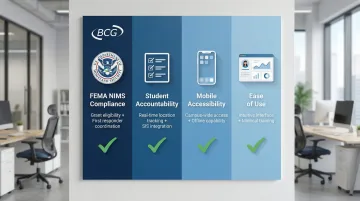
FEMA NIMS Compliance: Federal Preparedness grants require NIMS adoption, making compliance essential for funding qualification. Solutions must support Incident Command System structures that align with first responder protocols.
Student Accountability & Reunification: During evacuations or lockdowns, schools need real-time visibility into student locations and streamlined processes for reunifying students with verified guardians. Integration with Student Information Systems ensures accurate rosters.
Mobile Accessibility: Staff must access emergency functions from anywhere on campus during crises. Offline capabilities are critical when network connectivity fails.
Ease of Use During High-Stress Situations: Intuitive interfaces requiring minimal training are essential. If staff can't remember how to use the system during an actual emergency, it provides no value.
Beyond these primary requirements, we evaluated several supporting factors:
- Drill Management: Automated scheduling, documentation, and compliance reporting for required exercises
- Communication Capabilities: Real-time alerts to parents and direct coordination with first responders
- Vendor Reliability: Company stability, customer support quality, and implementation track record
- Deployment Speed: Timeline from purchase to full operation and training requirements
Implementation speed matters because schools need solutions deployed before the school year begins.
Solutions requiring weeks of staff training create adoption barriers, while platforms with intuitive interfaces and role-based workflows enable faster proficiency.
Conclusion
The right emergency management solution goes beyond feature checklists. It must integrate with daily school operations, enable confident staff usage during actual emergencies, and meet both regulatory requirements and budget constraints.
School leaders should evaluate potential solutions carefully:
- Request demos that simulate actual emergency scenarios, not just feature tours
- Speak with references from similar-sized districts to understand real-world implementation challenges
- Calculate total cost of ownership including implementation, training, ongoing support, and integration costs
For districts seeking a FEMA-compliant solution, BCG's DisasterLAN brings 43 years of experience serving schools and emergency management agencies. Key features include:
- Flexible cloud or on-premises deployment
- Bandwidth-based licensing that reduces costs for larger districts
- U.S.-based technical support
- Template-guided Incident Action Plans aligned with FEMA guidelines
Contact BCG for a consultation on your school's emergency management needs.
Frequently Asked Questions
What features should schools prioritize in emergency management software?
Schools should prioritize FEMA NIMS compliance for grant eligibility, real-time student accountability with location tracking, and mass notification to parents and staff. Mobile accessibility with offline functionality and integration with Student Information Systems ensures accurate rosters during emergencies.
How much does emergency management software cost for K-12 schools?
Pricing ranges from a few thousand to tens of thousands of dollars annually based on district size and features. Licensing models include per-user, per-building, or bandwidth-based options. Schools should evaluate total cost of ownership including implementation, training, and ongoing support.
What is FEMA NIMS compliance and why does it matter for schools?
FEMA NIMS (National Incident Management System) compliance ensures software follows standardized incident command protocols used by first responders. This is critical for coordinating with local emergency services during crises and is required for federal Preparedness grant funding, making it both an operational and financial necessity.
How long does it take to implement emergency management software in a school district?
Implementation typically takes 2-8 weeks depending on district size and complexity, including system setup, data integration with Student Information Systems, staff training, and initial drills. Cloud-based solutions generally offer faster deployment than on-premises installations, though comprehensive training remains essential regardless of deployment model.
Can emergency management software integrate with existing school systems?
Leading solutions integrate with Student Information Systems (PowerSchool, Infinite Campus, Skyward) for real-time rosters, plus visitor management, access control, PA systems, and mass notification platforms. Schools should verify compatibility with their existing technology stack before purchasing.
What's the difference between emergency notification systems and full emergency management platforms?
Notification systems only send alerts to stakeholders via text, email, or voice calls. Full emergency management platforms provide comprehensive incident management including resource tracking, student accountability, drill management, after-action reporting, FEMA-compliant documentation, and coordination with first responders—in addition to communication capabilities.