Introduction: Why Incident Response Platforms Matter for Nursing Homes
Nursing homes face extraordinary emergency management challenges that set them apart from other healthcare settings.
With 77% of nursing homes in high-risk areas reporting significant preparedness challenges, the gap between regulatory compliance and operational readiness has never been clearer.
The vulnerability of nursing home residents—many requiring dialysis, oxygen support, or extensive assistance with daily activities—creates severe bottlenecks during evacuations and emergencies.
Compounding this challenge, nursing staff turnover averages approximately 53%, meaning institutional memory constantly erodes and emergency procedures must be relearned by new staff members.
The Centers for Medicare & Medicaid Services (CMS) Emergency Preparedness Rule (42 CFR 483.73) mandates that nursing homes maintain comprehensive emergency plans, conduct annual training, and implement incident command structures that enable coordination with local emergency services.
Incident response platforms transform these regulatory requirements from paperwork exercises into operational tools that protect residents during natural disasters, infectious disease outbreaks, utility failures, and other emergencies.
TLDR: Key Takeaways
- NIMS/ICS-based platforms enable seamless coordination with emergency services through standardized command structures
- Clinical workflow integration maintains medication tracking, dietary needs, and resident monitoring during crises
- Role-based workflows help small teams respond effectively despite 53% average staff turnover rates
- Automated documentation captures incident logs and decisions for CMS compliance and legal protection
Feature 1: NIMS/ICS Framework Compliance and Standardization
The National Incident Management System (NIMS) and Incident Command System (ICS) form the foundation for emergency coordination across all levels of government and private sector organizations.
For nursing homes, adopting these frameworks isn't just a best practice—it's a federal requirement that ensures coordination with emergency services when disasters strike.
Understanding NIMS and ICS Requirements
NIMS provides a consistent nationwide template that enables nursing homes to work seamlessly with local fire departments, EMS, hospitals, and emergency management agencies.
ICS establishes a standardized organizational structure with clear chains of command, common terminology, and modular scalability that expands or contracts based on incident severity.
The CMS Emergency Preparedness Rule explicitly requires nursing homes to include processes for cooperation with local, state, and federal emergency preparedness officials. Facilities must also establish means of providing information about their needs and capabilities to the "authority having jurisdiction or the Incident Command Center."
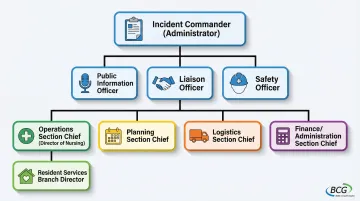
NHICS: ICS Adapted for Long-Term Care
The Nursing Home Incident Command System (NHICS) adapts standard ICS principles specifically for long-term care settings. Unlike hospital-based systems that assume large staffing depths, NHICS streamlines the team to 11 core positions—down from 28 in hospital models.
This reflects the staffing realities of nursing homes.
Key NHICS positions include:
- Incident Commander (Administrator)
- Operations Section Chief (typically Director of Nursing)
- Planning Section Chief
- Logistics Section Chief
- Finance/Administration Section Chief
- Resident Services Branch Director (unique to long-term care)
Smaller facilities may need one person to fill multiple roles initially. NHICS includes clear protocols for expanding the structure as additional personnel become available.
FEMA NIMS STEP Certification
The NIMS Supporting Technology Evaluation Program (STEP) provides objective evaluation of incident management software against federal standards. Platforms that achieve FEMA NIMS STEP certification demonstrate proven compatibility with emergency services and adherence to all 24 NIMS concepts and principles.
Buffalo Computer Graphics' DisasterLAN holds full STEP compliance certification—the only incident management system evaluated as fully compliant by FEMA's program.
When evaluating platforms, nursing homes should verify:
- Pre-loaded NHICS organizational charts and role assignments
- ICS-compliant forms and documentation templates
- Common terminology aligned with emergency services
- Compatibility standards (CAP, EDXL, IPAWS protocols)
- Modular structure that scales with incident complexity
Feature 2: Role-Based Workflows Tailored to Nursing Home Operations
Generic hospital emergency management systems don't translate well to nursing homes due to fundamental differences in staffing models, organizational structures, and resident care requirements. During Hurricane Katrina, facilities without role-specific guidance experienced 3x longer evacuation times. Effective platforms provide position-specific workflows that guide staff through their responsibilities during high-stress situations.
Why Nursing Homes Need Specialized Workflows
Hospital incident command assumes dedicated emergency departments, trauma teams, and additional emergency capacity. Nursing homes operate with skeleton crews during nights and weekends, limited clinical resources, and residents who cannot be rapidly discharged to create capacity.
The focus shifts from acute trauma response to maintaining continuity of chronic disease management, dietary services, and activities of daily living during extended disruptions.
Critical Role-Based Features
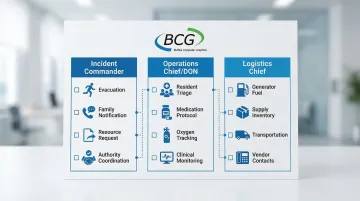
Platforms should provide Job Action Sheets (JAS) for each NHICS position. These role-specific guides ensure every team member knows exactly what to do when an incident strikes.
Incident Commanders need:
- Decision trees for evacuation vs. shelter-in-place determinations
- Communication templates for notifying families, physicians, and authorities
- Resource request protocols aligned with local emergency management
Operations Chiefs/Directors of Nursing require:
- Resident acuity triage protocols for evacuation priority
- Medication administration procedures during power outages
- Clinical status tracking for oxygen-dependent residents
- Tracking for dialysis-dependent residents
Logistics Chiefs manage:
- Generator fuel calculations and vendor contact lists
- Emergency supply inventories (7-30 day medication stocks, oxygen tanks)
- Transportation coordination for evacuation scenarios
Planning Chiefs handle documentation with:
- Resident evacuation tracking forms (NHICS Form 260)
- Incident Action Plan templates with shift-by-shift objectives
- Resource status documentation and situation reports
Cross-Training Capabilities
Nursing staff turnover reaches 53%, meaning platforms must support rapid role assignment and cross-training. Look for systems that:
- Allow multiple role assignments to single individuals with clear accountability
- Provide just-in-time training materials accessible during activation
- Track certifications and qualifications for ICS positions
- Support credentialing for temporary staff and mutual aid personnel
Feature 3: Comprehensive Documentation and Compliance Management
Documentation failures during emergencies create legal liability, survey deficiencies, and barriers to FEMA reimbursement.
Platforms must capture real-time incident information automatically, eliminating the need to reconstruct events from memory after the crisis ends.
CMS Emergency Preparedness Rule Documentation Requirements
The federal regulations mandate specific documentation records:
| Requirement | Documentation Needed | Update Frequency |
|---|---|---|
| Emergency Plan | Written all-hazards plan based on risk assessment | Annually |
| Policies & Procedures | Subsistence, evacuation, tracking protocols | Annually |
| Communication Plan | Staff, physician, and official contact lists | Annually |
| Training Records | Initial and annual training logs with attendance | Ongoing |
| Exercise Documentation | After-Action Reports for drills and actual events | After each exercise |
State Reporting Requirements
While federal requirements set the baseline, state regulations often impose tighter deadlines:
- Florida: Preliminary adverse incident report within 1 business day; full report within 15 days
- California: Suspected abuse causing serious injury must be reported to law enforcement within 2 hours
- Texas: Emergency situations causing death or serious injury require immediate phone notification and written reports within 5 working days
Effective platforms automate these reporting workflows with configurable timelines and escalation alerts.
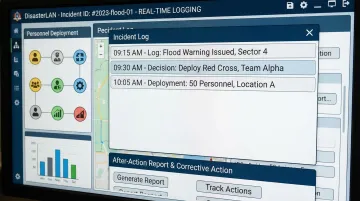
Real-Time Incident Logging
Effective systems capture critical incident details in real time:
- Decision rationale with authorization details and influencing factors
- Personnel deployment, equipment usage, and supply consumption with timestamps
- Notifications sent to families, physicians, and authorities with delivery confirmation
- Chronological incident logs with automatic timestamps for all actions
After-Action and Corrective Action Features
Post-incident analysis drives continuous improvement:
- After-Action Reports generated automatically from captured incident data
- Lessons learned documentation with assigned corrective actions
- Completion tracking with deadline reminders and escalation
- Cross-incident trend analysis identifying recurring vulnerabilities
Feature 4: Integration with Clinical Operations and Resident Care
Emergency response platforms cannot exist as separate systems accessed only during disasters. They need to connect seamlessly to daily nursing home operations.
This integration ensures clinical continuity when electronic health records fail or power outages disrupt routine workflows.
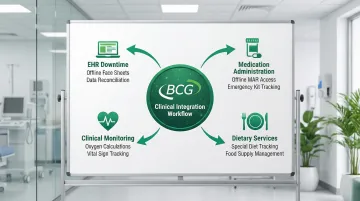
Clinical Workflow Integration Points
During emergencies, routine resident care continues under adverse conditions. Effective platforms support:
Medication Administration During Disruptions:
- Offline access to Medication Administration Records (MARs)
- Paper backup protocols with reconciliation workflows
- Emergency medication kit inventory tracking
- Physician notification for medication substitutions
Dietary Services Coordination:
- Tracking renal diets for dialysis-dependent residents
- Non-perishable food supply management
- Special nutritional needs documentation
- Kitchen equipment failure protocols
Clinical Status Monitoring:
- Oxygen supply calculations based on resident usage rates
- Dialysis center coordination and transportation scheduling
- Vital sign tracking during extended shelter-in-place
- Behavioral health considerations for residents with dementia
Resident-Specific Emergency Considerations
Beyond general workflows, platforms need to support priority-based decision-making that accounts for individual resident needs:
Evacuation Prioritization:
- Triage classifications by mobility (ambulatory, wheelchair, bedbound)
- Life-sustaining equipment dependencies (ventilators, oxygen, dialysis)
- Cognitive impairment levels affecting cooperation during transport
- Advance directive documentation for end-of-life decisions
Family Communication Workflows:
- Automated notification systems with resident-specific updates
- HIPAA-compliant information sharing protocols
- Reunion coordination for separated families
- Status tracking for residents transferred to hospitals
EHR Downtime Protocols
When electronic health records become unavailable, platforms provide critical backup capabilities:
- Offline resident "face sheets" with allergies, diagnoses, and current medications
- Paper-based Treatment Administration Records (TARs) templates
- Data reconciliation workflows when systems restore
- Clinical decision support for common emergency scenarios
Feature 5: Training, Exercises, and Usability Features
The most sophisticated platform fails if staff cannot use it effectively during high-stress emergencies. With limited IT resources and constant staff turnover, nursing homes need intuitive systems with embedded training capabilities.
CMS Training and Exercise Requirements
Federal regulations mandate:
- Annual training for all staff, volunteers, and contractors consistent with their emergency roles
- Two exercises annually: one full-scale exercise (community-based or facility-based) and one additional exercise (mock drill or tabletop)
- Exception: Facilities that experience actual emergencies requiring plan activation are exempt from the next required full-scale exercise
Built-In Training Features
To meet these requirements efficiently, effective platforms provide:
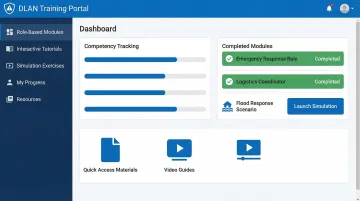
- Role-based training modules accessible for onboarding
- Interactive tutorials for key functions (creating incident logs, tracking residents, requesting resources)
- Quick-reference guides embedded in the interface
- Video demonstrations of common workflows
- Searchable help documentation
Exercise and Drill Capabilities
Platforms should support realistic training through:
Tabletop Exercise Tools:
- Pre-built scenario libraries (hurricane, infectious outbreak, utility failure)
- Facilitation guides for exercise controllers
- Inject templates for introducing complications during drills
Simulation Modes:
- Training environments separate from production systems
- Ability to practice without affecting live data
- Realistic incident progression with time compression
Competency Validation:
- Performance tracking during exercises
- Automated assessment of key actions completed
- Certification records for ICS position qualifications
- Gap analysis identifying training needs
Usability Considerations for Small Facilities
Beyond training tools, the platform itself must be practical for daily operations. Look for systems that:
Function on existing devices (no specialized hardware required)
Provide mobile access for staff without desktop computers
Work offline during internet or power outages
Use plain language rather than technical jargon
Offer phone support during activation, not just email tickets
Offer phone support during activation, not just email tickets
Systems like BCG's DLAN platform incorporate these training and usability features while maintaining FEMA NIMS compliance—ensuring that nursing homes can both meet regulatory requirements and respond effectively when incidents occur.
Feature 6: Scalability and Customization for Facility Size
The U.S. nursing home landscape ranges from small rural facilities with 30 beds to large urban centers with 200+ residents. Effective platforms serve this diversity without forcing small facilities to pay for enterprise features they don't need.
Facility Size and Resource Variations
Small/Rural Facilities:
- Limited IT staff or expertise
- Tighter budgets for software investments
- Simpler organizational structures
- Greater reliance on mutual aid during emergencies
Large/Urban Facilities:
- Dedicated emergency management personnel
- Complex corporate reporting structures
- Higher resident acuity and medical complexity
- Integration requirements with corporate systems
These differences require flexible platforms that scale appropriately. Systems like DLAN use bandwidth-based licensing rather than per-seat pricing, allowing facilities to pay based on actual usage instead of staff count.
Modular Implementation Approaches
Effective platforms offer:
- Core capabilities available to all facilities—incident command, documentation, and communication tools
- Optional modules facilities can add as needed, such as GIS mapping, advanced analytics, and integration services
- Tiered pricing based on facility size or bandwidth usage
- Multi-facility management for organizations operating multiple locations
Customization Features
Beyond scalability, platforms must adapt to each facility's unique operational context:
Facility-Specific Risk Assessments:
- Customizable hazard assessments based on geographic location (flood zones, hurricane risk, earthquake potential)
- Local emergency contact directories—county emergency management, nearby hospitals, mutual aid partners
- Community resource coordination with Red Cross shelters, transportation providers, and equipment vendors
Workflow Configuration:
- Custom forms aligned with facility policies
- Approval workflows matching organizational structure
- Automated notifications to appropriate personnel
- Reporting formats for state-specific requirements
Multi-Site Organization Considerations
For chains operating multiple facilities, platforms should provide:
- Centralized emergency plan templates with facility-specific annexes
- Corporate visibility into all facility operations during incidents
- Shared resource coordination across locations
- Consolidated reporting for executive leadership
Feature 7: Interoperability and External Coordination Capabilities
Nursing homes cannot respond to major emergencies in isolation. Effective platforms enable seamless coordination with multiple external partners:
- Hospitals for acute care transfers and clinical consultation
- Emergency medical services for evacuations and medical assessment
- Public health departments for outbreak guidance and surveillance
- Emergency management agencies for situational awareness and resource coordination
Critical External Dependencies
Each external partner serves distinct functions during emergencies:
Hospitals provide bed availability for acute care transfers, patient tracking across the continuum of care, and clinical consultation for complex medical decisions.
Emergency medical services coordinate ambulance transport for evacuations, medical assessment for injured residents, and transport priority decisions.
Public health departments deliver infectious disease outbreak guidance, disease reporting and surveillance, and vaccine and medication distribution.
Emergency management agencies supply situational awareness and threat information, resource coordination and mutual aid, and shelter identification and access.
Communication and Coordination Features
Essential communication capabilities include:
External Notification Systems:
- Automated status updates to local emergency management
- Family notification with resident-specific information
- Physician alerts for clinical changes or evacuations
- Vendor contact management for supply deliveries
Standards-Based Interoperability:
- CAP (Common Alerting Protocol) for alert distribution
- EDXL (Emergency Data Exchange Language) for information sharing
- NIEM (National Information Exchange Model) compliance
- Integration with Healthcare Coalition communication systems
Beyond basic communication, platforms must support real-time collaboration across agencies.
Multi-Agency Collaboration Tools
Key capabilities include:
- Shared situational awareness dashboards visible to external partners
- Secure information exchange with role-based access controls
- Bed reporting to regional coordination centers
- Resource request workflows aligned with emergency management systems
Healthcare Coalition Participation
Healthcare Coalitions (HCCs) coordinate emergency response among hospitals, nursing homes, and other healthcare providers.
Platforms must enable nursing homes to:
Report operational status to coalition partners
Request resources through established coordination channels
Track residents transferred to coalition hospitals
Participate in coalition-wide exercises and drills
Participate in coalition-wide exercises and drills
BCG's DLAN platform supports these interoperability requirements through its FEMA NIMS STEP certification—the first and only incident management system evaluated as fully compliant with NIMS and ICS principles and interoperability communications standards.
Frequently Asked Questions
What are the essential features of an incident response platform for nursing homes?
Essential features include NHICS-compliant incident command structures, role-based workflows with Job Action Sheets, comprehensive documentation, clinical operations integration (medication administration, resident tracking), training capabilities, and interoperability with external emergency services. The right platform balances regulatory requirements with usability for facilities facing limited IT resources and high staff turnover.
How does NIMS and ICS apply to nursing homes specifically?
The Nursing Home Incident Command System (NHICS) adapts ICS to long-term care by streamlining the Incident Management Team to 11 positions (versus 28 in hospital models) and including a Resident Services Branch. This maintains interoperability with emergency services while providing practical command structures for facilities with limited personnel.
What is the difference between an incident response platform and an emergency preparedness plan?
The emergency preparedness plan is your documented strategy with policies and procedures. The incident response platform is the technology that executes and documents incidents according to that plan. The platform provides digital workflows, real-time communication, and automated documentation that bring the static plan to life while capturing compliance records.
How can small nursing homes with limited resources implement incident response platforms?
Prioritize platforms with bandwidth-based pricing rather than per-seat licensing, which accommodates fluctuating user counts. Start with free NHICS resources from AHCA/CAHF, then add platforms that integrate these frameworks. Many vendors offer tiered implementations that let you start small and expand as budgets grow.
What regulatory requirements drive the need for incident response platforms in nursing homes?
The CMS Emergency Preparedness Rule (42 CFR 483.73) requires emergency plans, annual training, two yearly exercises, and incident command structures. Platforms meet these mandates by automating documentation, providing training tools, supporting exercise management, and maintaining audit trails—transforming compliance from paperwork into operational readiness.
How do incident response platforms integrate with existing nursing home workflows?
Effective platforms connect to daily operations by providing offline access to resident information during EHR downtime, supporting medication administration when power fails, and maintaining family communication workflows. Integration with existing systems (EHRs, staffing platforms) ensures staff use familiar processes during emergencies, reducing the learning curve.
About Buffalo Computer Graphics' DisasterLAN
Buffalo Computer Graphics developed DisasterLAN (DLAN) as the first and only incident management system evaluated by FEMA's NIMS STEP program as fully compliant with all NIMS and ICS principles. With over 40 years of engineering experience, BCG provides nursing homes and healthcare facilities with incident response platforms that balance regulatory compliance with operational usability. DLAN's healthcare emergency communications capabilities support internal coordination, external partner workflows, and operational consistency across both planned events and emergent responses. For more information about implementing incident response platforms in your nursing home, contact Buffalo Computer Graphics for a personalized demonstration.